Jewish food traditions live within wider regional traditions. They are not one fixed recipe or a short origin story that can be pasted onto every plate. Sabich, kubbeh, couscous and soups take different forms across regions, communities, families and kitchens. Here we connect documented context, family memory and an accurate description of the dish served today without blending them together.
Three layers of a responsible food story
Documented context comes from cultural institutions, curated collections and edited sources. Family memory explains how a particular person learned, ate or passed on a dish. The Complete99 description states what is in our version and how it is offered. Each layer answers a different question.
A family source matters because it preserves voice, custom and details that may never have entered a history book. It does not prove that every member of a community cooked the same way. An edited cultural source also cannot replace checking the current dish when an ingredient, allergen or personal need matters.
Sabich between Shabbat breakfast and street food
A family story published by Jewish Food Society connects sabich components with Iraqi Jewish Shabbat breakfast: aubergine, eggs, tahini, salad, amba and bread set out so each person could assemble a plate. The source describes how that family meal also took on the form of Israeli street food.
There is more than one account of the name and of the stall that spread the sandwich. We therefore do not present one popular tale as settled fact. It is more accurate to say that Israeli sabich has a strong connection with Iraqi Jewish food tradition and that its form continued to change in Israel.
The Complete99 sabich combines aubergine, egg, potato, salad, tahini, amba and hot sauce in a pita or on a plate. That describes our dish. It does not claim that every sabich must use exactly the same list or balance.
Kubbeh is a family, not one shape
Kubbeh may be fried, baked or cooked in broth, while the shell, filling and liquid change across versions. The family recipe linked below documents a semolina shell, a beef and onion filling and a beet broth. It also shows how one recipe was learned from a mother and grandmother, then written down so the process would not be lost.
The Complete99 menu describes meat-filled kubbeh in a sweet and sour beet soup. We present it as one version within a much larger world. Another source using rice, bulgur, potato or a different broth is not a contradiction. It is evidence that the name holds several traditions.
Couscous as shared knowledge and a local plate
UNESCO inscribed the knowledge, skills and practices related to the production and consumption of couscous after a joint submission by Algeria, Mauritania, Morocco and Tunisia. The focus is not just a grain or recipe. It includes preparation methods, tools, eating occasions and transmission between generations.
FOODISH at ANU Museum adds the context of Maghrebi Jewish communities and the adoption of couscous in Israeli cooking. Reading the two sources together shows how a wide regional heritage can enter different Jewish homes and acquire local occasions, accompaniments and memories.
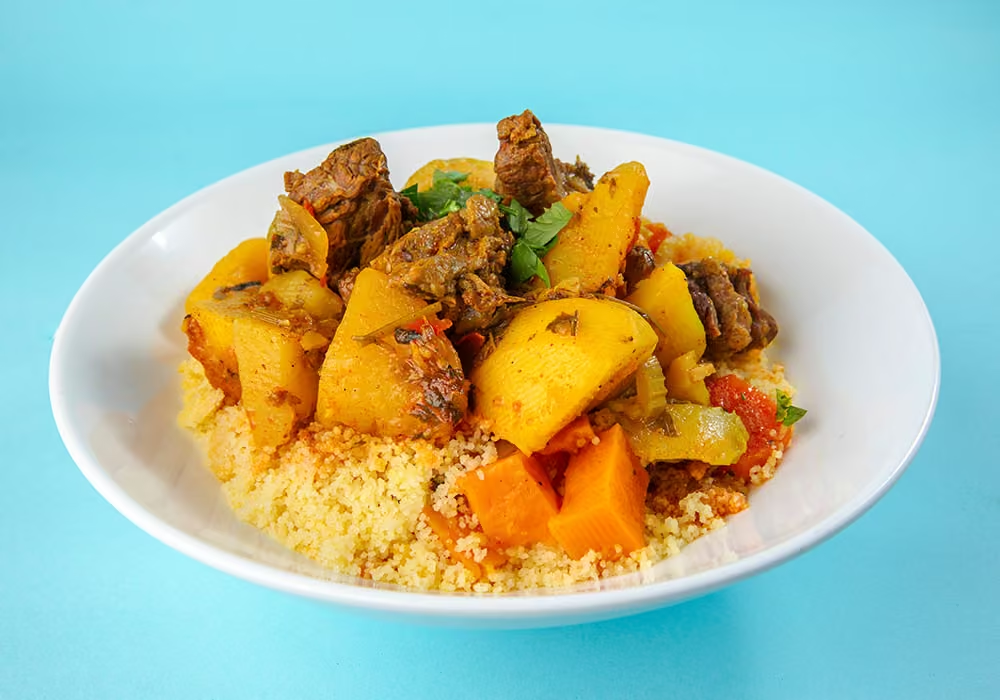
At Complete99, couscous is offered with vegetables and a changing stew. That is useful information for choosing lunch today, but it does not claim to represent every couscous in North Africa, Jewish communities or Israel.
A familiar name still needs a current description
Aja is described here as a herb omelette with salads and sauces. Shakshuka is built around tomato sauce and eggs. Yemenite beef soup appears as a warm bowl from the pots. These are menu descriptions, not complete historical definitions of every dish or community.
When a familiar name creates an expectation of a particular flavour or ingredient, read the current description and ask. Tradition can create recognition, but it is not an ingredient label and does not guarantee that one kitchen matches another.
How to read a disputed origin
Food stories often contain several claims about a name, place or first maker. Rather than selecting the most attractive tale, we ask who published it, whether it is a document, research, personal memory or oral tradition, and whether another source supports it.
When evidence is limited, we keep the uncertainty visible. "A family story recalls" is more accurate than declaring that an entire community acted one way. "Our version" respects a tradition without claiming authority over every version.
Tradition lives because it continues to change
Home cooking moves between people through hands, taste, memory and repetition. Sometimes a method remains, sometimes a combination of ingredients, and sometimes the name continues while the dish changes. Those differences are not defects to erase.
Our approach gives each story a precise place: a cultural source beside a cultural claim, family testimony beside a memory, and the current menu beside the food you can choose now. That makes room for pleasure and context without forcing one rigid version.