Gazpacho

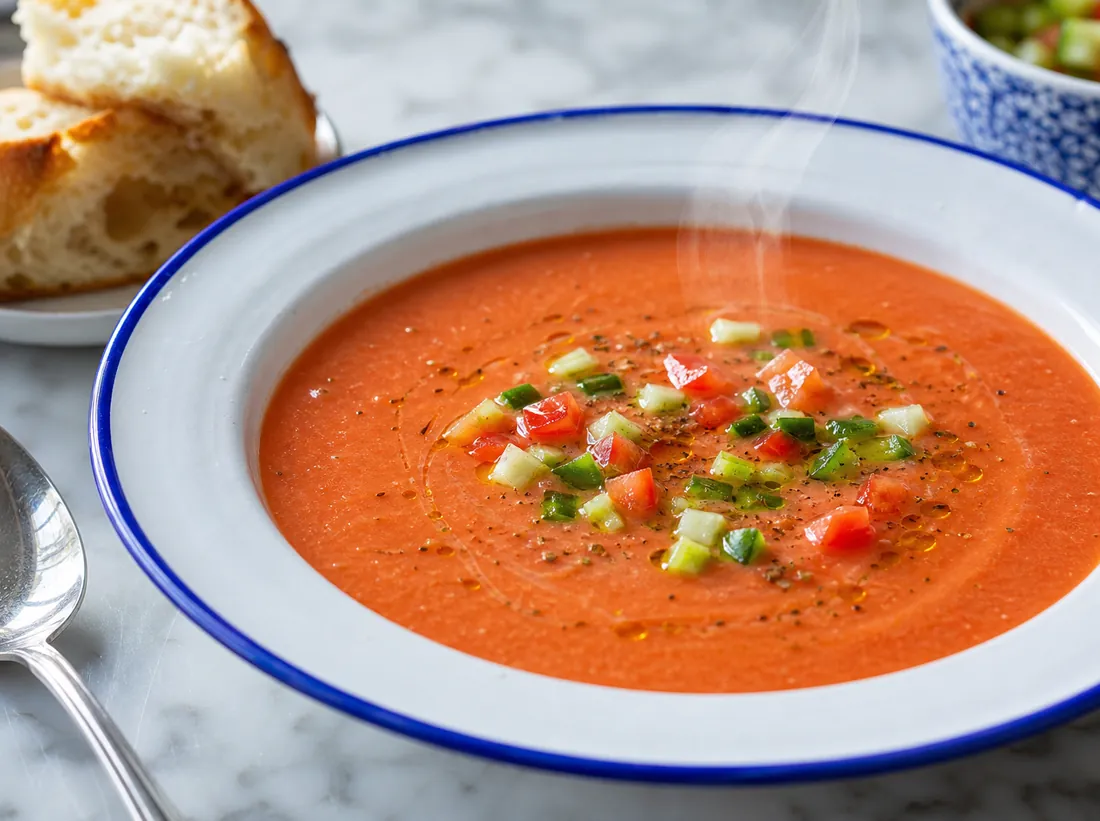
Gazpacho is a cold tomato soup from Andalusia that is never cooked: ripe tomatoes, cucumber, green pepper, garlic, bread, olive oil and vinegar, blended into a velvety emulsion the colour of pale coral. It works only with summer tomatoes, and it is seasoned only once it is cold.

Pot calculatorOrder Gazpacho

VeganDairy freeParveAllergens:Gluten

Updated

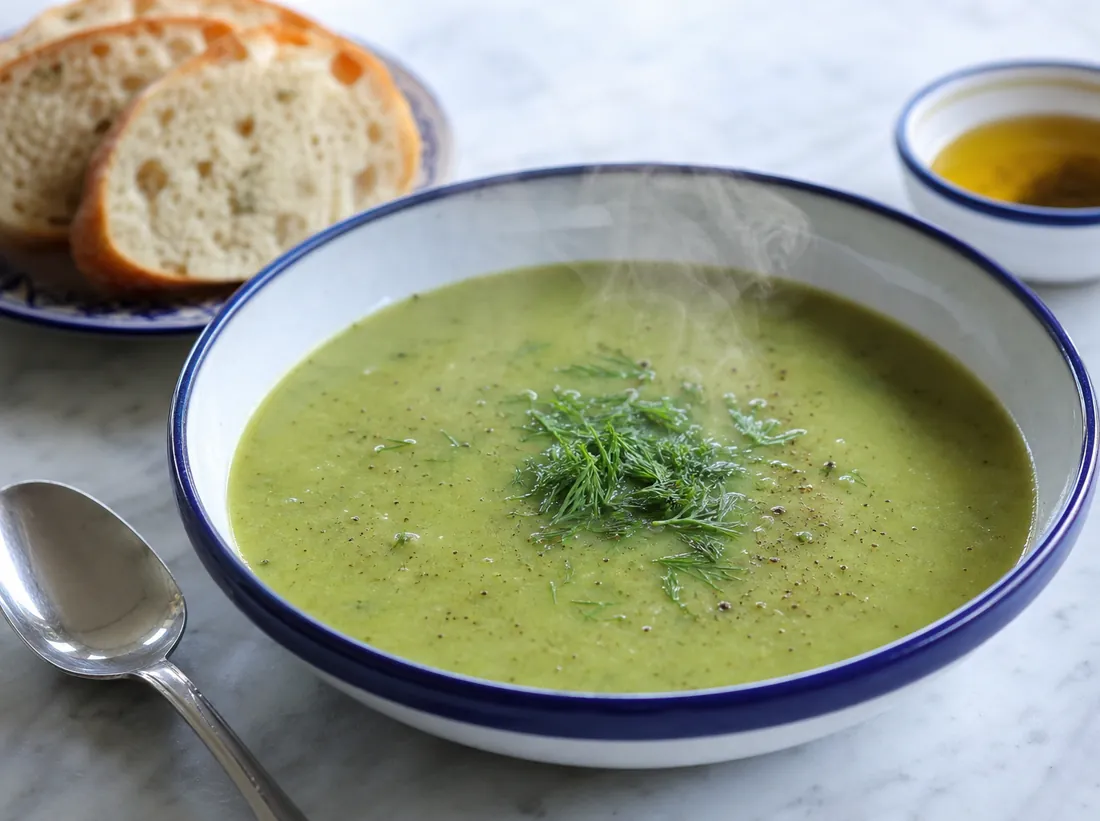
GazpachoIllustration
Time3 h 50 min
Pot6 bowls2.1 litres
Per bowl238 kcal4.2 g protein · a 350 ml bowl
Cost of the pot₪22for the pot, about ₪3.7 a bowl

The story of Gazpacho

In southern Spain gazpacho was field workers' food: stale bread, olive oil, garlic, vinegar and water, pounded in a mortar and eaten in the shade during the hottest hours. Tomatoes and peppers came from the Americas and joined later, and within a few generations they became its heart. The older white version, with almonds and garlic, is still made in Andalusia as ajo blanco.

Today gazpacho is served all over Spain in summer, in a glass or a bowl, sometimes with diced vegetables and toasted bread on the side. In Israel, with its long summers and good tomatoes, it found a natural home: a soup that needs no stove, parve and vegan, made in a blender in a quarter of an hour and left to rest in the fridge for a few hours.

What makes Gazpacho itself

Gazpacho is neither tomato juice nor a blended salad. The bread and olive oil are blended with the tomatoes into an emulsion, which gives it a creamy texture without any dairy and a coral colour rather than red. Temperature is part of the recipe too: it is eaten very cold, so it is seasoned after chilling.
Gazpacho for any number of people

Change the number of people and the bowl size, and every ingredient updates in grams, with the cost, calories and protein per bowl.

Bowl size
Units
2.1litres in the pot
3Pot to use, litres
₪22Cost of the pot
₪3.7per bowl
238kcal per bowl
4.2g protein per bowl
IngredientAmountCost
The vegetables
Very ripe tomatoes1.5 kg₪12
Cucumber, peeled200 g₪1.6
Green pepper, seeded150 g₪1.3
Onion50 g₪0.3
Garlic6 g · 1 pcs₪0.2
The emulsion
Stale white bread, crust removed100 g₪1.6
Cold water200 ml
Extra virgin olive oil100 ml₪5.3
Sherry or wine vinegar30 ml₪0.2
Salt10 g₪0.0
Send on WhatsApp

Shelf prices at a large Israeli chain and specialty shops, October 2026. Nutrition from the ingredients in grams, before cooking.

How many calories in Gazpacho? Nutrition facts and calorie calculator

Change the amount of any ingredient, drop one, or pick a lighter version, and the numbers per serving update at once: calories, fat, carbs, protein, sodium and fibre.

Gazpacho has 68 calories per 100 ml. A 350 ml bowl made with our recipe has 238 calories: 4.2 g protein, 16.2 g fat and 17.7 g carbohydrates. A 250 ml cup has 170 calories.

Lighter

Ingredients, for the whole recipe

  • 1,500 g45 kcal per serving
  • 200 g4 kcal per serving
  • 150 g4 kcal per serving
  • 50 g3 kcal per serving
  • 1 pcs1 kcal per serving
  • 100 g44 kcal per serving
  • 100 ml136 kcal per serving
  • 30 ml1 kcal per serving
  • 10 g0 kcal per serving

What each add-on adds to Gazpacho

Values for the amount in the row, from the national food database.

Add-onCaloriesProtein, gFat, g
A tablespoon of oil122013.8
A slice of white bread792.50.5
A slice of challah12641.1

How to make Gazpacho

In cook mode the screen stays on, tap a step when it is done, and the timers run next to each step.
  1. Keep the tomatoes at room temperature until you start. Quarter them and cut out the stem base.
  2. Cut the cucumber, pepper and onion into pieces and slice the garlic.
  3. Toss all the vegetables with the salt in a large bowl and leave for 30 minutes. The salt draws out their juice.
  4. Soak the bread in the cold water for 5 minutes and squeeze lightly. Keep the water.
  5. Put the vegetables with all their juice, the bread and the vinegar into a blender and blend on high for 2 minutes until very smooth.
  6. Lower to medium speed and pour in the olive oil in a thin stream over about a minute. The colour shifts from red to coral and the texture turns creamy.
  7. Strain through a fine sieve, pressing with a spoon to hold back skins and seeds. Thin with the bread soaking water if needed.
  8. Cover and chill for at least 3 hours, until very cold.
  9. Taste it cold and add salt and vinegar if needed. Stir well or blend again for 5 seconds just before serving.

The science of Gazpacho

Kitchen science

Gazpacho is an emulsion

Oil and water do not mix, but a fast blade breaks the oil into tiny droplets. Starch from the bread and pectin and fibre from the tomatoes thicken the water and sit between the droplets, so they do not merge quickly. The droplets scatter light, which turns gazpacho from red to coral, and they, not dairy, are what make it creamy.

Kitchen science

Cold mutes salt and aroma

The tongue senses salty and sweet less strongly when food is cold, and aroma molecules evaporate less, so less scent reaches the nose. A gazpacho seasoned at room temperature will taste flat after three hours in the fridge, so adjust salt and vinegar only once it is cold.

Kitchen science

Olive oil at high speed

Extra virgin olive oil contains bitter polyphenols that normally stay inside the oil. Blended hard for a long time, they disperse into the water and taste bitter. That is why the oil goes in last, at medium speed and briefly.

Kitchen science

Tomatoes stay out of the fridge

In the cold of a fridge a tomato loses some of its aroma molecules and its flesh turns mealy. Keep the tomatoes on the counter until you make the soup, and chill only the finished gazpacho.

Kitchen science

Salt pulls out the juice

Salt on cut vegetables draws water out of the cells by osmosis. Half an hour of salting yields concentrated, flavourful juice, and the softened cells blend more easily, so the gazpacho comes out smoother and deeper in flavour.

Gazpacho in every kitchen

Classic Andalusian

The recipe on this page: tomatoes, cucumber, green pepper, garlic, bread, olive oil and vinegar, blended smooth and strained.

Salmorejo

The Córdoba version: much more bread and oil, no cucumber or pepper, as thick as a cream. Served with chopped hard boiled egg on top.

Ajo blanco

The white gazpacho of Málaga: almonds, garlic, bread, olive oil and vinegar, no tomatoes, topped with green grapes.

With watermelon

Replace a third of the tomatoes with seedless watermelon. Sweeter and redder, and good with a pinch of chilli.

Green gazpacho

Cucumber, green pepper, herbs, bread or avocado, olive oil and vinegar. No tomatoes, green and fresh.

Common Gazpacho problems and how to fix them

My gazpacho separated

The emulsion broke: too little bread, oil added too fast, or hours in the fridge. Blend again for 5 to 10 seconds before serving, and add another piece of bread if needed.

Gazpacho tastes bitter

Olive oil blended too long at high speed, the skin and seeds of a bitter cucumber, or too much garlic. Add the oil last, peel the cucumber, and balance a bitter soup with a pinch of salt and a teaspoon of vinegar.

Gazpacho is watery and tasteless

Underripe tomatoes, tomatoes that were refrigerated, or too much water. Use very ripe summer tomatoes, hold back some of the water, and season after chilling.

Gazpacho is foamy

The blender whipped in a lot of air. Let the soup rest in the fridge and the foam rises and disappears, or skim it off with a spoon before serving.

The gazpacho is too garlicky

Raw garlic keeps spreading through the soup as it rests. Use one clove for a batch this size and remove any green sprout at its centre. If it is already too strong, blend in another tomato and a slice of bread.

Storing, freezing and reheating

3 days

In the fridge

Not suitable, the emulsion and texture suffer

In the freezer

2+4

To cool

Bring it from 60 to 21 °C within two hours and down to 5 °C within four more. Split a big pot into shallow boxes.

75 °C

Reheating

Do not heat it. Take it out of the fridge, stir well or blend for a few seconds, then taste and season again.

Nutrition of Gazpacho

From our recipe, per bowl and per 100 g, next to the national food database.

ServingkcalProtein, gFat, gCarbs, gFibre, g
Our recipe, a 350 ml bowl2384.216.217.74.0
Our recipe, 100 ml681.24.65.11.1
Typical Gazpacho, 100 g761.44.86.41.4

What the ingredients of Gazpacho cost

What each ingredient costs in one pot, and where to buy it.

IngredientPriceIn this potWhere to buy
Very ripe tomatoes₪7.9 per kg₪12Greengrocer
Extra virgin olive oil₪53 per litre₪5.3Supermarket
Stale white bread, crust removed₪8 each₪1.6Supermarket
Cucumber, peeled₪7.9 per kg₪1.6Greengrocer
Green pepper, seeded₪8.9 per kg₪1.3Greengrocer
Onion₪5.9 per kg₪0.3Greengrocer
Garlic₪34 per kg₪0.2Greengrocer
Sherry or wine vinegar₪6.9 per litre₪0.2Supermarket
Salt₪2.1 per kg₪0Supermarket

Shelf prices at a large Israeli chain and specialty shops, October 2026, VAT included. Vegetable prices change with the season.

Make Gazpacho a meal

Shabbat

Ready Shabbat food

Soup, hamin, mains and sides, with a quantity calculator and prices.

Plan Shabbat
Hosting

Hosting trays

9 trays to go with the soup, with a planner by number of guests.

Tray planner
Events

Catering

A whole menu in grams per guest, with a reheating table.

Menus

What to serve with Gazpacho

Serve very cold in glasses or small bowls with diced cucumber, pepper and onion, olive oil croutons and a few drops of olive oil on top. It goes well before grilled fish, next to a Spanish tortilla, or as a light summer supper.

Gazpacho in large quantities: events, offices and communities

How much of everything by number of guests, at a 350 ml bowl. For institutional pots, catering and community kitchens.

GuestsLitres30 l potsCost of ingredients
258.81₪93
50181₪187
100352₪374
200703₪747
5001757₪1,868

Every ingredient for any number of guests is in the calculator above: type the number of people.

Order Gazpacho

A ready pot for Shabbat, an event or the office, ordered ahead.

  • Cooked to order, for Shabbat, an event or the office.
  • Tell us how many people and when, and we send a quote.
  • Delivery in Tel Aviv from ₪35, free over ₪750.

Order Gazpacho for a large event

Large orders in Israel and abroad: events, offices, synagogues, communities and institutions.

  • In Israel: cooked in Tel Aviv and delivered to events in the area, and to large events anywhere in the country on a quote.
  • Abroad: for communities, events and restaurants. Tell us where, how many and when, and we come back with a quote and options.
  • Institutional quantities and a shopping list for any number of guests, in the calculator above.

Frequently asked questions

Do you peel tomatoes for gazpacho?

Not if you strain it at the end. The blender processes everything and the sieve removes skins and seeds. Without a sieve, peeling is better.

Why is there bread in gazpacho?

Bread thickens the soup and holds the olive oil emulsion together, which gives gazpacho its creamy texture. For a gluten free version use a handful of almonds instead, or simply less water.

How long does gazpacho keep in the fridge?

Up to 3 days in a closed container. It often tastes better on day two, but the garlic gets stronger, so stir and taste before serving.

Can you freeze gazpacho?

It is not worth it. After thawing it separates and turns watery. If you have frozen it, blend it again with a slice of bread and a little olive oil.

What is the difference between gazpacho and salmorejo?

Salmorejo is a thick version from Córdoba: more bread and oil, no cucumber or pepper, and hard boiled egg on top. Gazpacho is thinner and can be drunk from a glass.

Why is my gazpacho orange, not red?

That is a good sign. The olive oil droplets in the emulsion scatter light and lighten the colour, and bread and green pepper add to the shade. A deep red gazpacho usually has less oil or uses red pepper.

How many calories are in Gazpacho?

A 350 ml bowl of Gazpacho made with our recipe has about 238 calories and 4.2 g of protein. Per 100 ml: 68 calories.

How much does it cost to make Gazpacho at home?

A pot of 6 bowls costs about ₪22 at Israeli shelf prices in October 2026, about ₪3.7 a bowl. The calculator above works it out for any number of people.

Every soup in Israel

75 soups, each with a pot calculator, a price list and the science. Search by community, time, calories or cost.

All the soups