Minestrone

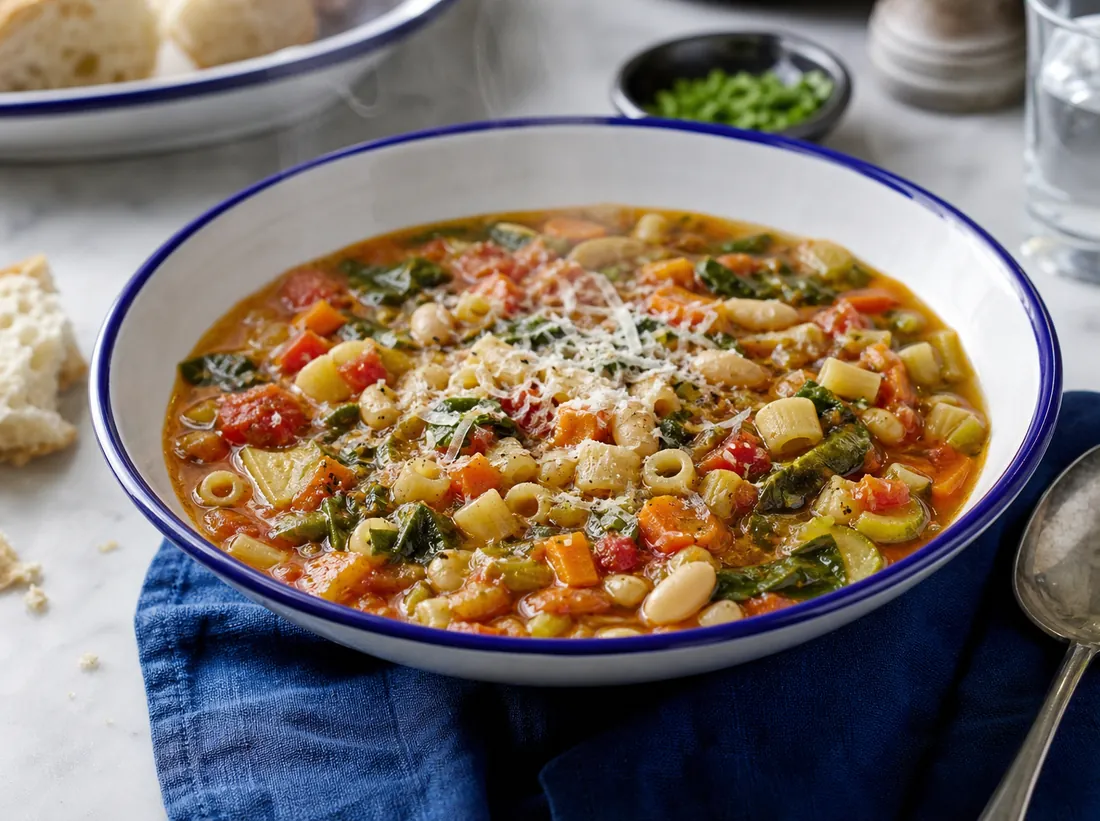
Minestrone is the big vegetable soup of Italy: a soffritto of onion, carrot and celery in olive oil, white beans, tomatoes, seasonal vegetables and small pasta, thick enough to be almost a stew. It has no single recipe, it has a method.

Pot calculatorOrder Minestrone

VeganDairy freeParveAllergens:GlutenCelery

Updated

MinestroneIllustration
Time2 h 25 minCook 1 h 45 min · + Soak 12 h
Pot10 bowls4 litres
Per bowl278 kcal10.6 g protein · a 400 ml bowl
Cost of the pot₪32for the pot, about ₪3.2 a bowl

The story of Minestrone

The name comes from the Italian minestra, soup, with an ending that means big. It belongs to the country kitchen, cucina povera: whatever grew in the garden, dried beans from the larder, and pasta or rice to make it filling. Tomatoes and potatoes joined only after they arrived from the Americas, and before that it leaned on cabbage, pulses and roots.

Every region of Italy has its own version. Genoa finishes it with a spoonful of pesto, Tuscany cooks the leftovers with stale bread and black cabbage until they become ribollita, and in the north rice often replaces pasta. In summer it is also eaten lukewarm there. In Israel minestrone has become a rich home vegetable soup that is easy to keep parve, and every household has its own take.

What makes Minestrone itself

What separates minestrone from ordinary vegetable soup is layering: a slow soffritto in olive oil, beans cooked until creamy, vegetables that go in each at their own time, and pasta only at the end. The result is a thick soup in which every vegetable can still be recognised, not a porridge with one flavour.
Minestrone for any number of people

Change the number of people and the bowl size, and every ingredient updates in grams, with the cost, calories and protein per bowl.

Bowl size
Units
4litres in the pot
5Pot to use, litres
₪32Cost of the pot
₪3.2per bowl
278kcal per bowl
10.6g protein per bowl
IngredientAmountCost
The beans
Dry white beans, soaked overnight250 g₪5.0
Water2.5 l
Bay leaves1 g · 2 pcs₪0.4
The soffritto
Olive oil, 60 ml for the base and 20 to serve80 ml₪4.3
Onion, finely chopped200 g₪1.2
Carrot, finely diced200 g₪1.0
Celery stalks, finely chopped150 g₪3.0
Garlic, chopped15 g · 3 pcs₪0.5
Tomato paste30 g₪1.1
Crushed tomatoes400 g₪5.0
Vegetables and pasta
Potatoes, in 1.5 cm cubes300 g₪1.8
Cabbage, thinly sliced250 g₪1.2
Zucchini, diced300 g₪3.9
Small pasta, ditalini or tubetti150 g₪1.8
Parsley, chopped15 g₪0.7
Fresh basil, chopped10 g₪1.3
Salt18 g₪0.0
Black pepper, ground2 g₪0.3
Send on WhatsApp

Shelf prices at a large Israeli chain and specialty shops, October 2026. Nutrition from the ingredients in grams, before cooking.

How many calories in Minestrone? Nutrition facts and calorie calculator

Change the amount of any ingredient, drop one, or pick a lighter version, and the numbers per serving update at once: calories, fat, carbs, protein, sodium and fibre.

Minestrone has 69 calories per 100 ml. A 400 ml bowl made with our recipe has 278 calories: 10.6 g protein, 8.2 g fat and 36.2 g carbohydrates. A 250 ml cup has 173 calories.

Lighter

Ingredients, for the whole recipe

  • 250 g83 kcal per serving
  • 2 pcs0 kcal per serving
  • 80 ml65 kcal per serving
  • 200 g8 kcal per serving
  • 200 g8 kcal per serving
  • 150 g2 kcal per serving
  • 3 pcs2 kcal per serving
  • 30 g4 kcal per serving
  • 400 g13 kcal per serving
  • 300 g23 kcal per serving
  • 250 g6 kcal per serving
  • 300 g5 kcal per serving
  • 150 g56 kcal per serving
  • 15 g1 kcal per serving
  • 10 g0 kcal per serving
  • 18 g0 kcal per serving
  • 2 g1 kcal per serving

What each add-on adds to Minestrone

Values for the amount in the row, from the national food database.

Add-onCaloriesProtein, gFat, g
A tablespoon of oil122013.8
A slice of white bread792.50.5
A slice of challah12641.1

How to make Minestrone

In cook mode the screen stays on, tap a step when it is done, and the timers run next to each step.
  1. The evening before, soak the beans in cold water with a little salt for at least 8 hours. Drain and rinse.
  2. Cook the beans in the 2.5 litres of water with the bay leaves for 60 to 75 minutes over low heat, until soft and creamy inside. Do not drain: the cooking liquid is the base of the soup.
  3. While the beans cook, heat 60 ml of the olive oil in a large pot over medium low heat and sweat the onion, carrot and celery with a pinch of salt for 12 to 15 minutes, until soft and sweet.
  4. Add the garlic and tomato paste and stir for 2 minutes, until the paste darkens slightly. Add the crushed tomatoes and cook for 5 minutes.
  5. Add the beans with all their cooking liquid and the potato cubes to the large pot, bring to a gentle boil and cook for 15 minutes.
  6. Add the cabbage and zucchini and cook for 10 more minutes.
  7. Add the pasta and the rest of the salt and cook for 8 to 10 minutes, stirring, until the pasta is done. If the soup is too thick, add boiling water.
  8. Turn off the heat, stir in the parsley, basil and black pepper, and let the pot stand covered for 10 minutes.
  9. Serve with a drizzle of the remaining olive oil over each bowl.

The science of Minestrone

Kitchen science

Soffritto: why minestrone starts slowly

Onion, carrot and celery cooked slowly in oil release water, their sugars concentrate, and many aroma molecules, which dissolve in fat, move into the oil and spread through the whole soup. On high heat the onion browns outside and stays sharp inside. A quarter of an hour on low heat builds the flavour the entire pot rests on.

Kitchen science

Beans, salt and acid

Soaking in lightly salted water softens bean skins: sodium ions take the place of the calcium and magnesium that stiffen the pectin in the skin. Acid does the opposite and firms the pectin, so beans that go into tomato sauce before they are soft can stay hard for hours. Cook them until tender first, and only then let them meet the tomatoes.

Kitchen science

The pasta keeps drinking

Even with the heat off, the starch in pasta keeps absorbing liquid and swelling, and it sheds starch that thickens the soup. By the next day the pasta is soft and bloated and the soup has almost no liquid left. That is why pasta is cooked separately when the pot has to last a few days.

Kitchen science

The order of the vegetables

Each vegetable softens at its own pace, depending on its pectin and fibre and on the size of the cut. Carrot and celery need a long time, potatoes about a quarter of an hour, cabbage and zucchini less, and leafy greens only minutes. Added in stages, they all finish together and stay distinct.

Kitchen science

The parmesan rind in the dairy version

Aged hard cheese is rich in free glutamate, the molecule behind umami. The rind softens as it simmers and releases glutamate and fat into the liquid without melting into strings, giving the soup the depth of a stock without any meat.

Minestrone in every kitchen

Parve and vegan

The recipe on this page: olive oil, white beans, vegetables and small pasta, finished with fresh olive oil and basil.

With a parmesan rind

A dairy version: the rind of a kosher hard cheese simmers in the soup and releases a deep umami taste. Remove it before serving and grate cheese on top.

Genoese, with pesto

In Genoa each bowl is finished with a spoonful of basil pesto. Pesto with cheese makes the dish dairy, and pesto without cheese keeps it parve.

Tuscan ribollita

The next day soup: leftover minestrone cooked again with slices of stale bread and black cabbage, until it is nearly as thick as a stew.

With rice

In northern Italy rice often replaces pasta. Add 120 g of short grain rice for the last 18 minutes.

Summer, served lukewarm

In summer it is made with zucchini, green beans and peas, and served at room temperature with fresh olive oil.

Common Minestrone problems and how to fix them

The pasta in my minestrone swelled into mush

The pasta kept absorbing liquid after cooking. Cook it separately if the soup will not be eaten at once, and reheat leftovers with a little boiling water.

The beans stayed hard

Old beans, hard water, or tomatoes added before the beans softened. Cook the beans on their own until tender and add acid later. Beans that are still hard can keep cooking separately in water with a pinch of salt.

Minestrone is watery and bland

The soffritto was too short or there was too much water. Sweat the base for a quarter of an hour, use the bean cooking liquid, and finish with good olive oil, black pepper and enough salt.

The vegetables in my minestrone turned to mush

Everything went in together and cooked for an hour. Add vegetables in stages, the hard ones first and the soft ones last, and check the zucchini after 10 minutes.

Minestrone is too thick the next day

The pasta, beans and potatoes soaked up the liquid. Add boiling water as you reheat, adjust the salt, and finish with fresh olive oil.

Storing, freezing and reheating

4 days, best with the pasta kept apart

In the fridge

3 months, without the pasta

In the freezer

2+4

To cool

Bring it from 60 to 21 °C within two hours and down to 5 °C within four more. Split a big pot into shallow boxes.

75 °C

Reheating

Reheat over medium heat with a little boiling water and add freshly cooked pasta. Finish with olive oil and fresh herbs, because their aroma does not survive the fridge.

Nutrition of Minestrone

From our recipe, per bowl and per 100 g, next to the national food database.

ServingkcalProtein, gFat, gCarbs, gFibre, g
Our recipe, a 400 ml bowl27810.68.236.28.1
Our recipe, 100 ml692.62.19.12.0
Typical Minestrone, 100 g401.11.74.40.8
Typical Minestrone, 100 g (2)401.11.74.40.8

What the ingredients of Minestrone cost

What each ingredient costs in one pot, and where to buy it.

IngredientPriceIn this potWhere to buy
Dry white beans, soaked overnight₪20 per kg₪5Supermarket
Crushed tomatoes₪12 per kg₪5Supermarket
Olive oil, 60 ml for the base and 20 to serve₪53 per litre₪4.3Supermarket
Zucchini, diced₪13 per kg₪3.9Greengrocer
Celery stalks, finely chopped₪6.9 each₪3Greengrocer
Small pasta, ditalini or tubetti₪12 per kg₪1.8Supermarket
Potatoes, in 1.5 cm cubes₪5.9 per kg₪1.8Greengrocer
Fresh basil, chopped₪7.9 each₪1.3Greengrocer
Cabbage, thinly sliced₪4.9 per kg₪1.2Greengrocer
Onion, finely chopped₪5.9 per kg₪1.2Greengrocer
Tomato paste₪35 per kg₪1.1Supermarket
Carrot, finely diced₪4.9 per kg₪1Greengrocer
Parsley, chopped₪4.9 each₪0.7Greengrocer
Garlic, chopped₪34 per kg₪0.5Greengrocer
Bay leaves₪360 per kg₪0.4Supermarket
Black pepper, ground₪139 per kg₪0.3Supermarket
Salt₪2.1 per kg₪0Supermarket

Shelf prices at a large Israeli chain and specialty shops, October 2026, VAT included. Vegetable prices change with the season.

Make Minestrone a meal

Shabbat

Ready Shabbat food

Soup, hamin, mains and sides, with a quantity calculator and prices.

Plan Shabbat
Hosting

Hosting trays

9 trays to go with the soup, with a planner by number of guests.

Tray planner
Events

Catering

A whole menu in grams per guest, with a reheating table.

Menus

What to serve with Minestrone

Serve in wide bowls with good olive oil, black pepper and garlic rubbed country toast. In the dairy version, grate kosher parmesan or pecorino on top.

Minestrone in large quantities: events, offices and communities

How much of everything by number of guests, at a 400 ml bowl. For institutional pots, catering and community kitchens.

GuestsLitres30 l potsCost of ingredients
25101₪81
50201₪161
100402₪323
200803₪645
5002008₪1,613

Every ingredient for any number of guests is in the calculator above: type the number of people.

Order Minestrone

A ready pot for Shabbat, an event or the office, ordered ahead.

  • Cooked to order, for Shabbat, an event or the office.
  • Tell us how many people and when, and we send a quote.
  • Delivery in Tel Aviv from ₪35, free over ₪750.

Order Minestrone for a large event

Large orders in Israel and abroad: events, offices, synagogues, communities and institutions.

  • In Israel: cooked in Tel Aviv and delivered to events in the area, and to large events anywhere in the country on a quote.
  • Abroad: for communities, events and restaurants. Tell us where, how many and when, and we come back with a quote and options.
  • Institutional quantities and a shopping list for any number of guests, in the calculator above.

Frequently asked questions

What is the difference between minestrone and vegetable soup?

Minestrone is thicker and built in layers: a soffritto in olive oil, beans, tomatoes, seasonal vegetables and small pasta or rice. In ordinary vegetable soup the vegetables simply cook together in water.

What pasta goes in minestrone?

Small, short pasta: ditalini, tubetti, farfalline, or spaghetti broken into short pieces. It should fit on a spoon together with the vegetables.

Can you make minestrone with canned beans?

Yes. Use 2 cans of white beans, drained and rinsed, instead of 250 g dry, add them with the potatoes, and use half a litre less water.

Is minestrone vegetarian?

This version is, and it is also vegan and parve. Versions with a parmesan rind or cheese pesto are dairy, and some Italian versions are made with meat stock.

Can you freeze minestrone?

Yes, for up to 3 months, but without the pasta. Freeze the soup and add fresh pasta when you reheat it.

Why is it called minestrone?

Minestra means soup in Italian and the ending one means big. So it is a big soup, a rich soup that is nearly a whole meal.

How many calories are in Minestrone?

A 400 ml bowl of Minestrone made with our recipe has about 278 calories and 10.6 g of protein. Per 100 ml: 69 calories.

How much does it cost to make Minestrone at home?

A pot of 10 bowls costs about ₪32 at Israeli shelf prices in October 2026, about ₪3.2 a bowl. The calculator above works it out for any number of people.

Every soup in Israel

75 soups, each with a pot calculator, a price list and the science. Search by community, time, calories or cost.

All the soups