Dukkah
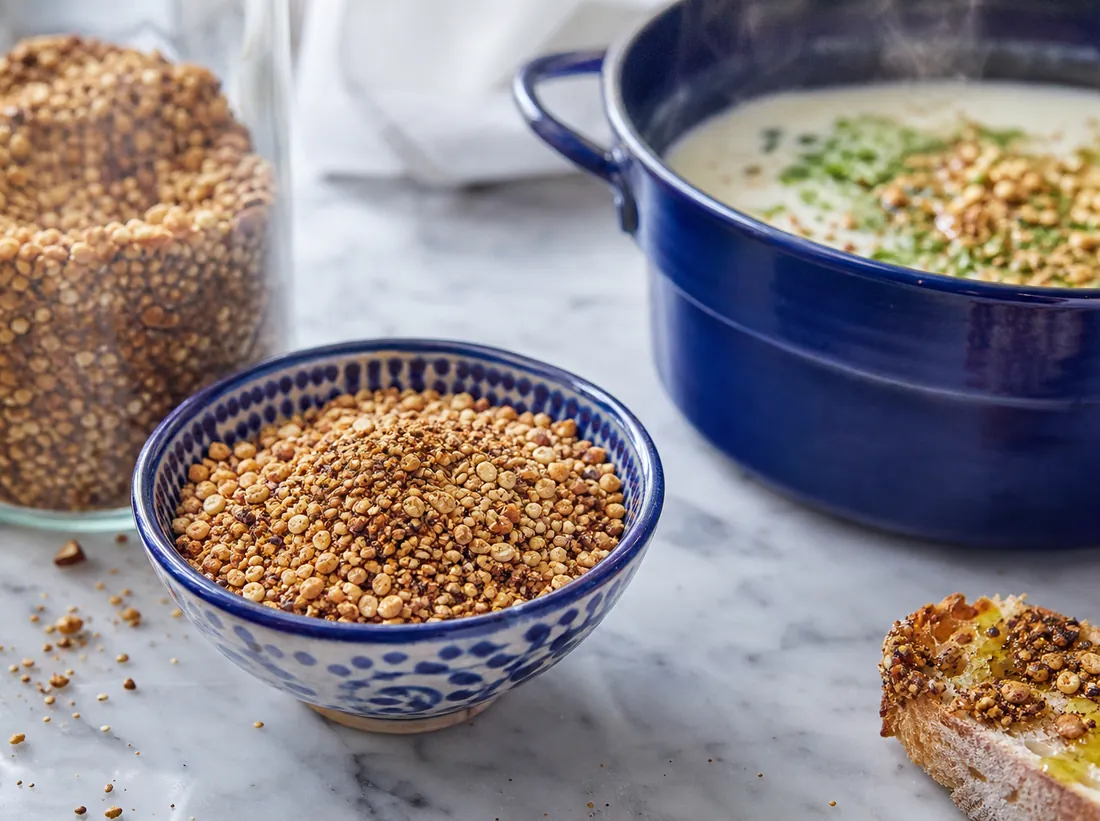
Dukkah is an Egyptian blend of toasted nuts, sesame and spices, coarsely crushed and dry, with no oil and no paste. Dip a slice of bread in olive oil and then in dukkah, scatter it over labneh, salad and soup, or press it onto fish or chicken for a crunchy crust.
 Illustration
What is Dukkah
The name dukkah comes from the Arabic root for pounding, and that is exactly the method: nuts, usually hazelnuts, are toasted with sesame, coriander seeds and cumin, seasoned with salt and black pepper, and pounded in a mortar to coarse crumbs. The blend stays dry and crunchy, and every bite brings nut, spice and salt.
In Egypt dukkah has been eaten with bread and olive oil for generations, at breakfast or as a snack, and every home has its own mix. Some add pistachios, almonds or peanuts, some put in dried mint, fennel seeds or nigella, and some versions have no nuts at all, using roasted chickpeas instead. In Israel it turns up on labneh, hummus, roasted vegetables and salads.
Price and where to buy
100 g
per kg
Where
Dukkah is sold mainly at the spice and nut shops of Carmel Market, Levinsky Market and Hatikva Market in Tel Aviv, Mahane Yehuda in Jerusalem and Wadi Nisnas in Haifa, at delis and at online spice shops. Israeli supermarket chains rarely stock it, so it is worth asking ahead whether it is in stock. It is also very easy to make at home.
Shelf prices, October 2026, VAT included.
Kinds of Dukkah
Classic Egyptian dukkah
Hazelnuts, sesame, coriander seeds, cumin, salt and black pepper. Nutty, aromatic and not hot.
Dukkah with pistachios or almonds
The nuts are swapped or added. Pistachio brings a green colour and a rich taste, almonds a gentle flavour and crunch.
Nut free dukkah
A version with roasted chickpeas and seeds only. It keeps longer and suits anyone avoiding nuts, but not anyone allergic to sesame.
Spicy dukkah
With chilli flakes or Aleppo pepper, sometimes sumac. Especially good on eggs, roasted vegetables and grilled meat.
How to use Dukkah
Bread, olive oil and dukkah
The Egyptian way: one small plate of olive oil and one of dukkah. Dip fresh bread or pitta in the oil and then in the dukkah. About 2 tablespoons of dukkah per person.
Homemade dukkah recipe
Toast 100 g of hazelnuts at 180°C for 10 to 12 minutes and rub them in a towel to remove the skins. In a dry pan toast 50 g of sesame, two tablespoons of coriander seeds and a tablespoon of cumin seeds for 2 to 3 minutes, until fragrant. Cool, add a teaspoon of salt and half a teaspoon of black pepper, and crush in a mortar or with a few short pulses in a food processor. Stop at coarse crumbs.
On labneh, hummus and salad
A tablespoon of dukkah over a plate of labneh or hummus, with a drizzle of olive oil. On a green or tomato salad it replaces croutons with crunch and salt.
Crust for fish or chicken
Spread a thin layer of raw tahini or mustard on a salmon fillet or chicken breast, press about two tablespoons of dukkah on each piece, and bake at 200°C. Fish 12 to 15 minutes, chicken 18 to 22 minutes.
On soup
A teaspoon of dukkah over a bowl of pumpkin, red lentil or cauliflower soup, just before serving. It gives a smooth soup crunch and the smell of toasted spices.
How to choose Dukkah
A fresh smell of toasted nuts and spices. A smell of stale oil, bitterness or paint means the nuts have oxidised.
A coarse, dry texture with visible pieces. Dukkah that looks like an oily paste was ground too far or is old.
Read the label for allergens: nuts, sesame and sometimes peanuts.
Buy small amounts, since the flavour fades quickly, and look for a kashrut mark on the pack.
What to use instead of Dukkah
| Substitute | How, and what changes |
|---|---|
| Quick dukkah | Two tablespoons of chopped toasted nuts, a teaspoon of toasted sesame, half a teaspoon of cumin and a pinch of salt, in place of two tablespoons of dukkah. |
| Za'atar with sesame | Same amount on labneh, bread and olive oil, and vegetables. The taste is herbal and lemony rather than nutty, and the texture finer. |
| Toasted sesame with salt | Same amount, for anyone avoiding nuts. Toast sesame until golden and mix with a little salt and black pepper. |
How to store Dukkah
In the pantry
In the fridge
In the freezer
The science of Dukkah
What toasting does
In the heat of the oven and pan, sugars and amino acids in the nuts and seeds react in Maillard reactions, creating hundreds of roasted, nutty aroma compounds. In the coriander and cumin seeds the aromatic oils are released and intensified. That is why everything is toasted first and crushed only once it has cooled.
Why it is crushed coarse, not ground
When nuts are ground all the way, the cell walls break and the oil flows out, which is how nut butter is made. Coarse crushing keeps most of the oil inside the pieces, so dukkah stays dry, crunchy and easy to scatter.
Why dukkah spoils quickly
Nuts and sesame are rich in unsaturated fat, which oxidises in contact with air, light and heat. Crushing greatly increases the surface area, so the process is fast. Make small batches and keep them cold.
Ask for Dukkah
Looking for Dukkah and cannot find it? Send a request and we will come back with a price and availability.
- Tell us how much you need and by when.
- We come back with a price, pack size and availability.
- Pick up at 99 Ibn Gabirol or delivery in Tel Aviv.
Frequently asked questions
What is dukkah?
An Egyptian blend of toasted nuts, sesame, coriander seeds, cumin, salt and pepper, coarsely crushed. It is eaten with bread and olive oil or scattered over dishes.
What is in dukkah?
The classic version is hazelnuts, sesame, coriander seeds, cumin, salt and black pepper. Some versions add pistachios, almonds, dried mint or roasted chickpeas.
How do you eat dukkah?
Dip bread in olive oil and then in dukkah, scatter it over labneh, hummus, salad and soup, or press it onto fish and chicken before baking.
How do you make dukkah at home?
Toast hazelnuts in the oven and sesame, coriander and cumin in a dry pan, cool, add salt and pepper and crush coarsely in a mortar.
What can I use instead of dukkah?
Chopped toasted nuts with sesame, cumin and salt, or za'atar with sesame for a herbal taste.
How long does dukkah keep?
Homemade dukkah two to three weeks in the cupboard and one to two months in the fridge. A few months in the freezer.
The Complete99 pantry
Ingredients and kitchen gear, with prices and availability.
More from the pantry
Amba
Amba is a sour, spicy sauce of pickled green mango, yellow from turmeric with a strong smell of fenugreek. It…
Baharat
Baharat is a blend of warm, fragrant spices, and its name is simply the Arabic word for spices. In Iraqi,…
Bulgur
Bulgur is wheat that has been boiled, dried and cracked, so it is ready in minutes. Fine bulgur, which many…