Amba
Amba is a sour, spicy sauce of pickled green mango, yellow from turmeric with a strong smell of fenugreek. It reached Baghdad from India, Iraqi Jews brought it to Israel, and today sabich, falafel or shawarma in pitta are hard to imagine without it.
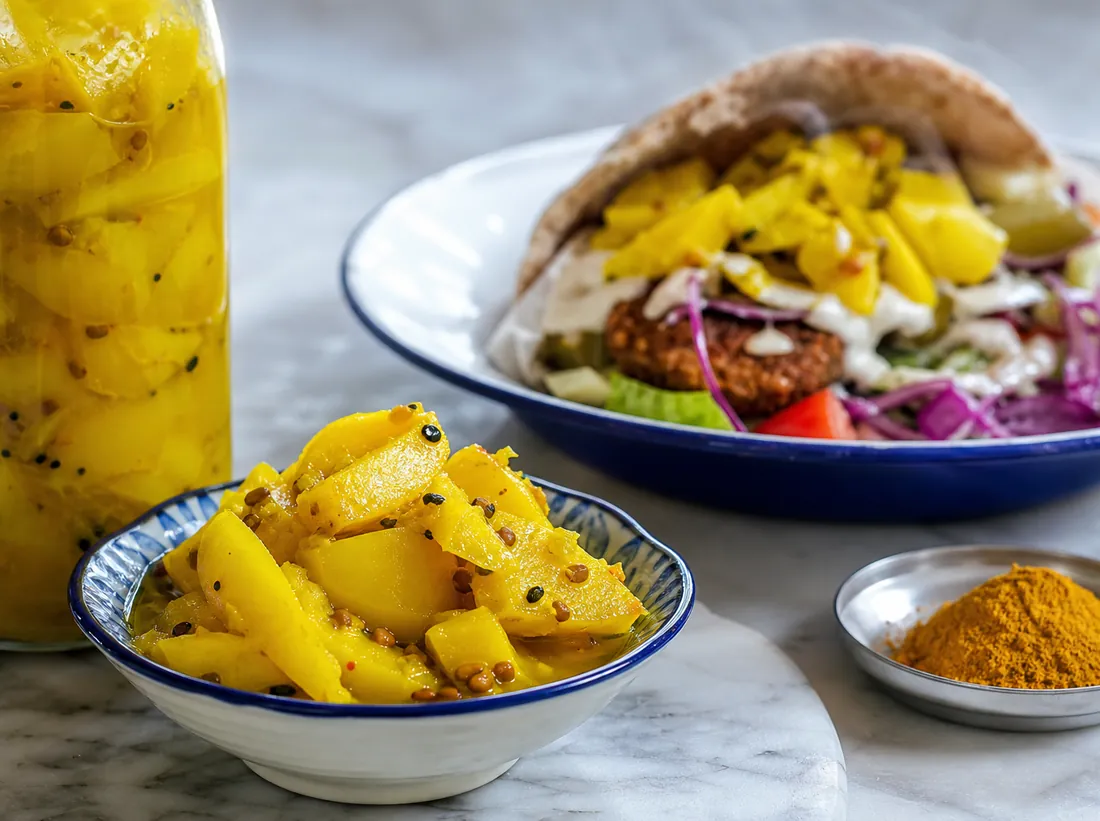 Illustration
What is Amba
Amba is made from green, unripe mango, which is sour, firm and full of pectin. The fruit is cut into pieces, salted and left for a few days, once in the sun on the rooftop, until it softens and sours. Then it is cooked or mixed with spices: ground fenugreek, turmeric, chilli, garlic, sometimes mustard seeds, and vinegar. The result is a thick, sour, moderately hot sauce that seasons everything it touches.
Pickled mango comes from Indian cooking and reached Baghdad through the links between Iraqi Jewish merchants and India. In Baghdad it became an everyday sauce, and when Iraqi Jews moved to Israel it came with them to the falafel and sabich stands. The name amba comes from a word for mango in the languages of India, and that is also what mango is called in Iraqi Arabic.
Price and where to buy
500 g
per kg
Where
Amba sauce is sold in every Israeli supermarket chain, on the sauces and pickles shelf. Fresh amba from tubs, chunky amba and amba spice are at the pickle shops, delis and spice shops of Carmel Market, Levinsky Market and Hatikva Market in Tel Aviv, Mahane Yehuda in Jerusalem and Wadi Nisnas in Haifa, and at Iraqi grocers.
Shelf prices, October 2026, VAT included.
Kinds of Amba
Smooth amba sauce
A thick, slightly runny sauce in a jar or squeeze bottle. Handy for drizzling over sabich, falafel and meat.
Amba with mango pieces
Sauce with chewy pieces of fruit. Better as a condiment on the plate and alongside rice and meat.
Hot amba
With more chilli, sometimes with crushed hot pepper. The sourness stays and the heat rises.
Amba spice
A dry powder of fenugreek, turmeric, chilli, salt and sometimes green mango powder. Mix with water, vinegar and oil for a quick amba, or season chicken and rice with it.
How to use Amba
In sabich
In a pitta with fried aubergine, hard boiled egg, potato, salad and tahini, drizzle a tablespoon or two of amba over everything. The sourness of the amba cuts through the oil of the aubergine.
Tahini with amba
A tablespoon of amba to four tablespoons of prepared tahini. Stir until evenly yellow and serve with falafel, schnitzel, roasted vegetables or meatballs.
Chicken marinade
Three tablespoons of amba, two tablespoons of oil and two crushed garlic cloves for a kilo of chicken thighs. Marinate for an hour in the fridge and roast at 200°C for about 40 minutes, until the skin is browned.
Quick homemade amba
Peel and dice two green mangoes, about 600 g. Mix with a tablespoon of salt and leave for 24 hours in the fridge. Drain, then cook for 10 to 15 minutes with a teaspoon of turmeric, a teaspoon of ground fenugreek, half a teaspoon of chilli, two garlic cloves, three tablespoons of vinegar, a tablespoon of sugar, three tablespoons of oil and half a cup of water. Blend smooth or leave chunky, and cool.
With grilled meat and rice
A spoonful of amba beside skewers, kebab, shawarma or chicken with rice. A little is enough, since the flavour is strong.
How to choose Amba
A strong yellow colour and a clear smell of fenugreek and vinegar when opened. Faded amba with no smell is old or short on mango.
Read the label: when mango comes first, there is more fruit. Cheap sauces contain plenty of water, starch and little mango.
A swollen lid or a mouldy smell means the jar should be thrown away.
Look for a kashrut mark on the pack.
What to use instead of Amba
| Substitute | How, and what changes |
|---|---|
| Indian mango pickle | The closest substitute, same amount. Oilier and hotter, with mustard seeds, and it can be blended with a little water into a smooth sauce. |
| Mango chutney | Same amount, with a teaspoon of lemon juice and a pinch of chilli for every tablespoon. It is sweet rather than sour, so the sourness comes from the lemon. |
| Amba spice with water and vinegar | A tablespoon of amba spice, two tablespoons of water, a tablespoon of vinegar and a tablespoon of oil, simmered for a minute. In place of a quarter cup of amba. |
How to store Amba
In the pantry
In the fridge
In the freezer
The science of Amba
Where the sourness comes from
Green mango is full of citric and malic acid and has almost no sugar. Salt draws water out of the fruit, and the natural bacteria on its skin begin a gentle fermentation that adds lactic acid and depth. That is why amba tastes sour in a different way from lemon juice.
The colour and the smell
The yellow comes from curcumin in turmeric. The strong smell, reminiscent of maple syrup and curry, belongs to a compound called sotolon from fenugreek seeds. It is so powerful that it lingers in the house and on clothes, and sometimes on the skin the next day.
Why amba keeps
Salt, vinegar and high acidity leave bacteria and moulds a very hostile environment. It is the same principle as any pickle, so a sealed jar lasts a long time, and once opened the cold and a clean spoon do the rest.
Ask for Amba
Looking for Amba and cannot find it? Send a request and we will come back with a price and availability.
- Tell us how much you need and by when.
- We come back with a price, pack size and availability.
- Pick up at 99 Ibn Gabirol or delivery in Tel Aviv.
Frequently asked questions
What is amba?
A sour, spicy sauce of pickled green mango with fenugreek, turmeric and chilli. It is eaten in sabich, falafel and shawarma and with meat.
What is amba made of?
Green mango that has been salted and soured, with ground fenugreek, turmeric, chilli, garlic, vinegar, sometimes mustard seeds, a little sugar and oil.
Where does amba come from?
Pickled mango travelled from India to Baghdad, and Iraqi Jews brought it to Israel. The name amba means mango.
What is amba spice made of?
Usually ground fenugreek, turmeric, chilli and salt, sometimes with green mango powder, mustard and sugar. Read the ingredients on the pack.
How do you make amba at home?
Salt cubes of green mango for a day in the fridge, drain, and cook for 10 to 15 minutes with turmeric, fenugreek, chilli, garlic, vinegar, sugar, oil and a little water.
What do you eat amba with?
In sabich, falafel and shawarma, with schnitzel, kebab and roast chicken, in tahini and with rice.
How long does amba keep once opened?
One to three months in the fridge, in a closed jar and with a clean spoon. Homemade amba two to three weeks.
The Complete99 pantry
Ingredients and kitchen gear, with prices and availability.
More from the pantry
Baharat
Baharat is a blend of warm, fragrant spices, and its name is simply the Arabic word for spices. In Iraqi,…
Bulgur
Bulgur is wheat that has been boiled, dried and cracked, so it is ready in minutes. Fine bulgur, which many…
Dashi
Dashi is the basic stock of Japanese cooking, clear and light, with a deep umami taste. It is made from kombu…