Udon noodles
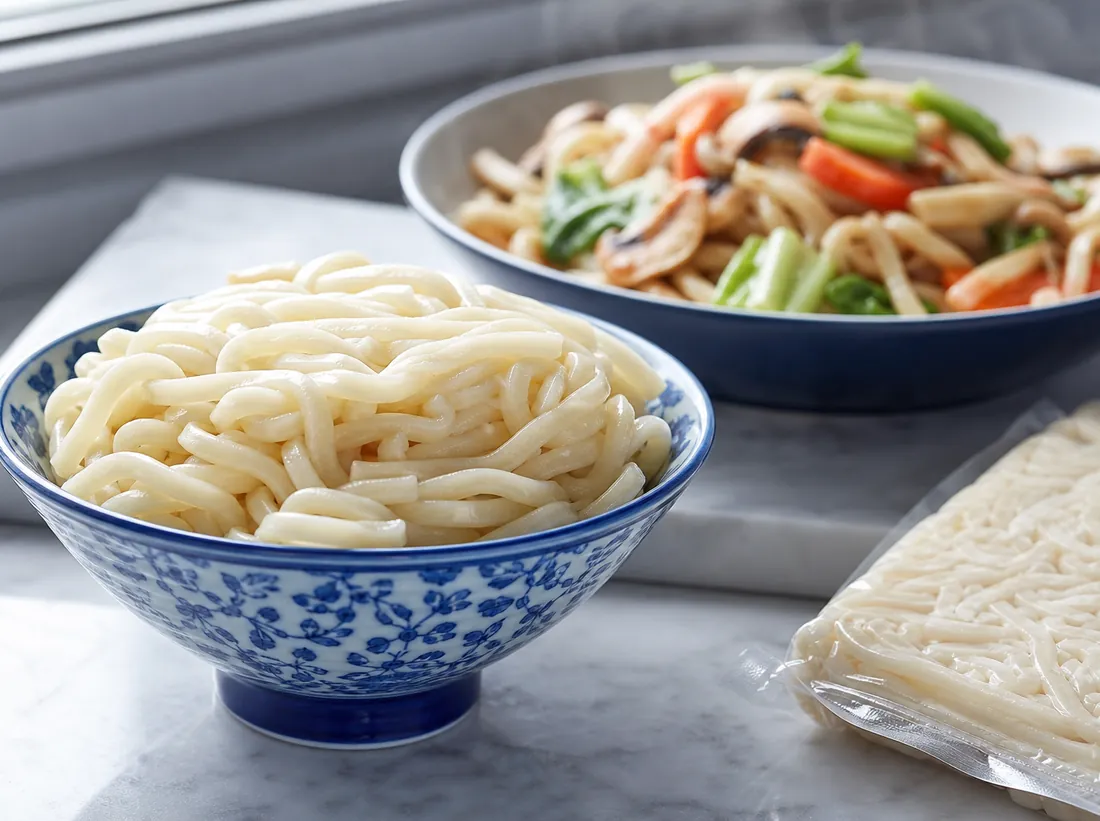
Udon noodles are thick, white, chewy Japanese wheat noodles made only from flour, water and salt. They hold a thick sauce in a stir fry and do not go too soft in hot broth, and in Israel they are easiest to find as precooked vacuum packed portions that are ready in two minutes.
 Illustration
What is Udon noodles
Udon dough is made from wheat flour, water and salt only, with no egg. The stiff dough is kneaded for a long time, in Japan sometimes by foot inside a bag, rested, rolled out and cut into thick strips. The noodles come out white, smooth and springy, with a slightly firm centre that Japanese cooks value most.
In Japan udon is eaten every way: in hot dashi with spring onion, topped with tempura, with sweet fried tofu, in curry sauce, stir fried, or cold with a dipping sauce in summer. In Israel udon is best known from stir fries, and some homes use it for lagman when there is no time to pull dough. Udon is made from wheat and contains gluten.
Price and where to buy
200 g vacuum packed portion
per kg
Where
Vacuum packed udon is sold on the Asian shelf of every Israeli supermarket chain. Dried udon in several thicknesses, frozen udon and kishimen are at the Asian supermarkets around the Central Bus Station and Florentin in Tel Aviv and at online Asian shops, which also carry larger packs at a better price per portion.
Shelf prices, October 2026, VAT included.
Kinds of Udon noodles
Vacuum packed udon
Noodles cooked in advance and packed in portions of about 200 g. Soft and ready in a minute or two in boiling water or straight in the pan. This is the udon most Israeli chains sell.
Dried udon
Dried noodles, usually thinner and flatter. Boil for 8 to 12 minutes, as the pack says, and rinse. Keeps a long time in the pantry.
Frozen udon
The kind Japanese home cooks love: cooked and flash frozen, with the springiest texture. Sold at Asian grocers and cooked straight from frozen in a minute.
Kishimen
Flat, wide udon like a ribbon, from the Nagoya area. Lovely in soup, since the wide surface catches plenty of broth.
How to use Udon noodles
Udon stir fry
Loosen two vacuum packed portions of udon, 400 g, for a minute in boiling water and drain. In a very hot wok stir fry strips of chicken or tofu and vegetables with a tablespoon of oil for 5 minutes, add the noodles and a sauce of 3 tablespoons of soy sauce, a tablespoon of mirin or a teaspoon of sugar and a tablespoon of sesame oil, and toss for 2 more minutes.
Udon soup
For two bowls: 500 ml of dashi, two tablespoons of soy sauce and two tablespoons of mirin. Bring to a gentle simmer, add two portions of udon for two minutes, and serve with sliced spring onion and a little chilli.
Cold udon with dipping sauce
Cook, rinse in iced water until completely cold and drain well. For the sauce: four parts dashi, one part soy sauce and one part mirin, simmered for a minute and cooled. Dip each bite, with spring onion and grated ginger.
In lagman
When there is no time to pull dough, thick udon goes into a bowl of lagman in place of the homemade noodles. Warm the noodles in boiling water and ladle the sauce over them.
Curry udon
Two portions of udon in 600 ml of stock with a tablespoon or two of melted Japanese curry roux, or curry powder with a tablespoon of flour toasted in oil. Simmer for 3 minutes until the sauce thickens.
How to choose Udon noodles
With vacuum packs read the label: wheat flour, water, salt and sometimes an acidity regulator that extends shelf life. The noodles should be white, not yellow, and the pack whole and not swollen.
For soup choose thick udon or flat kishimen, and for stir fries thick round udon that does not break in the wok.
When a pack comes with a seasoning sachet, check on the pack whether the sachet is parve, dairy or meat.
Look for a kashrut mark on the pack, and remember that udon is wheat, so it is chametz at Passover.
What to use instead of Udon noodles
| Substitute | How, and what changes |
|---|---|
| Thick spaghetti | Same dry weight in stir fries and lagman. Cook until it still has a little bite. Less chewy and springy, but it holds sauce well. |
| Ramen noodles | Same amount, for soup and stir fries. Thinner, yellowish and springy, with a slightly different taste. |
| Soba noodles | In place of cold udon with dipping sauce, same amount. Thinner, brown and nutty buckwheat noodles. |
| Wide rice noodles | In a stir fry, same weight, for anyone avoiding gluten. Softer and prone to sticking, so toss gently. |
How to store Udon noodles
In the pantry
In the fridge
In the freezer
The science of Udon noodles
Why udon is chewy
Salt strengthens the gluten network, and long kneading and resting align it into long, flexible strands. In a thick noodle water travels in slowly, so the outside turns soft while the centre stays a little firm. That combination, soft outside and springy inside, is the texture udon is prized for.
How udon differs from ramen
Ramen dough contains alkaline salts that turn the noodles yellowish and springy, with a slightly mineral taste. Udon has only ordinary salt, so it stays white, softer and tastes cleanly of wheat.
Why cold udon is rinsed
During cooking starch is released onto the surface of the noodles and makes them sticky. Rinsing in cold water washes that starch away and stops the cooking, and the cold firms up the starch inside, so the noodles stay separate and springy.
Ask for Udon noodles
Looking for Udon noodles and cannot find it? Send a request and we will come back with a price and availability.
- Tell us how much you need and by when.
- We come back with a price, pack size and availability.
- Pick up at 99 Ibn Gabirol or delivery in Tel Aviv.
Frequently asked questions
What are udon noodles?
Thick, white, chewy Japanese wheat noodles made only from flour, water and salt. They are eaten in hot broth, in stir fries and, in summer, cold with a dipping sauce.
What is the difference between udon and ramen?
Udon is thick, white and soft, with only salt in the dough. Ramen is thinner, yellowish and springy thanks to alkaline salts in the dough.
How do you cook udon noodles?
Loosen vacuum packed udon for a minute or two in boiling water, or put it straight in the pan with a splash of water. Boil dried udon for 8 to 12 minutes, as the pack says, and rinse.
Does udon contain egg?
Classic udon has no egg, only wheat flour, water and salt. Still read the ingredients, since some products have additions.
Can you freeze udon?
Yes. Vacuum packs and cooked udon keep in the freezer for up to three months and cook straight from frozen.
What can I use instead of udon?
Thick spaghetti in stir fries and lagman, ramen noodles in soup, and soba noodles when serving cold.
Does udon contain gluten?
Yes. Udon is made from wheat flour. For a gluten free stir fry use wide rice noodles.
The Complete99 pantry
Ingredients and kitchen gear, with prices and availability.
More from the pantry
Amba
Amba is a sour, spicy sauce of pickled green mango, yellow from turmeric with a strong smell of fenugreek. It…
Baharat
Baharat is a blend of warm, fragrant spices, and its name is simply the Arabic word for spices. In Iraqi,…
Bulgur
Bulgur is wheat that has been boiled, dried and cracked, so it is ready in minutes. Fine bulgur, which many…