Tamarind
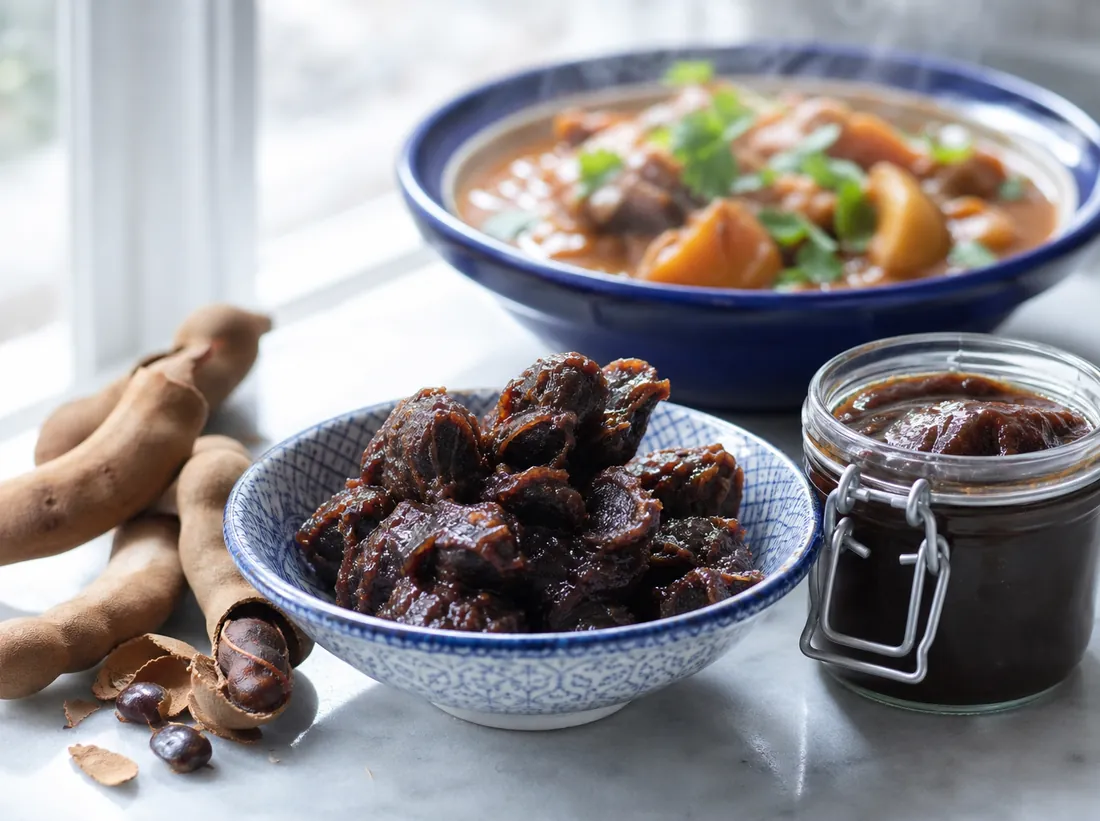
Tamarind is the sticky pulp inside the pods of a tropical tree. It is sour and sweet at once, and in Indian, Thai, Syrian and Iraqi cooking it gives a dark, deep sourness to soups, sauces and kubbeh.
 Illustration
What is Tamarind
Tamarind is the fruit of a tall evergreen tree of the legume family, native to tropical Africa and grown today mainly in India and Southeast Asia. The fruit is a brittle brown pod holding a sticky, dark brown pulp around hard seeds. The Hebrew name comes from the Arabic tamar hindi, Indian date, although it has nothing to do with the date palm. Shops sell it mostly as a pressed block of pulp or as ready concentrate.
It tastes very sour, with the sweetness of dried fruit and a little astringency. In India it goes into sambar, rasam and chutney, in Thailand into pad thai sauce and some versions of tom yum, and in the cooking of the Jews of Aleppo it sours kibbeh, stuffed vegetables and okra kubbeh. In Egypt and Syria it is drunk cold, as a sweet and tangy summer drink.
Price and where to buy
400 g concentrate
per kg
Where
Tamarind concentrate, blocks and pods are sold at the Asian supermarkets around the Central Bus Station and in Florentin in Tel Aviv, at Indian and Asian shops near Levinsky Market and in online Asian food shops. Some supermarket chains carry concentrate on the Asian food shelf, but not every branch.
Shelf prices, October 2026, VAT included.
Kinds of Tamarind
Pulp block
Pressed pulp, usually with seeds and fibres. Soak in hot water and strain. Fresh and fruity, and the cheapest per kilo.
Concentrate or paste
A dark, thick paste, ready to use and very concentrated. Start with a teaspoon and add gradually, because it is much stronger than homemade tamarind water.
Whole pods
Sour varieties for cooking and sweet ones, mostly from Thailand, eaten like dried fruit. Peel off the brittle shell and remove the seeds.
Ou't, the Aleppo syrup
A sweet and sour syrup of tamarind cooked with sugar and lemon. It is made at home and kept in the fridge, for kibbeh and stuffed vegetables.
How to use Tamarind
Tamarind water from a block
50 g of pulp in half a cup of boiling water for 15 minutes. Mash with your fingers, push through a sieve with a spoon. You get about half a cup of paste for cooking, and the seeds and fibres go in the bin.
Okra kubbeh and sour soups
One or two tablespoons of concentrate in place of some of the lemon, dissolved in a ladle of the sauce. The sourness turns dark, deep and slightly fruity, like the okra of the Jews of Aleppo.
Kharcho without tkemali
Dissolve 40 g of tamarind concentrate in a ladle of broth and add it to the pot at the end of cooking, in place of the tkemali.
Pad thai sauce
Three tablespoons of tamarind water, three of fish sauce and two to three of brown sugar. Warm until the sugar melts, and toss it through the noodles at the end.
Cold tamarind drink
Two tablespoons of concentrate, a litre of cold water and three to four tablespoons of sugar. Stir until the sugar dissolves, chill and serve over ice.
How to choose Tamarind
A good concentrate lists tamarind and water, sometimes a preservative. Sugar on the list suits a drink better than cooking.
A good block is soft, sticky and dark brown. A hard, dry block is older, but still fine after a longer soak.
Check whether the block says seedless. A block with seeds costs less but gives less pulp per 100 g.
Look for a kashrut mark on the pack.
What to use instead of Tamarind
| Substitute | How, and what changes |
|---|---|
| Lime juice and silan | For each tablespoon of tamarind water, a tablespoon of lime juice and a teaspoon of silan or brown sugar. Brighter and without the depth, but close in a Thai soup. |
| Pomegranate molasses | Same amount as tamarind water, or a tablespoon of molasses for each teaspoon of concentrate. Redder and fruitier, good in kubbeh and kharcho. |
| Lemon and a pinch of sugar | A tablespoon of lemon juice and a pinch of sugar for each tablespoon of tamarind water. In kubbeh and sour soups this is the usual choice, sharper and brighter. |
How to store Tamarind
In the pantry
In the fridge
In the freezer
The science of Tamarind
Why it is sour and sweet at once
Tamarind pulp is rich in both sugar and tartaric acid, the acid of grapes, which is rare in most other fruit. Tartaric acid gives a deep, lasting sourness and the sugar rounds it off, so tamarind tastes rounder and darker than lemon.
Why you soak it in hot water
The pulp is held together by fibres and pectin, and cold water barely gets in. Hot water softens the pectin and dissolves the sugars and acids, so the pulp can be pushed through a sieve, leaving the seeds and fibres behind.
Why it darkens soup
The pulp holds polyphenols and brown pigments that form as the fruit ripens and dries inside the pod. They dissolve into the sauce and colour it brown, which is why okra kubbeh with tamarind is darker than okra kubbeh with lemon.
Ask for Tamarind
Looking for Tamarind and cannot find it? Send a request and we will come back with a price and availability.
- Tell us how much you need and by when.
- We come back with a price, pack size and availability.
- Pick up at 99 Ibn Gabirol or delivery in Tel Aviv.
Frequently asked questions
What is tamarind?
The sour and sweet pulp inside the pods of a tropical tree of the legume family. It is used in Indian, Thai, Syrian and Iraqi cooking.
Tamarindi or tamarhindi?
Both Hebrew spellings mean the same fruit. Tamarhindi comes from the Arabic for Indian date, and tamarindi is close to the English name. Some also write tamarind or tamar hindi.
Is tamarind related to dates?
No. It is the fruit of a tree of the legume family, and it got the name Indian date because its dark, sticky pulp looks like dates.
How do you use a tamarind block?
Soak 50 g in half a cup of boiling water for 15 minutes, mash, strain and use the paste. Throw away the seeds.
What can replace tamarind?
A tablespoon of lime juice and a teaspoon of silan or brown sugar for each tablespoon of tamarind water, or pomegranate molasses in the same amount.
Where can you buy tamarind in Israel?
At the Asian supermarkets and Indian shops around the Central Bus Station and Levinsky in Tel Aviv, and in online Asian food shops.
How much does tamarind cost?
A 400 g pack of concentrate costs about 19.9 ILS, which is about 50 ILS per kilo.
The Complete99 pantry
Ingredients and kitchen gear, with prices and availability.
More from the pantry
Amba
Amba is a sour, spicy sauce of pickled green mango, yellow from turmeric with a strong smell of fenugreek. It…
Baharat
Baharat is a blend of warm, fragrant spices, and its name is simply the Arabic word for spices. In Iraqi,…
Bulgur
Bulgur is wheat that has been boiled, dried and cracked, so it is ready in minutes. Fine bulgur, which many…