Lagman

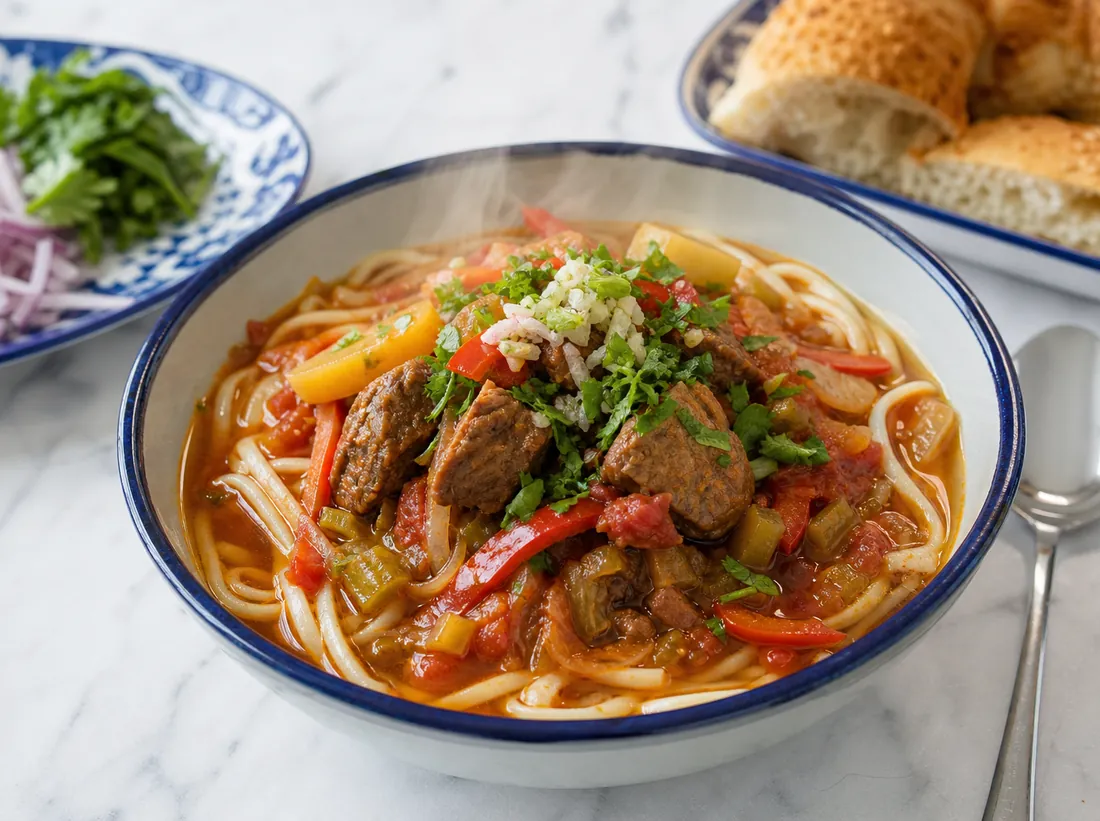
Lagman is a noodle soup from Central Asia: long noodles stretched by hand, topped with a thick sauce of beef or lamb with peppers, tomatoes, radish, celery and plenty of garlic. In Bukharan homes it is a whole meal in a bowl.

Pot calculatorOrder Lagman

Dairy freeMeatAllergens:GlutenCelery

Updated

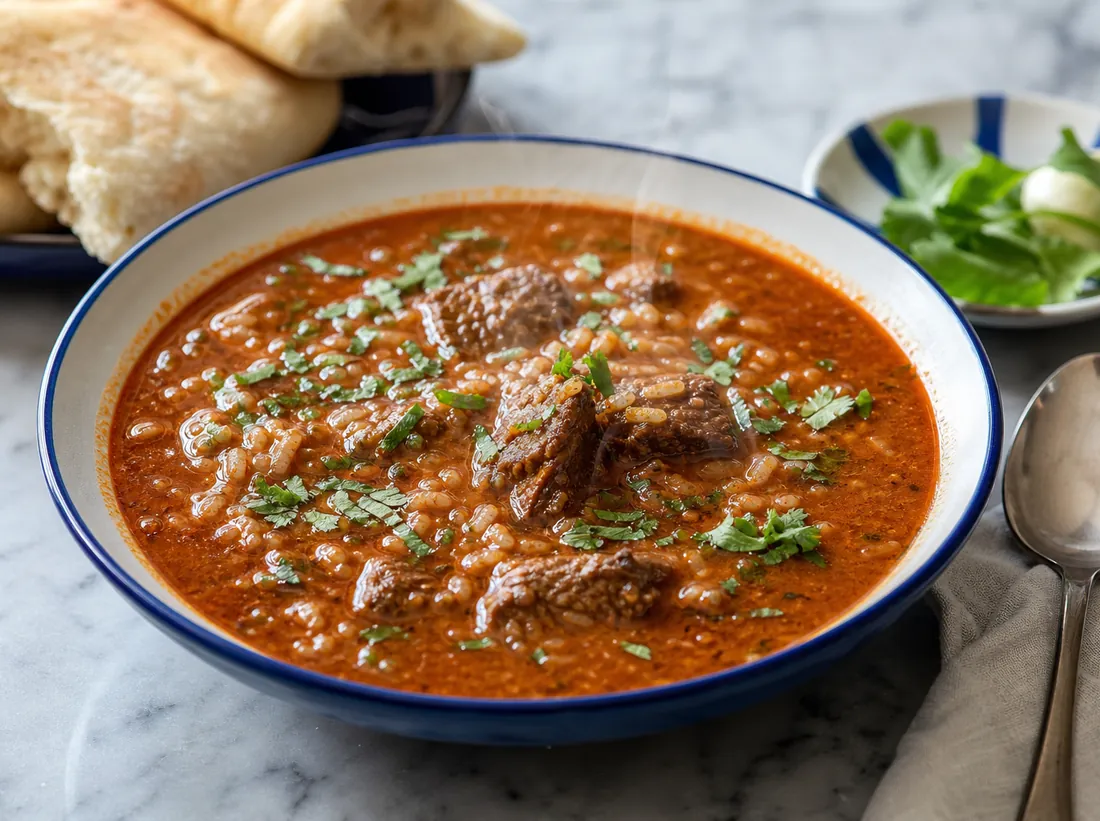
LagmanIllustration
Time3 h 10 minCook 1 h
Pot6 bowls3.6 litres
Per bowl604 kcal31.3 g protein · a 600 ml bowl
Cost of the pot₪59for the pot, about ₪9.8 a bowl

The story of Lagman

Lagman comes from the cooking of the Uyghur people, who live in western China and Central Asia, and its name is probably related to the Chinese name for pulled noodles. From there it spread across Central Asia, became a familiar dish in Uzbekistan, Kyrgyzstan and Kazakhstan, and reached the whole former Soviet Union. The heart of it is the noodles: a plain dough of flour, water and salt, stretched by hand into long strands.

Bukharan Jews took lagman from the cooking of their neighbours in Uzbekistan, and it became part of their table alongside plov and shurpa. In Bukharan homes in Israel it is made with beef or lamb, and when there is no time to pull dough, thick shop-bought noodles stand in. Many homes serve it with vinegar and crushed garlic, which everyone adds to their own bowl.

What makes Lagman itself

Lagman is not soup with noodles but noodles with soup. The noodles are the heart: long, springy, as thick as spaghetti or thicker, and cooked separately. Over them goes a sauce built like a stir-fry: beef seared over high heat, then vegetables in pieces, tomatoes and spices, and only at the end hot water. The result is a bowl in three layers: noodles, thick sauce and broth.
Lagman for any number of people

Change the number of people and the bowl size, and every ingredient updates in grams, with the cost, calories and protein per bowl.

Bowl size
Units
3.6litres in the pot
5Pot to use, litres
₪59Cost of the pot
₪9.8per bowl
604kcal per bowl
31.3g protein per bowl
IngredientAmountCost
The noodles
Bread flour500 g₪3.0
Water270 ml
Salt6 g₪0.0
Baking soda2 g₪0.1
Oil for coating the dough40 ml₪0.6
Sauce and broth
Beef chuck in thin strips600 g₪39
Canola oil50 ml₪0.8
Onion200 g · 1 pcs₪1.2
Garlic25 g · 6 pcs₪0.9
Carrot150 g · 1 pcs₪0.7
White radish (daikon)150 g₪1.5
Celery stalks100 g · 2 pcs₪2.0
Red and green peppers300 g · 3 pcs₪3.0
Tomatoes400 g · 3 pcs₪3.2
Tomato paste30 g₪1.1
Cumin3 g₪0.3
Ground coriander seed2 g₪0.1
Chilli10 g · 1 pcs₪0.1
Black pepper2 g₪0.3
Salt12 g₪0.0
Hot water1.5 l
For the table
Fresh coriander, chopped20 g₪1.0
Vinegar30 ml₪0.2
Crushed garlic for the vinegar10 g · 2 pcs₪0.4
Send on WhatsApp

Shelf prices at a large Israeli chain and specialty shops, October 2026. Nutrition from the ingredients in grams, before cooking.

How many calories in Lagman? Nutrition facts and calorie calculator

Change the amount of any ingredient, drop one, or pick a lighter version, and the numbers per serving update at once: calories, fat, carbs, protein, sodium and fibre.

Lagman has 101 calories per 100 ml. A 600 ml bowl made with our recipe has 604 calories: 31.3 g protein, 17.9 g fat and 74 g carbohydrates. A 250 ml cup has 252 calories.

Lighter

Ingredients, for the whole recipe

  • 500 g303 kcal per serving
  • 6 g0 kcal per serving
  • 2 g0 kcal per serving
  • 40 ml54 kcal per serving
  • 600 g107 kcal per serving
  • 50 ml68 kcal per serving
  • 1 pcs13 kcal per serving
  • 6 pcs6 kcal per serving
  • 1 pcs10 kcal per serving
  • 150 g4 kcal per serving
  • 2 pcs3 kcal per serving
  • 3 pcs9 kcal per serving
  • 3 pcs12 kcal per serving
  • 30 g7 kcal per serving
  • 3 g2 kcal per serving
  • 2 g1 kcal per serving
  • 1 pcs1 kcal per serving
  • 2 g1 kcal per serving
  • 12 g0 kcal per serving
  • 20 g1 kcal per serving
  • 30 ml1 kcal per serving
  • 2 pcs2 kcal per serving

What each add-on adds to Lagman

Values for the amount in the row, from the national food database.

Add-onCaloriesProtein, gFat, g
A tablespoon of oil122013.8
A slice of white bread792.50.5
A slice of challah12641.1
A side cup of cooked rice, about1823.50.3

How to make Lagman

In cook mode the screen stays on, tap a step when it is done, and the timers run next to each step.
  1. Dissolve the salt and baking soda in the water. Add to the flour and knead for 10 minutes into a smooth, slightly stiff dough. Cover and rest for 30 minutes.
  2. Knead again for 3 to 4 minutes and rest for another 30 minutes. The dough should be smooth and supple.
  3. Divide into about 12 pieces, roll each into a finger-thick rope, coat well with oil, coil on a plate, cover and rest for 30 to 60 minutes.
  4. Meanwhile heat the oil in a wide pot over high heat and sear the beef strips in two batches, 4 to 5 minutes each.
  5. Return all the meat, add the diced onion, garlic, carrot and radish and fry for 5 minutes. Add the peppers and celery and fry for 5 minutes more.
  6. Add the tomato paste and fry for 2 minutes, then the diced tomatoes, cumin, ground coriander and chilli. Cook for 5 minutes, add the hot water, salt and black pepper, and simmer for 40 minutes, until the meat is tender.
  7. Pull the noodles: stretch each rope gently between your hands, swing it and slap it lightly on the counter, until it is 3 to 4 mm thick. If the dough resists, let it rest another 5 minutes.
  8. Cook the noodles in a large pot of salted boiling water for 2 to 4 minutes, until they float and are tender but springy. Rinse in warm water and toss with a little oil.
  9. Put noodles in a deep bowl, ladle sauce and broth over them and scatter with coriander. Serve with vinegar and crushed garlic on the side.

The science of Lagman

Kitchen science

Gluten that builds and relaxes

When wheat flour is kneaded with water, two proteins, glutenin and gliadin, bond into a stretchy network called gluten. Kneading aligns and strengthens the network, and resting lets the bonds inside it rearrange and relax, so the dough stretches without springing back. Dough that has not rested enough resists and tears, while well-rested dough almost stretches by itself.

Kitchen science

Salt and soda in lagman dough

Salt strengthens the gluten network and makes the dough more elastic and stronger. Baking soda makes the dough slightly alkaline, which tightens the bonds between proteins further and gives the noodles a springy bite. The alkaline conditions also tint the noodles yellowish, because natural pigments in the flour change colour.

Kitchen science

Oil that coats the dough

A layer of oil on the dough stops moisture evaporating from the surface. Without it a dry skin forms that does not stretch with the dough beneath and tears first. The oil also keeps the strands from sticking to each other on the plate.

Kitchen science

Meat that browns instead of greying

The Maillard reaction, which gives meat its brown colour and deep flavour, happens only when the surface is dry and hotter than about 140 °C. Put too much meat in at once and the pot cools, the juices run, and the meat stews in them and turns grey. That is why it is seared in two batches over high heat.

Kitchen science

Noodles in a separate pot

Fresh noodles release starch into the water they cook in. Cooked in the soup, that starch thickens and clouds the broth and makes it gluey. Cooking them in a separate pot and rinsing briefly keeps the broth clean and the noodles from sticking.

Lagman in every kitchen

Lagman soup

The version in this recipe, with plenty of broth over the noodles. Common in Uzbekistan and in Bukharan homes.

Fried lagman

No broth. The cooked noodles are stir-fried in a pan with the meat and vegetables, sometimes with a fried egg on top.

Uyghur

The sauce is thicker with almost no broth and more peppers, and it is poured over the noodles just before eating.

With lamb

Lamb shoulder in thin strips instead of beef. The flavour is stronger, and cumin suits it well.

With shop-bought noodles

Many homes in Israel use thick wheat noodles such as udon or thick spaghetti when there is no time to pull dough. The sauce stays the same.

Common Lagman problems and how to fix them

Lagman dough tears when pulled

The dough did not rest enough, is too dry, or was not kneaded enough. Cover it and let it rest another 15 minutes, and oil the pieces. Next time knead until completely smooth and keep to every resting time.

The noodles are sticky and clump together

They were not rinsed and oiled after cooking, or they cooked in a pot that was too small. Cook in plenty of boiling water, rinse in warm water and toss with a spoonful of oil.

The beef in lagman came out grey and stewed

All the meat went into the pot at once and the pot cooled. Sear in two batches over high heat and do not stir in the first minute.

Lagman soup is thick and gluey

The noodles cooked in the soup and released their starch into it. Always cook them in a separate pot and add them to the bowl just before serving.

The noodles are too soft and mushy

They cooked too long, or the flour was weak. Fresh noodles are ready in 2 to 4 minutes. Use bread flour and test a noodle after 2 minutes.

Storing, freezing and reheating

3 days

In the fridge

3 months, sauce only

In the freezer

2+4

To cool

Bring it from 60 to 21 °C within two hours and down to 5 °C within four more. Split a big pot into shallow boxes.

75 °C

Reheating

Keep the sauce and noodles separate. Bring the sauce to a boil and dip the noodles in boiling water for a minute. Noodles left sitting in the soup turn soft and swollen.

Nutrition of Lagman

From our recipe, per bowl and per 100 g, next to the national food database.

ServingkcalProtein, gFat, gCarbs, gFibre, g
Our recipe, a 600 ml bowl60431.317.974.06.3
Our recipe, 100 ml1015.23.012.31.0

What the ingredients of Lagman cost

What each ingredient costs in one pot, and where to buy it.

IngredientPriceIn this potWhere to buy
Beef chuck in thin strips₪65 per kg₪39Butcher
Tomatoes₪7.9 per kg₪3.2Greengrocer
Red and green peppers₪9.9 per kg₪3Greengrocer
Bread flour₪5.9 per kg₪3Supermarket
Celery stalks₪6.9 each₪2Greengrocer
White radish (daikon)₪9.9 per kg₪1.5Greengrocer
Oil for coating the dough₪15 per litre₪1.3Supermarket
Garlic₪34 per kg₪1.2Greengrocer
Onion₪5.9 per kg₪1.2Greengrocer
Tomato paste₪35 per kg₪1.1Supermarket
Fresh coriander, chopped₪4.9 each₪1Greengrocer
Carrot₪4.9 per kg₪0.7Greengrocer
Black pepper₪139 per kg₪0.3Supermarket
Cumin₪86 per kg₪0.3Supermarket
Vinegar₪6.9 per litre₪0.2Supermarket
Chilli₪13 per kg₪0.1Greengrocer
Ground coriander seed₪44 per kg₪0.1Spice shop
Baking soda₪24 per kg₪0Supermarket
Salt₪2.1 per kg₪0Supermarket

Shelf prices at a large Israeli chain and specialty shops, October 2026, VAT included. Vegetable prices change with the season.

Make Lagman a meal

Shabbat

Ready Shabbat food

Soup, hamin, mains and sides, with a quantity calculator and prices.

Plan Shabbat
Hosting

Hosting trays

9 trays to go with the soup, with a planner by number of guests.

Tray planner
Events

Catering

A whole menu in grams per guest, with a reheating table.

Menus

What to serve with Lagman

Serve in deep bowls with plenty of chopped coriander on top, and vinegar with crushed garlic and chilli on the side. Fresh round bread goes well with it.

Lagman in large quantities: events, offices and communities

How much of everything by number of guests, at a 600 ml bowl. For institutional pots, catering and community kitchens.

GuestsLitres30 l potsCost of ingredients
25151₪246
50302₪492
100603₪984
2001205₪1,967
50030012₪4,918

Every ingredient for any number of guests is in the calculator above: type the number of people.

Order Lagman

A ready pot for Shabbat, an event or the office, ordered ahead.

  • Cooked to order, for Shabbat, an event or the office.
  • Tell us how many people and when, and we send a quote.
  • Delivery in Tel Aviv from ₪35, free over ₪750.

Order Lagman for a large event

Large orders in Israel and abroad: events, offices, synagogues, communities and institutions.

  • In Israel: cooked in Tel Aviv and delivered to events in the area, and to large events anywhere in the country on a quote.
  • Abroad: for communities, events and restaurants. Tell us where, how many and when, and we come back with a quote and options.
  • Institutional quantities and a shopping list for any number of guests, in the calculator above.

Frequently asked questions

What is the difference between lagman and ramen?

Lagman is a Central Asian soup of hand-pulled wheat noodles with a thick sauce of beef or lamb, peppers and tomatoes. Ramen is a Japanese noodle soup in broth, with toppings such as egg and spring onion and no thick vegetable sauce.

Can I make lagman with shop-bought noodles?

Yes. Thick wheat noodles such as udon or thick spaghetti work. The sauce is what makes lagman, and bought noodles save an hour and a half.

Which flour is best for lagman noodles?

Bread flour, which has more protein. It builds strong gluten, and the dough stretches without tearing. Plain flour works too, but needs longer rests.

Why does the dough have baking soda in it?

A small amount of soda makes the dough slightly alkaline and strengthens the bonds between proteins. The noodles come out springier and more yellow. It can be left out.

Where does lagman come from?

From Uyghur cooking, and from there it spread across Central Asia. In Uzbekistan it is one of the best-known dishes, and Bukharan Jews brought it with them to Israel.

Can lagman be made with lamb?

Yes. Lamb shoulder in thin strips works very well, and cumin suits its flavour. The cooking time is similar.

What is the difference between lagman and shurpa?

Lagman is a noodle soup with a thick sauce of meat and vegetables. Shurpa is a clear meat soup with vegetables in large pieces and no noodles.

How many calories are in Lagman?

A 600 ml bowl of Lagman made with our recipe has about 604 calories and 31.3 g of protein. Per 100 ml: 101 calories.

How much does it cost to make Lagman at home?

A pot of 6 bowls costs about ₪59 at Israeli shelf prices in October 2026, about ₪9.8 a bowl. The calculator above works it out for any number of people.

Every soup in Israel

75 soups, each with a pot calculator, a price list and the science. Search by community, time, calories or cost.

All the soups