Rassolnik

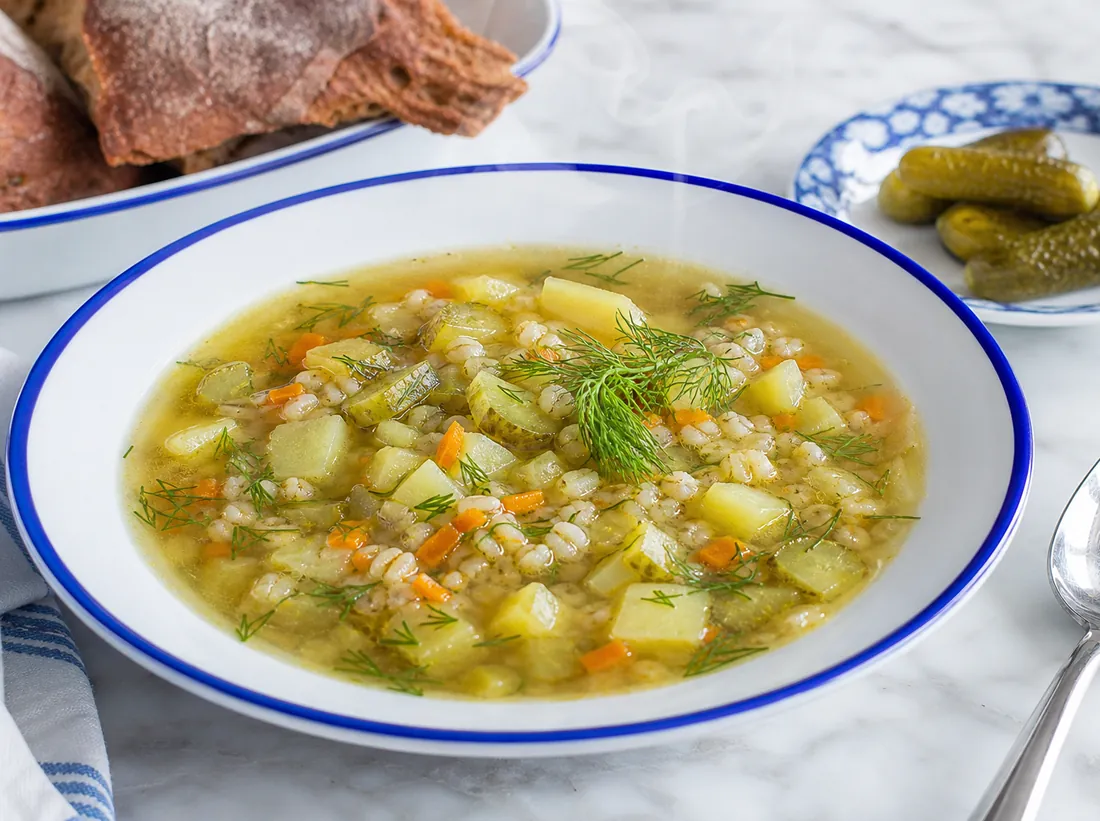
Rassolnik is a tangy Russian soup of pickled cucumbers and their brine, with pearl barley, potatoes, carrot and onion, in chicken broth. It is gentle, warming and filling, and its sourness is round rather than sharp.

Pot calculatorOrder Rassolnik

Dairy freeMeatAllergens:Gluten

Updated

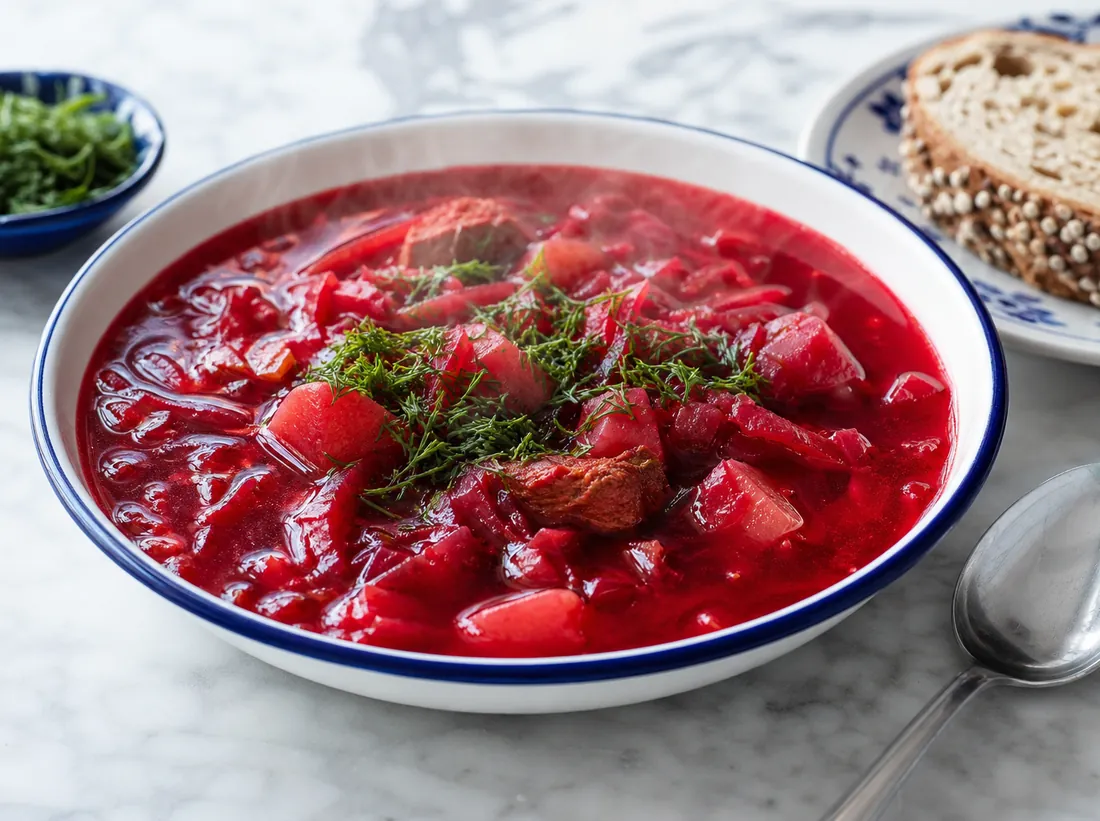
RassolnikIllustration
Time2 h 10 minCook 1 h 30 min · + Soak 2 h
Pot8 bowls3.6 litres
Per bowl317 kcal15.4 g protein · a 450 ml bowl
Cost of the pot₪48for the pot, about ₪6 a bowl

The story of Rassolnik

The name rassolnik comes from the Russian word rassol, brine. It is an old soup of Russian cooking, built on a simple idea: pickle brine is a seasoning. It brings sourness, salt and the smell of dill and garlic all at once. The best-known version is cooked with pearl barley, potatoes and carrot, and there is a lighter version with rice.

In the homes of olim from the former USSR in Israel, rassolnik is an everyday home soup, the kind cooked in a big pot and eaten over several days. Salt-brined pickles, sold in Russian shops in almost every town, are its heart. In Russia it is served with a spoonful of sour cream. In the kosher meat version, made on chicken broth, the cream goes and the dill does the work.

What makes Rassolnik itself

Rassolnik is a gently sour soup, neither spicy nor heavy. What sets it apart is the balance of three things: barley that gives body and a creamy texture, potatoes that give softness, and pickles with their brine that give sourness and salt. The secret is the order. First the potatoes and barley soften, and only then does the sour go in. Cooked the other way round, the potatoes stay hard even after an hour.
Rassolnik for any number of people

Change the number of people and the bowl size, and every ingredient updates in grams, with the cost, calories and protein per bowl.

Bowl size
Units
3.6litres in the pot
5Pot to use, litres
₪48Cost of the pot
₪6.0per bowl
317kcal per bowl
15.4g protein per bowl
IngredientAmountCost
The broth
Chicken thighs, skin on and bone in800 g · 6 pcs₪28
Water2.5 l
Bay leaves1 g · 2 pcs₪0.4
Black peppercorns2 g₪0.3
Barley and vegetables
Pearl barley120 g₪1.3
Potatoes500 g · 4 pcs₪3.0
Onion200 g · 1 pcs₪1.2
Carrot150 g · 1 pcs₪0.7
Parsley root80 g · 1 pcs₪3.2
Canola oil30 ml₪0.5
The sour and the finish
Salt-brined pickled cucumbers350 g · 5 pcs₪6.2
Pickle brine200 ml₪2.8
Salt, only if needed5 g₪0.0
Dill, chopped15 g₪0.9
Send on WhatsApp

Shelf prices at a large Israeli chain and specialty shops, October 2026. Nutrition from the ingredients in grams, before cooking.

How many calories in Rassolnik? Nutrition facts and calorie calculator

Change the amount of any ingredient, drop one, or pick a lighter version, and the numbers per serving update at once: calories, fat, carbs, protein, sodium and fibre.

Rassolnik has 70 calories per 100 ml. A 450 ml bowl made with our recipe has 317 calories: 15.4 g protein, 15.5 g fat and 25.4 g carbohydrates. A 250 ml cup has 176 calories.

Lighter

Ingredients, for the whole recipe

  • 6 pcs155 kcal per serving
  • 2 pcs0 kcal per serving
  • 2 g1 kcal per serving
  • 120 g53 kcal per serving
  • 4 pcs48 kcal per serving
  • 1 pcs10 kcal per serving
  • 1 pcs8 kcal per serving
  • 1 pcs6 kcal per serving
  • 30 ml30 kcal per serving
  • 5 pcs5 kcal per serving
  • 200 ml0 kcal per serving
  • 5 g0 kcal per serving
  • 15 g1 kcal per serving

What each add-on adds to Rassolnik

Values for the amount in the row, from the national food database.

Add-onCaloriesProtein, gFat, g
A tablespoon of oil122013.8
A slice of white bread792.50.5
A slice of challah12641.1
A side cup of cooked rice, about1823.50.3
Chicken breast, 100 g raw12022.52.6
Chicken thigh, 100 g raw12119.74.1

How to make Rassolnik

In cook mode the screen stays on, tap a step when it is done, and the timers run next to each step.
  1. Rinse the barley several times in cold water until the water runs clear, then soak it for two hours.
  2. Put the chicken thighs in a pot with the water, bring to a boil and skim off the foam. Add the bay leaves and peppercorns and simmer gently for 40 minutes.
  3. Lift out the chicken, drain the barley and add it to the broth. Simmer for 30 minutes. Meanwhile pull the chicken off the bones and tear it into pieces.
  4. Fry the chopped onion and the grated carrot and parsley root in the oil for 8 to 10 minutes, until soft and golden.
  5. Peel the pickles if the skin is tough, cut them into thin strips or grate them coarsely, and add them to the pan with a ladle of broth. Cook for 5 minutes.
  6. Add the diced potatoes to the broth and cook for 15 minutes, until almost completely tender.
  7. Only now add the contents of the pan, the vegetables and pickles, and cook for 10 minutes.
  8. Return the chicken, add the brine little by little and taste after each addition. Cook for another 5 minutes, and only then add salt if needed.
  9. Turn off the heat, add chopped dill, cover and rest for a quarter of an hour.

The science of Rassolnik

Kitchen science

Why rassolnik never starts with the sour

The cell walls of a potato are held together by pectin. With heat in a neutral liquid the pectin breaks down and the potato softens. In an acidic liquid this process almost stops, so potatoes cooked with pickles and brine from the start stay hard even after an hour. They need to be nearly tender before the sour goes in.

Kitchen science

Lactic fermentation in the pickle

A cucumber pickled in salt turns sour thanks to lactic acid bacteria, which feed on its sugars and leave lactic acid behind. This acid is softer than the acetic acid in vinegar, and fermentation also creates aromas of dill, garlic and spice. Those aromas are volatile, so the brine goes in at the end, once the soup is already done.

Kitchen science

Barley that thickens

Pearl barley holds starch and also beta-glucan, a soluble fibre that makes liquid thick and smooth. That is what gives rassolnik its creamy body. A good rinse removes the starch on the surface of the grains, and soaking shortens the cooking, so the soup comes out thick rather than gluey.

Kitchen science

A clear chicken broth

When chicken is heated from cold water, soluble proteins leave the meat and set at around 60 to 80 °C into a grey foam that rises to the top. Skim it before the full boil, or it breaks into small particles that cloud the broth. Gentle simmering keeps the broth clear.

Kitchen science

Carrot fried in oil

The orange of carrot comes from beta-carotene, a pigment that dissolves in fat, not in water. When carrot and onion are fried in oil, the oil turns golden and the colour spreads through the whole pot. Frying also concentrates the vegetables' sugars and gives a sweetness that balances the sourness.

Rassolnik in every kitchen

With pearl barley

The classic, thicker version. The barley cooks in the broth for about 45 minutes and gives the soup a creamy texture.

With rice

A lighter, quicker version. 100 g of rice replaces the barley and goes into the broth with the potatoes.

On beef broth

Beef shank or beef bones instead of chicken, simmered for an hour and a half. The broth is darker and richer.

Vegetarian with mushrooms

Water or mushroom stock instead of chicken broth, with dried mushrooms for depth. This version can take sour cream and becomes dairy.

Home style in Israel

Chicken broth, salt-brined pickles from the Russian shop, and sometimes a spoonful of tomato paste fried with the onion for an orange colour.

Common Rassolnik problems and how to fix them

The potatoes in rassolnik stayed hard

The pickles or brine went in before the potatoes had softened, and the acid stopped the softening. If it has already happened, keep cooking for another 20 to 30 minutes. Next time add the sour only when the potatoes are almost tender.

Rassolnik is too salty

Pickle brine is very salty and every jar is different. Dilute with broth or boiling water and cook for a few more minutes. Next time add the brine gradually and do not salt before the final taste.

The barley turned gluey and the soup set like jelly

There was too much barley, or it was not rinsed. Thin with hot broth. Next time rinse well, or cook the barley separately in water, drain it and add it to the soup already cooked.

The barley in rassolnik stayed hard

It was not soaked, or the sour went in too early. Pearl barley needs about 45 minutes of cooking after soaking. Cook until tender, and only then add the pickles.

Rassolnik tastes of vinegar

Vinegar pickles were used. Their taste is sharp and metallic, and even more noticeable in a hot soup. Next time buy salt-brined pickles, and if there are none, add only a very little of the brine.

Storing, freezing and reheating

4 days

In the fridge

3 months

In the freezer

2+4

To cool

Bring it from 60 to 21 °C within two hours and down to 5 °C within four more. Split a big pot into shallow boxes.

75 °C

Reheating

The barley keeps absorbing liquid, so reheat over low heat with a little water or broth, stirring. The potatoes soften slightly in the freezer. Add fresh dill after reheating.

Nutrition of Rassolnik

From our recipe, per bowl and per 100 g, next to the national food database.

ServingkcalProtein, gFat, gCarbs, gFibre, g
Our recipe, a 450 ml bowl31715.415.525.45.7
Our recipe, 100 ml703.43.45.61.3
Typical Rassolnik, 100 g531.40.210.62.0
Typical Rassolnik, 100 g (2)501.20.310.51.0

What the ingredients of Rassolnik cost

What each ingredient costs in one pot, and where to buy it.

IngredientPriceIn this potWhere to buy
Chicken thighs, skin on and bone in₪35 per kg₪28Supermarket
Salt-brined pickled cucumbers₪18 per kg₪6.2Supermarket
Parsley root₪7.9 each₪3.2Greengrocer
Potatoes₪5.9 per kg₪3Greengrocer
Pickle brine₪14 per litre₪2.8Supermarket
Pearl barley₪11 per kg₪1.3Supermarket
Onion₪5.9 per kg₪1.2Greengrocer
Dill, chopped₪4.9 each₪0.9Greengrocer
Carrot₪4.9 per kg₪0.7Greengrocer
Canola oil₪15 per litre₪0.4Supermarket
Bay leaves₪360 per kg₪0.4Supermarket
Black peppercorns₪139 per kg₪0.3Supermarket
Salt, only if needed₪2.1 per kg₪0Supermarket

Shelf prices at a large Israeli chain and specialty shops, October 2026, VAT included. Vegetable prices change with the season.

Make Rassolnik a meal

Shabbat

Ready Shabbat food

Soup, hamin, mains and sides, with a quantity calculator and prices.

Plan Shabbat
Hosting

Hosting trays

9 trays to go with the soup, with a planner by number of guests.

Tray planner
Events

Catering

A whole menu in grams per guest, with a reheating table.

Menus

What to serve with Rassolnik

Serve hot with chopped dill on top and rye bread on the side. A sliced pickle next to the bowl suits anyone who likes it more sour.

Rassolnik in large quantities: events, offices and communities

How much of everything by number of guests, at a 450 ml bowl. For institutional pots, catering and community kitchens.

GuestsLitres30 l potsCost of ingredients
25111₪151
50221₪302
100452₪603
200904₪1,207
5002259₪3,016

Every ingredient for any number of guests is in the calculator above: type the number of people.

Order Rassolnik

A ready pot for Shabbat, an event or the office, ordered ahead.

  • Cooked to order, for Shabbat, an event or the office.
  • Tell us how many people and when, and we send a quote.
  • Delivery in Tel Aviv from ₪35, free over ₪750.

Order Rassolnik for a large event

Large orders in Israel and abroad: events, offices, synagogues, communities and institutions.

  • In Israel: cooked in Tel Aviv and delivered to events in the area, and to large events anywhere in the country on a quote.
  • Abroad: for communities, events and restaurants. Tell us where, how many and when, and we come back with a quote and options.
  • Institutional quantities and a shopping list for any number of guests, in the calculator above.

Frequently asked questions

What is rassolnik?

A Russian soup of pickled cucumbers and their brine, with pearl barley or rice, potatoes, carrot and onion. The name comes from the Russian word rassol, brine.

Rassolnik with barley or with rice?

Both are standard. With pearl barley the soup is thicker and creamier and takes longer to cook. With rice it is lighter and ready sooner.

Which pickles are best for rassolnik?

Salt-brined, fermented pickles, like the ones sold in Russian shops. Vinegar pickles give a sourness that is too sharp.

Why do the pickles go into rassolnik at the end?

Because acid stops the potatoes and barley from softening. Add them only once the potatoes are almost tender, which also keeps the aroma of the brine.

Can rassolnik be made vegetarian?

Yes. Cook it in water or mushroom stock, with dried mushrooms for depth. That version can take sour cream and become dairy.

Is rassolnik served with sour cream?

In Russia, yes. Rassolnik on chicken or beef broth, like this one, is served without cream, with dill. Only the vegetarian version can take sour cream.

How long does rassolnik keep in the fridge?

Up to 4 days in a closed container. It thickens in the fridge, so add a little water when reheating.

How many calories are in Rassolnik?

A 450 ml bowl of Rassolnik made with our recipe has about 317 calories and 15.4 g of protein. Per 100 ml: 70 calories.

How much does it cost to make Rassolnik at home?

A pot of 8 bowls costs about ₪48 at Israeli shelf prices in October 2026, about ₪6 a bowl. The calculator above works it out for any number of people.

Every soup in Israel

75 soups, each with a pot calculator, a price list and the science. Search by community, time, calories or cost.

All the soups