Tarator

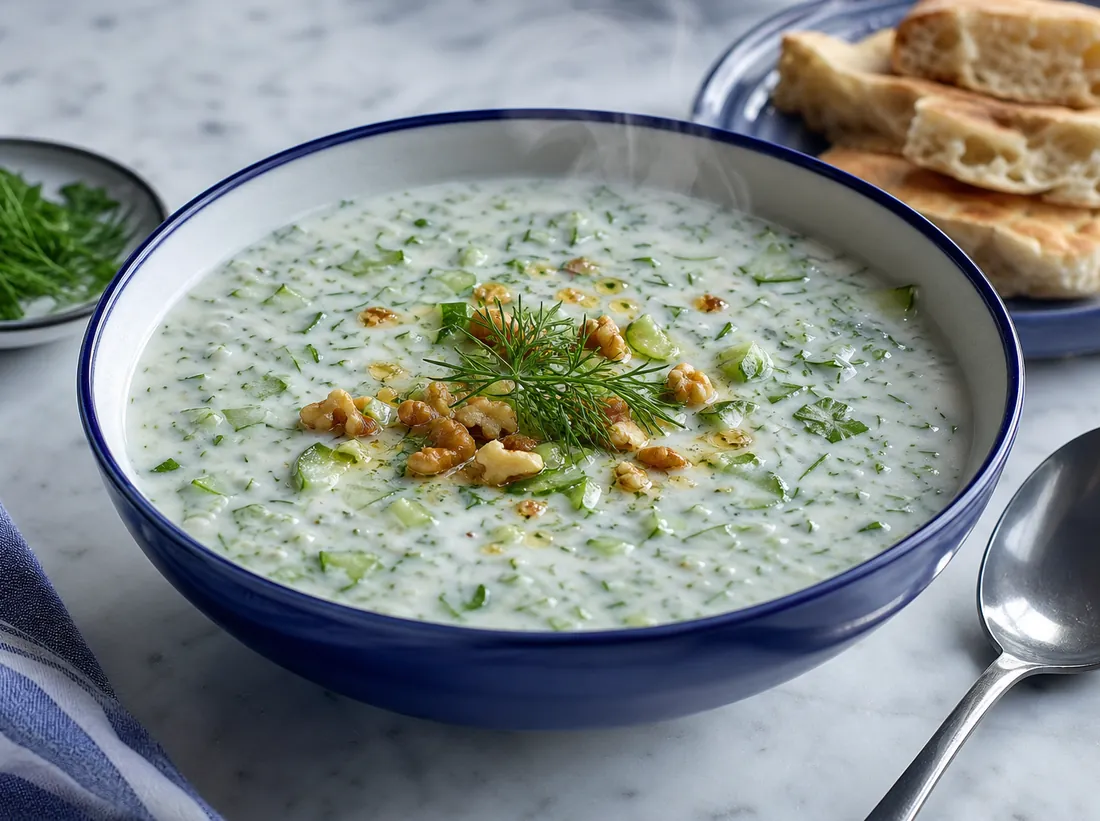
Tarator is Bulgaria's cold summer soup: tangy yogurt thinned with cold water, chopped cucumbers, garlic, dill, walnuts and sunflower oil. Nothing is cooked; you mix, chill for an hour and serve it very cold.

Pot calculatorOrder Tarator

VegetarianGluten freeDairyAllergens:MilkTree nuts

Updated

TaratorIllustration
Time1 h 15 min
Pot6 bowls1.8 litres
Per bowl229 kcal9.6 g protein · a 300 ml bowl
Cost of the pot₪27for the pot, about ₪4.5 a bowl

The story of Tarator

In Bulgaria yogurt is almost a national symbol. One of the bacteria that sour yogurt is named after Bulgaria, and Bulgarian yogurt is known for its sharp tang. In the summer heat it is thinned with cold water, cucumber and dill to make tarator, a soup eaten with a spoon and also drunk from a glass on a hot day.

The name tarator is confusing, because in every country it is something else. In Lebanon and Syria tarator is a tahini sauce with lemon and garlic served with fish, and in Turkey it is a sauce of walnuts, bread and garlic. The yogurt and cucumber mix is called cacık in Turkey and tzatziki in Greece. Immigrants from Bulgaria, many of whom settled in Jaffa in the early years of the state, brought Bulgarian tarator into the Israeli kitchen.

What makes Tarator itself

Tarator is a soup with no heat, so everything depends on balance. The yogurt brings sourness, the garlic bite, the dill freshness and the walnuts depth and crunch. It is thinner than tzatziki but not watery: the right texture is that of buttermilk or kefir. And because it is eaten very cold, it is seasoned after chilling, since cold dulls salt.
Tarator for any number of people

Change the number of people and the bowl size, and every ingredient updates in grams, with the cost, calories and protein per bowl.

Bowl size
Units
1.8litres in the pot
3Pot to use, litres
₪27Cost of the pot
₪4.5per bowl
229kcal per bowl
9.6g protein per bowl
IngredientAmountCost
The base
Plain 3% yogurt or Bulgarian yogurt1 kg₪16
Ice cold water500 ml
Cucumbers, finely diced or coarsely grated600 g · 6 pcs₪4.7
Garlic cloves, crushed10 g · 3 pcs₪0.4
Chopped dill25 g₪1.5
Salt8 g₪0.0
To finish
Walnuts, roughly chopped60 g₪4.2
Sunflower or canola oil30 ml₪0.5
Send on WhatsApp

Shelf prices at a large Israeli chain and specialty shops, October 2026. Nutrition from the ingredients in grams, before cooking.

How many calories in Tarator? Nutrition facts and calorie calculator

Change the amount of any ingredient, drop one, or pick a lighter version, and the numbers per serving update at once: calories, fat, carbs, protein, sodium and fibre.

Tarator has 76 calories per 100 ml. A 300 ml bowl made with our recipe has 229 calories: 9.6 g protein, 16.4 g fat and 10.4 g carbohydrates. A 250 ml cup has 191 calories.

Lighter

Ingredients, for the whole recipe

  • 1,000 g108 kcal per serving
  • 6 pcs11 kcal per serving
  • 3 pcs2 kcal per serving
  • 25 g2 kcal per serving
  • 8 g0 kcal per serving
  • 60 g65 kcal per serving
  • 30 ml41 kcal per serving

What each add-on adds to Tarator

Values for the amount in the row, from the national food database.

Add-onCaloriesProtein, gFat, g
A tablespoon of oil122013.8
A slice of white bread792.50.5
A slice of challah12641.1
30 g feta744.56
30 g soft white cheese, 5%292.71.5
2 tablespoons sour cream480.84.5

How to make Tarator

In cook mode the screen stays on, tap a step when it is done, and the timers run next to each step.
  1. Wash the cucumbers. Small Israeli cucumbers need no peeling; peel any with thick or waxed skin. Cut into half centimetre dice or grate coarsely.
  2. In a large bowl mix the cucumbers with the salt and crushed garlic and leave for 10 minutes. The juice that comes out stays in the bowl.
  3. In a separate bowl whisk the yogurt until smooth and glossy, then add the cold water gradually, whisking all the time, until it has the texture of buttermilk.
  4. Pour the yogurt over the cucumbers, add the dill and half the oil, and stir.
  5. Cover and refrigerate for at least an hour and up to 4 hours.
  6. Meanwhile toast the walnuts in a dry pan over medium heat for 3 to 4 minutes, until fragrant, and let them cool.
  7. After chilling, taste and correct the salt, because cold dulls the flavour. If the soup is thick, add a little more cold water.
  8. Serve in chilled bowls with walnuts and a drizzle of the remaining oil on top, and on a very hot day an ice cube in each bowl.

The science of Tarator

Kitchen science

Why the yogurt is whisked before the water

Yogurt is a gel of milk proteins, casein, that forms when lactic acid lowers the pH to around 4.5. Whisking breaks the gel into a smooth, thick liquid, and water added gradually spreads through it evenly. Water poured all at once onto unwhisked yogurt leaves lumps floating in a thin liquid.

Kitchen science

What salt does to the cucumber

Salt on the cut surface of a cucumber draws water out by osmosis, and the juice runs within minutes. In tzatziki the juice is squeezed out so the dip stays thick; in tarator it stays in the soup, because it adds a fresh cucumber flavour.

Kitchen science

Why you season after chilling

In the cold the tongue senses less salt and less sweetness, and aroma compounds evaporate more slowly, so they are noticed less. A tarator seasoned perfectly at room temperature tastes flat straight from the fridge, so taste and correct the salt only after an hour of chilling.

Kitchen science

Why tarator separates

Over time the casein network in yogurt contracts and squeezes out whey, a process called syneresis. In a thinned soup it happens faster, and a clear layer appears on top. It is completely natural; just stir before serving.

Tarator in every kitchen

Classic Bulgarian

Finely diced cucumbers, dill, garlic, chopped walnuts and sunflower oil, with yogurt thinned with water into a soup. This is the recipe here.

Snezhanka salad

The same ingredients with thick strained yogurt and no water, and cucumber squeezed of its juice. In Bulgaria it is a salad, and its name means Snow White.

Turkish cacık

Yogurt with cucumber, garlic and dried mint, sometimes dill, with olive oil on top. Some serve it thick as a dip and some thin it into a cold bowl, usually without nuts.

Greek tzatziki

Thick strained yogurt, grated and squeezed cucumber, garlic, olive oil and vinegar or lemon. It is a dip, not a soup.

Persian, ab doogh khiar

Yogurt or doogh with cucumber, dried mint, walnuts, raisins and dried rose petals, topped with pieces of dry bread and ice cubes.

Common Tarator problems and how to fix them

My tarator came out thin and watery

There was too much water, or the yogurt was low fat. Add more whisked yogurt, and next time add the water gradually and stop when the soup has the texture of buttermilk.

There are lumps of yogurt in the soup

The yogurt was not whisked before the water went in. Whisk well, and if the lumps are stubborn, blend part of the soup with a stick blender for a few seconds and return it to the bowl.

The tarator tastes bitter

There were cucumbers with bitter ends, or old walnuts whose oil had turned rancid. Taste every cucumber and the walnuts before adding them, and keep walnuts in the fridge.

There is too much garlic

Add more yogurt and water in the same proportion, and a little dill. Next time start with 2 cloves, because the bite grows in the fridge.

The tarator separated in the fridge

Whey seeps out of yogurt as it stands. That is normal: stir well before serving, and whisk again for a few seconds if needed.

Storing, freezing and reheating

2 days

In the fridge

Do not freeze

In the freezer

2+4

To cool

Bring it from 60 to 21 °C within two hours and down to 5 °C within four more. Split a big pot into shallow boxes.

75 °C

Reheating

Never heat it. Serve very cold, straight from the fridge, and stir before serving.

Nutrition of Tarator

From our recipe, per bowl and per 100 g, next to the national food database.

ServingkcalProtein, gFat, gCarbs, gFibre, g
Our recipe, a 300 ml bowl2299.616.410.43.1
Our recipe, 100 ml763.25.53.51.0

What the ingredients of Tarator cost

What each ingredient costs in one pot, and where to buy it.

IngredientPriceIn this potWhere to buy
Plain 3% yogurt or Bulgarian yogurt₪16 per kg₪16Supermarket
Cucumbers, finely diced or coarsely grated₪7.9 per kg₪4.7Greengrocer
Walnuts, roughly chopped₪70 per kg₪4.2Supermarket
Chopped dill₪4.9 each₪1.5Greengrocer
Sunflower or canola oil₪15 per litre₪0.4Supermarket
Garlic cloves, crushed₪34 per kg₪0.3Greengrocer
Salt₪2.1 per kg₪0Supermarket

Shelf prices at a large Israeli chain and specialty shops, October 2026, VAT included. Vegetable prices change with the season.

Make Tarator a meal

Shabbat

Ready Shabbat food

Soup, hamin, mains and sides, with a quantity calculator and prices.

Plan Shabbat
Hosting

Hosting trays

9 trays to go with the soup, with a planner by number of guests.

Tray planner
Events

Catering

A whole menu in grams per guest, with a reheating table.

Menus

What to serve with Tarator

Serve very cold in bowls or glasses chilled in the fridge, as a starter at a dairy summer meal, with fresh bread, cheeses, eggs or bourekas.

Tarator in large quantities: events, offices and communities

How much of everything by number of guests, at a 300 ml bowl. For institutional pots, catering and community kitchens.

GuestsLitres30 l potsCost of ingredients
257.51₪113
50151₪226
100302₪451
200603₪903
5001506₪2,257

Every ingredient for any number of guests is in the calculator above: type the number of people.

Order Tarator

A ready pot for Shabbat, an event or the office, ordered ahead.

  • Cooked to order, for Shabbat, an event or the office.
  • Tell us how many people and when, and we send a quote.
  • Delivery in Tel Aviv from ₪35, free over ₪750.

Order Tarator for a large event

Large orders in Israel and abroad: events, offices, synagogues, communities and institutions.

  • In Israel: cooked in Tel Aviv and delivered to events in the area, and to large events anywhere in the country on a quote.
  • Abroad: for communities, events and restaurants. Tell us where, how many and when, and we come back with a quote and options.
  • Institutional quantities and a shopping list for any number of guests, in the calculator above.

Frequently asked questions

What is tarator?

Tarator is a cold Bulgarian soup of yogurt thinned with water, cucumbers, garlic, dill and walnuts, served very cold in summer. It is not cooked at all.

What is the difference between tarator and tzatziki?

Tarator is a soup: yogurt thinned with water, with the cucumber juice left in. Tzatziki is a thick dip of strained yogurt and squeezed cucumber. The seasonings are almost the same.

Is tarator also a tahini sauce?

Yes, in Lebanon and Syria tarator is a sauce of tahini, lemon and garlic served with fish. It is a completely different food with the same name, and has nothing to do with the Bulgarian soup.

Which yogurt is best for tarator?

Bulgarian yogurt, the sourest, or ordinary 3% yogurt. Fat free yogurt makes a watery soup, and Greek yogurt or labneh need more water.

How long does tarator keep in the fridge?

Up to two days in a closed container. The cucumbers soften and the garlic grows stronger, so it is best on the day it is made. Do not freeze it.

Can I make tarator without nuts?

Yes. The walnuts add depth and crunch but are not essential, and many families serve them separately so everyone can add as much as they like.

How many calories are in Tarator?

A 300 ml bowl of Tarator made with our recipe has about 229 calories and 9.6 g of protein. Per 100 ml: 76 calories.

How much does it cost to make Tarator at home?

A pot of 6 bowls costs about ₪27 at Israeli shelf prices in October 2026, about ₪4.5 a bowl. The calculator above works it out for any number of people.

Every soup in Israel

75 soups, each with a pot calculator, a price list and the science. Search by community, time, calories or cost.

All the soups