The story of Chopped liver
The beginnings of chopped liver are usually traced to the Jews of Germany and Alsace, who raised geese, so the first versions were made with goose liver and goose fat. As communities moved east into Poland and Lithuania, the chicken took the goose's place, and chicken liver with schmaltz, rendered chicken fat, became the familiar version. In a kosher kitchen fat was a serious matter: butter is forbidden with meat and olive oil was rare and expensive, so chicken fat was the fat of the house, and nothing from the bird went to waste.
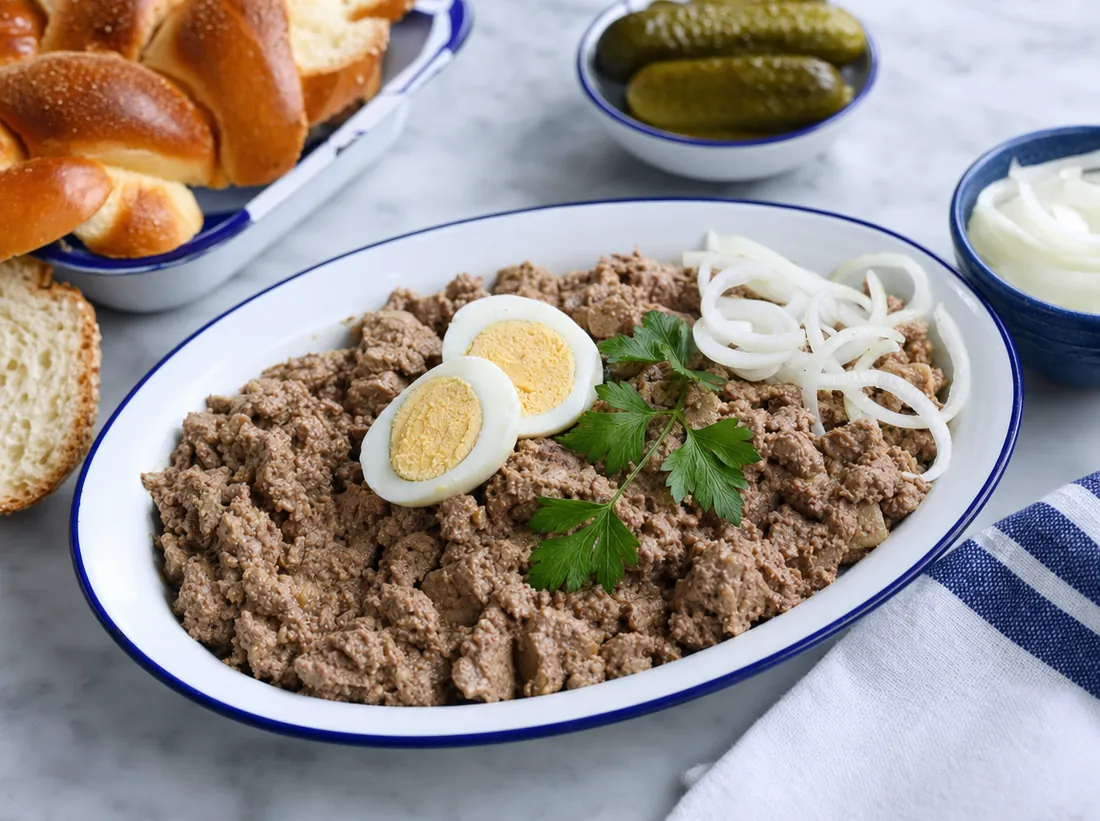
At the end of the 19th century immigrants brought it to America, and in the New York delis it became an institution: a mound of liver on rye bread, with a pickle on the side. That is also where the phrase what am I, chopped liver? was born, said by someone who feels treated like a side dish. In Israel it joined the Friday table of Ashkenazi homes, then the homes of other communities, the butchers and the delis, and in recent years new versions with onion jam.
What makes Chopped liver itself
Good chopped liver is a balance of three things: the liver gives depth and a mineral taste, the fried onion gives sweetness, and the egg softens and lightens. Because it is kashered by broiling, kosher chicken liver is drier than the liver in a French pâté, so the fat and onions here are not decoration but part of the structure. The texture is coarse, not smooth, and it is served cold, but not straight from the fridge.