Gefilte fish

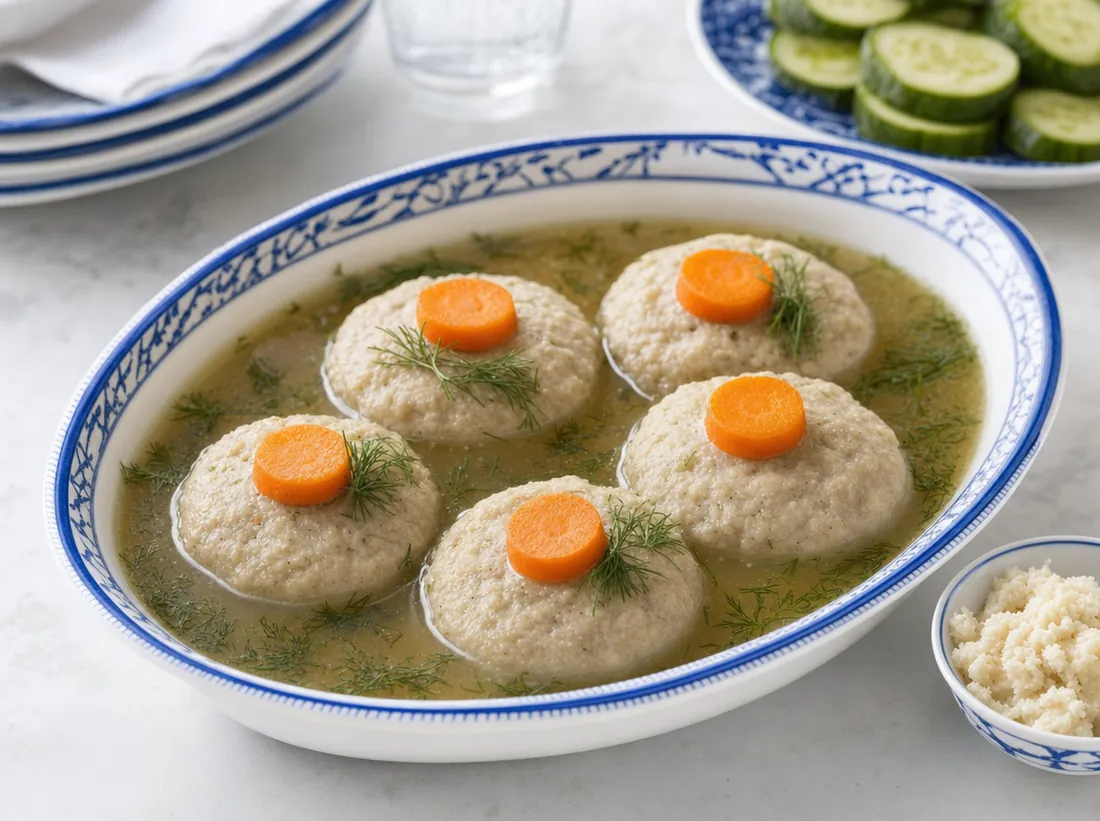
Gefilte fish are patties of ground fish, usually carp, with onion, egg and matzo meal, poached slowly in a broth of fish heads and carrots and served cold, with a carrot round on top, jelly from the broth and chrain. It is the opening course of Friday night, Rosh Hashanah and the Passover seder in Ashkenazi homes.

Quantity calculatorOrder Gefilte fish

Dairy freeParveAllergens:GlutenEggsFish

Updated

Gefilte fishIllustration
Time7 hCook 1 h 50 min
Amount12 portions1.8 kg
Per portion188 kcal19 g protein · a 150 g portion
Cost of the pot₪73for the pot, about ₪6.1 a bowl

The story of Gefilte fish

Gefilte means stuffed in Yiddish, and at first that is exactly what it was: a fish skin filled with the ground flesh mixed with onion and breadcrumbs, or thick slices of fish with the filling packed into them around the backbone. In Ashkenazi communities fish was Shabbat food, and grinding also solved a question of Jewish law: whoever eats ground fish does not need to separate bones on Shabbat. Little by little the filling itself became the dish, and the skin was left out.

Yiddish scholars found that the sweetness of gefilte fish follows the map of the dialects: in Poland and Galicia, where a beet sugar industry grew in the 19th century, gefilte fish is eaten sweet, while in Lithuania and the north east it is peppery and sugarless. They jokingly called the border the gefilte fish line. In Israel carp from the fish ponds became the fish of the dish, and in many homes, as in old Poland, it was bought alive and swam in the bathtub until cooking day.

What makes Gefilte fish itself

Good gefilte fish is a soft, airy, pale patty that holds its shape on the spoon but melts in the mouth, in a broth that sets to clear jelly. Carp gives fat, moisture and a delicate taste, and a lean white fish lightens the texture. Sweet or peppery is a family matter: sweet in a Polish home, peppery in a Lithuanian one, and in Israel usually something in between. What never changes is the cooking: a very gentle, long simmer, and several hours of chilling at least.
Gefilte fish for any number of people

Change the number of people and the portion size, and every ingredient updates in grams, with the cost, calories and protein per portion.

Portion size
Units
1.8kg of food
3Pot to use, litres
₪73Cost of the pot
₪6.1per portion
188kcal per portion
19.0g protein per portion
IngredientAmountCost
The mixture
Carp fillet, skinless and boneless700 g₪28
White fish fillet, such as sea bass or tilapia300 g₪27
Onions, for grinding250 g · 2 pcs₪1.5
Eggs165 g · 3 pcs₪4.0
Matzo meal50 g₪0.7
Ice cold water100 g
Salt14 g₪0.0
Ground white pepper3 g₪0.8
Sugar, for the sweet Polish style20 g₪0.1
The broth
Fish heads without gills, bones and skin600 g₪7.2
Onions, sliced300 g · 2 pcs₪1.8
Carrots, in rounds400 g · 4 pcs₪2.0
Water2.5 kg
Salt for the broth12 g₪0.0
Sugar for the broth25 g₪0.1
Black pepper2 g₪0.3
Send on WhatsApp

Shelf prices at a large Israeli chain and specialty shops, October 2026. Nutrition from the ingredients in grams, before cooking.

How many calories in Gefilte fish? Nutrition facts and calorie calculator

Change the amount of any ingredient, drop one, or pick a lighter version, and the numbers per serving update at once: calories, fat, carbs, protein, sodium and fibre.

Gefilte fish has 125 calories per 100 g. A 150 g serving made with our recipe has 188 calories: 19 g protein, 5.6 g fat and 13.5 g carbohydrates.

Ingredients, for the whole recipe

  • 700 g76 kcal per serving
  • 300 g23 kcal per serving
  • 2 pcs8 kcal per serving
  • 3 pcs20 kcal per serving
  • 50 g16 kcal per serving
  • 14 g0 kcal per serving
  • 3 g1 kcal per serving
  • 20 g6 kcal per serving
  • 600 g5 kcal per serving
  • 2 pcs10 kcal per serving
  • 4 pcs14 kcal per serving
  • 12 g0 kcal per serving
  • 25 g8 kcal per serving
  • 2 g0 kcal per serving

What each add-on adds to Gefilte fish

Values for the amount in the row, from the national food database.

Add-onCaloriesProtein, gFat, g
One large egg837.35.5
A tablespoon of oil122013.8

How to make Gefilte fish

In cook mode the screen stays on, tap a step when it is done, and the timers run next to each step.
  1. Ask the fishmonger to fillet the fish and to give you the heads, bones and skin separately. Remove the gills from the heads, because they make the broth bitter.
  2. Broth: in a wide pot of at least 6 litres, place the heads, bones and skin, the sliced onions and the carrot rounds. Add the water and the broth's salt, sugar and pepper, bring to a boil, skim the foam and simmer for 20 minutes over low heat.
  3. Mixture: grind the fish fillets with the onions twice through a meat grinder with a fine plate, or pulse in a food processor until fine but not a smooth paste.
  4. Add the eggs, matzo meal, salt, pepper and sugar, then the cold water gradually, stirring in one direction for 5 minutes, until the mixture is sticky, pale and holds its shape. Chill for 30 minutes.
  5. Test the seasoning: poach a teaspoon of the mixture in the broth for 5 minutes, taste and correct the salt, sugar and pepper.
  6. With wet hands shape 24 oval patties of about 65 g and lower them one by one into the gently bubbling broth, in a single layer. If needed, add boiling water until the broth barely covers them.
  7. Partly cover and cook for 90 minutes at a very gentle simmer. Do not stir with a spoon, just shake the pot now and then.
  8. Cool in the broth for 30 minutes and move the patties to a serving dish, with a carrot round on each. Strain the broth through a fine sieve, and if it is thin, boil it down to about 750 ml.
  9. Pour a little broth around the patties and chill for at least 4 hours, until the broth sets to jelly. Serve cold, with chrain.

The science of Gefilte fish

Kitchen science

What holds gefilte fish together

Salt dissolves the fish's muscle proteins, myosin and actin, and stirring turns them into a sticky paste. When heated, these proteins unfold and link into an elastic gel, the same principle behind the fish cakes of Japanese cooking. Egg strengthens the network, and matzo meal absorbs water and lightens it. Without enough salt and stirring, the patties crumble.

Kitchen science

Why a gentle simmer, not a boil

A patty holds air and water. In a hard boil they expand fast, and the patty cracks, or puffs up and shrinks into rubber. At a gentle simmer, just below boiling, the heat travels in slowly and the gel forms evenly. After 90 minutes the centre is long past the 63°C at which fish is safe to eat.

Kitchen science

Where the jelly comes from

Fish skin, bones and heads contain collagen, which breaks down into gelatin during long cooking and passes into the broth. As it chills, the gelatin molecules link up again and the broth sets. Fish gelatin melts at a lower temperature than beef gelatin, so gefilte jelly melts quickly on the table and is served straight from the fridge.

Kitchen science

Why carp

Carp is a fairly fatty freshwater fish with delicate white flesh and collagen rich skin, so it gives moist patties and a broth that sets well. Its flesh has fine, forked bones that are hard to remove, and grinding solves them. Lean fish alone gives dry patties, so carp is mixed with a white fish.

Kitchen science

Sugar in gefilte fish

Sugar does more than sweeten: it softens saltiness, mutes bitterness and sharp fishy notes, and strengthens the natural sweetness of onion and carrot. That is why sweet gefilte fish tastes gentler. Pepper, through piperine, does the opposite job: it sharpens and highlights the taste of the fish.

Gefilte fish in every kitchen

Polish and Galician, the sweet one

Sugar in the mixture and the broth, raw ground onion and sweetish carrots. The patties are pale and soft, and this is the most common version in Israel.

Lithuanian, the peppery one

No sugar, plenty of black or white pepper, and sometimes fried onion in the mixture. The taste is saltier and fishier, and the patties are slightly firmer.

The stuffed fish of the past

A whole carp is cut into thick slices, the flesh is removed, ground and packed back into the rings around the bone and skin, and everything poaches in the broth. A whole ring with its skin is served on the plate.

American, whitefish and pike

In North America it is made from lake whitefish and pike, sometimes as a frozen loaf poached or baked in its paper. In jars of jelly it is sold in almost every kosher supermarket.

French pike quenelles

In Lyon, quenelles are made from ground pike with eggs and a soft dough, poached in water and served hot in a sauce. They are a distant relative of gefilte fish, from the same family of poached fish dumplings.

North African fish balls in sauce

In the homes of Moroccan and Tunisian Jews, ground fish balls with garlic and coriander are cooked in a hot tomato and paprika sauce for Shabbat and the holidays. They are the Sephardi sister of gefilte fish, hot and red instead of cold and clear.

Common Gefilte fish problems and how to fix them

My gefilte fish falls apart while cooking

The mixture is too wet, was not chilled or not stirred enough, or the broth boiled hard. Stir with the salt for 5 minutes until sticky, chill for half an hour, and cook only at a gentle simmer. You can add a spoonful of matzo meal.

Gefilte fish came out hard and rubbery

Too much matzo meal, grinding to too smooth a paste, or a hard boil. Keep to about 50 g of matzo meal per kilo of fish, add the cold water, and cook at a simmer that barely moves.

My gefilte fish tastes muddy

Carp picks up this taste from algae and bacteria in the pond, through a compound called geosmin. Buy fresh carp from a shop you trust, remove the dark strip along the side, and mix it with white fish. Onion, sugar or pepper balance what remains.

The gefilte broth did not set to jelly

There were too few heads and skins, or too much water. Boil the strained broth down to about 750 ml, and test a spoonful on a plate chilled in the freezer. Next time ask for more skin and heads.

The broth is bitter

The gills were left in the heads, or the broth boiled hard on the bones for hours. Remove the gills, skim the foam at the start, and cook the broth only at a gentle simmer.

My gefilte fish is bland

The raw mixture should be seasoned more strongly than seems right, because the cold dulls taste. Poach a small test patty before shaping, taste and correct.

Storing, freezing and reheating

4 days, in the jelly

In the fridge

2 months for cooked patties, without the jelly

In the freezer

2+4

To cool

Bring it from 60 to 21 °C within two hours and down to 5 °C within four more. Split a big pot into shallow boxes.

75 °C

Reheating

Serve cold. Thaw overnight in the fridge and make fresh jelly from broth kept separately. If you like gefilte fish warm, reheat it in the broth over low heat.

Nutrition of Gefilte fish

From our recipe, per bowl and per 100 g, next to the national food database.

ServingkcalProtein, gFat, gCarbs, gFibre, g
Our recipe, a 150 g portion18819.05.613.51.9
Our recipe, 100 g12512.63.79.01.3
Typical Gefilte fish, 100 g19913.712.86.90.8

What the ingredients of Gefilte fish cost

What each ingredient costs in one pot, and where to buy it.

IngredientPriceIn this potWhere to buy
Carp fillet, skinless and boneless₪40 per kg₪28Market
White fish fillet, such as sea bass or tilapia₪90 per kg₪27Supermarket
Fish heads without gills, bones and skin₪12 per kg₪7.2Specialty shop
Eggs₪1.4 each₪4Supermarket
Onions, for grinding₪5.9 per kg₪3.2Greengrocer
Carrots, in rounds₪4.9 per kg₪2Greengrocer
Ground white pepper₪250 per kg₪0.8Supermarket
Matzo meal₪14 per kg₪0.7Supermarket
Black pepper₪139 per kg₪0.3Supermarket
Sugar, for the sweet Polish style₪5.5 per kg₪0.2Supermarket
Salt₪2.1 per kg₪0.1Supermarket

Shelf prices at a large Israeli chain and specialty shops, October 2026, VAT included. Vegetable prices change with the season.

Gefilte fish and its culture

Gefilte fish is an opening course. On Friday night it follows kiddush and challah, on Rosh Hashanah it is part of the festive table, and at the seder it is the first course after the Haggadah reading. Fish and meat are customarily eaten separately, so the fish is a course of its own, before the soup and the meat. In many homes the cooking itself is a family tradition of a whole day: grandmother decides how much sugar, the grandchildren shape the patties, and the whole kitchen smells of onion and fish.

In the diaspora gefilte fish moved partly from the kitchen to the jar: in the United States, Britain and Canada it is sold in jars and frozen loaves before Passover, and yet many families still make it at home for the holidays. Communities and synagogues around the world order it in quantity for the communal seder, because cooking hundreds of patties needs big pots, a day's work and room in the fridge for a whole night.

Make Gefilte fish a meal

Shabbat

Ready Shabbat food

Soup, hamin, mains and sides, with a quantity calculator and prices.

Plan Shabbat
Hosting

Hosting trays

9 trays to go with the soup, with a planner by number of guests.

Tray planner
Events

Catering

A whole menu in grams per guest, with a reheating table.

Menus

What to serve with Gefilte fish

Serve cold, one or two patties per plate, with a carrot round on top, cubes of jelly and red chrain of beetroot and horseradish. Next to challah, as the opening of Friday night, Rosh Hashanah and the seder.

Gefilte fish in large quantities: events, offices and communities

How much of everything by number of guests, at a 150 g portion. For trays, catering and community kitchens.

Guestskg of food3 kg traysCost of ingredients
253.82₪153
507.53₪305
100155₪611
2003010₪1,222
5007525₪3,055

Every ingredient for any number of guests is in the calculator above: type the number of people.

Order Gefilte fish

A ready pot for Shabbat, an event or the office, ordered ahead.

  • Cooked to order, for Shabbat, an event or the office.
  • Tell us how many people and when, and we send a quote.
  • Delivery in Tel Aviv from ₪35, free over ₪750.

Order Gefilte fish for a large event

Large orders in Israel and abroad: events, offices, synagogues, communities and institutions.

  • In Israel: cooked in Tel Aviv and delivered to events in the area, and to large events anywhere in the country on a quote.
  • Abroad: for communities, events and restaurants. Tell us where, how many and when, and we come back with a quote and options.
  • Institutional quantities and a shopping list for any number of guests, in the calculator above.

Frequently asked questions

What is the difference between sweet and peppery gefilte fish?

Sweet is the version of Poland and Galicia, with sugar in the mixture and the broth. Peppery is the Lithuanian version, with no sugar and plenty of pepper. Yiddish scholars mapped the border between them and called it the gefilte fish line.

Which fish goes into gefilte fish?

In Israel mainly carp, alone or with a white fish such as sea bass or tilapia. In America whitefish and pike. Any kosher fish, with fins and scales, will do, and a mix of a fatty fish and a lean one gives the best texture.

Why is it called gefilte fish?

In Yiddish gefilte means stuffed. At first the skin or slices of the fish itself were filled with the ground fish, and over time only the patties remained.

How long do you cook gefilte fish?

About an hour and a half at a very gentle simmer for patties of about 65 g, and an hour for small ones. Then cool in the broth and chill for at least 4 hours.

Can I make gefilte fish for Passover?

Yes, with matzo meal, if you eat gebrokts. If you do not, replace the matzo meal with potato starch, and add an egg if the mixture is too soft.

Can I freeze gefilte fish?

Yes. Cooked patties freeze well for up to two months, without the jelly. Thaw overnight in the fridge and serve with fresh jelly from broth kept separately.

How much gefilte fish do I need for an event or a seder?

One large or two small patties per guest as a first course. This recipe makes 24 patties, enough for 12 to 20 guests, and for 50 guests make about three times the amount.

How many calories are in Gefilte fish?

A 150 g portion of Gefilte fish made with our recipe has about 188 calories and 19 g of protein. Per 100 g: 125 calories.

How much does it cost to make Gefilte fish at home?

A tray or pot of 12 portions costs about ₪73 at Israeli shelf prices in October 2026, about ₪6.1 a portion. The calculator above works it out for any number of people.

Every dish

Home dishes of every community, each with a calculator, a price list and the science.

All the dishes