Jachnun

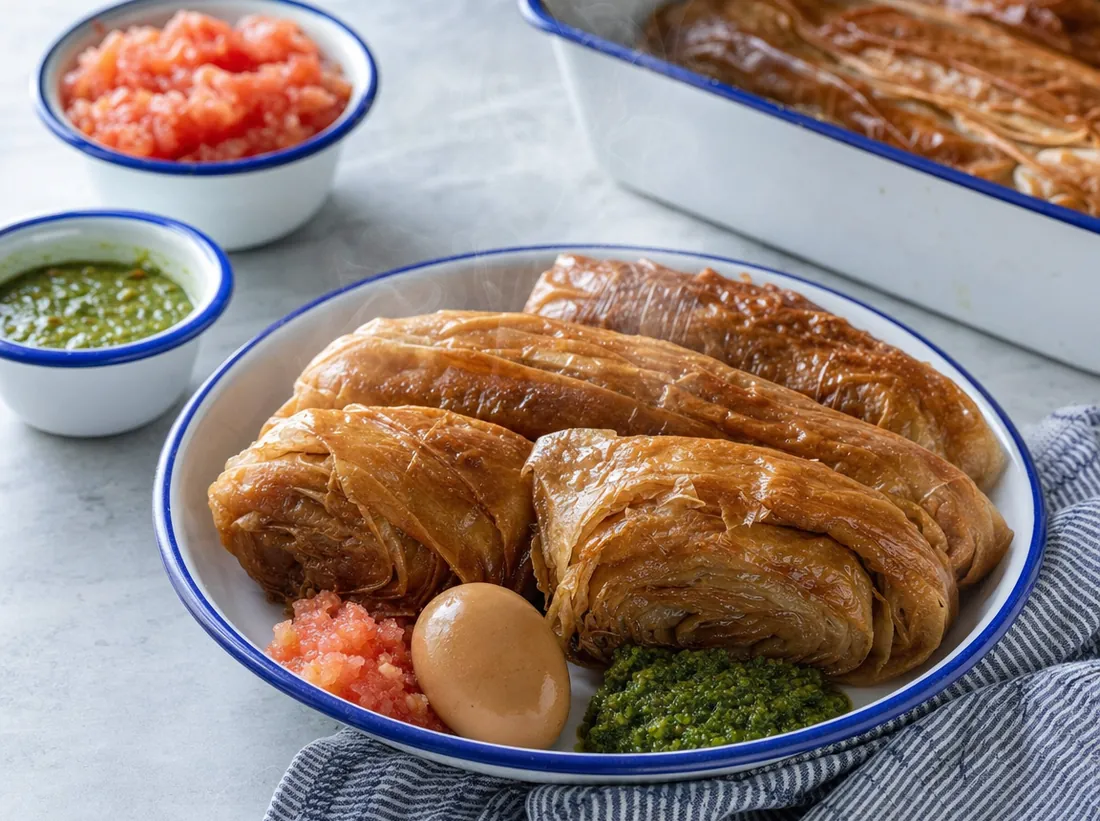
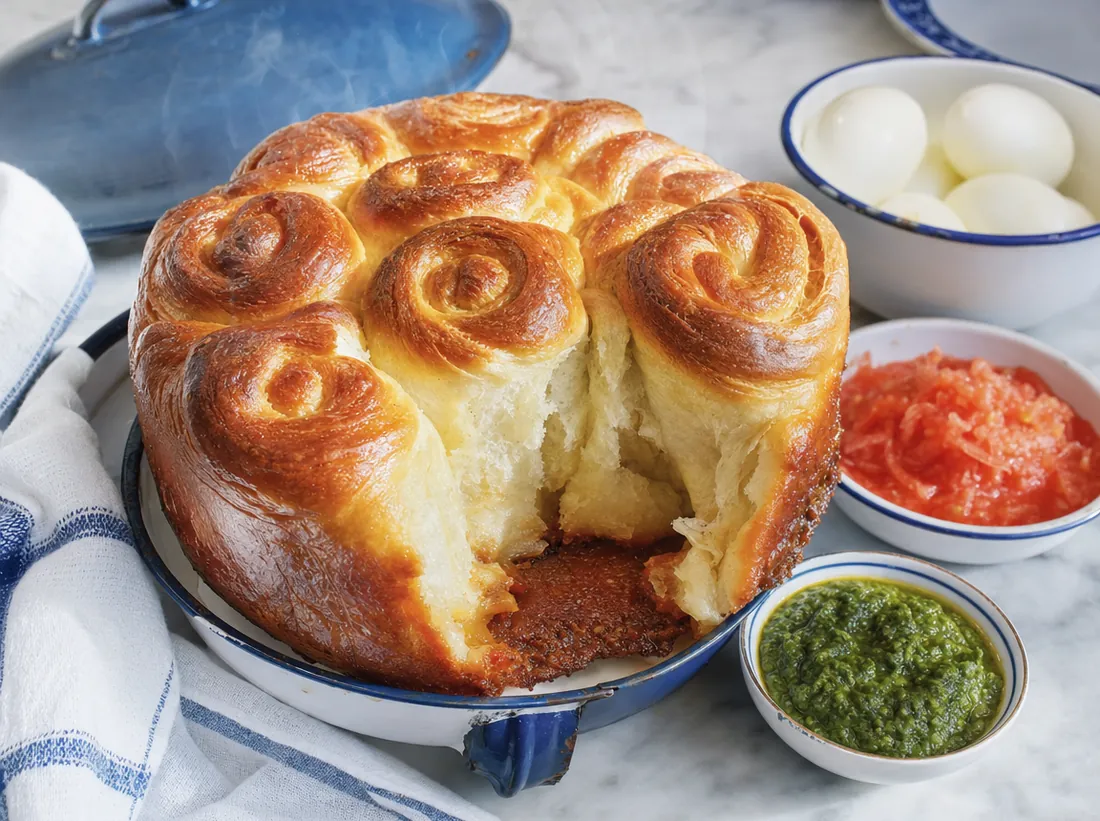
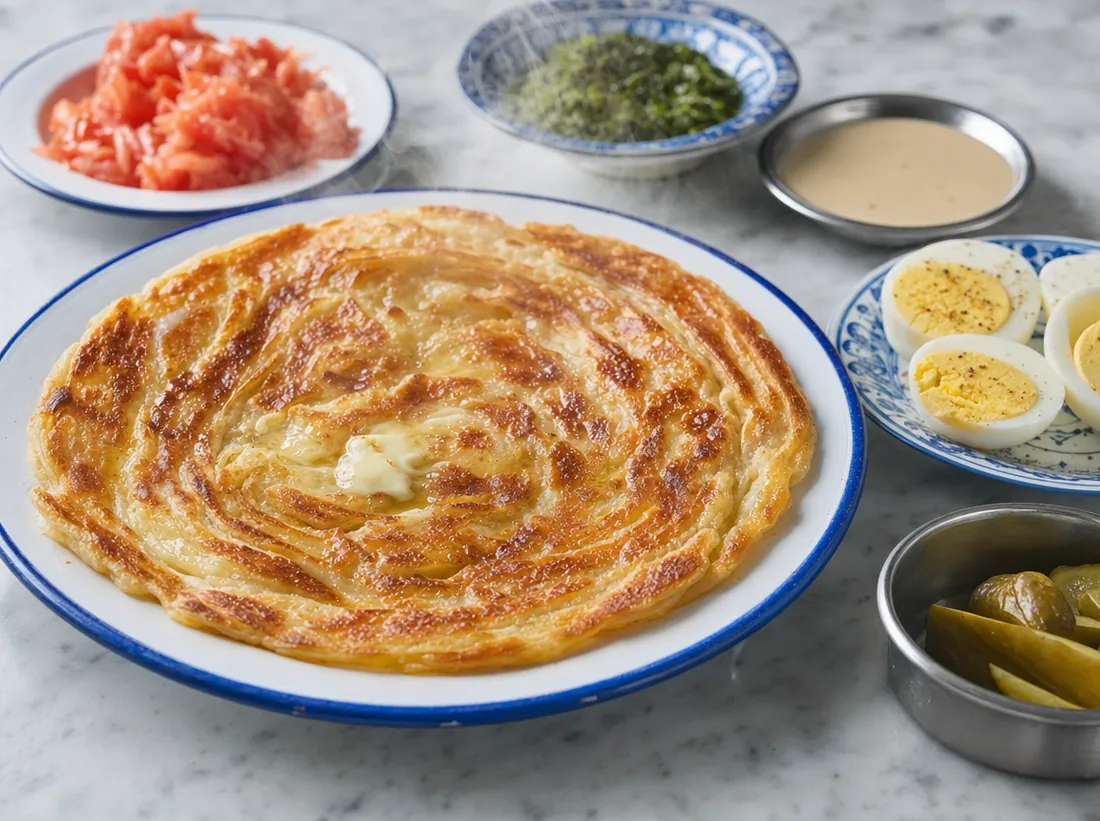
Jachnun is a Yemenite Jewish dough stretched paper thin, brushed with margarine, rolled into logs and baked all night in a sealed pot until it is amber, sweetish and layered. It is served on Shabbat morning with grated tomato, a haminados egg and schug, and one pot makes 10 rolls.

Quantity calculatorOrder Jachnun

VegetarianDairy freeParveAllergens:GlutenEggs

Updated

JachnunIllustration
Time14 h 30 minCook 12 h
Amount10 portions3 kg
Per portion717 kcal19.3 g protein · a 300 g portion
Cost of the pot₪45for the pot, about ₪4.5 a bowl

The story of Jachnun

Jachnun was born among the Jews of Aden, the port city in southern Yemen, as the answer to Shabbat morning: a dough rolled up on Friday, sealed in a pot and baked slowly all night, so that a hot breakfast waits in the morning without lighting a fire. In Aden it was made with wholemeal flour and samneh, a spiced clarified butter, and the pot was buried in embers or set in a large oven that stayed warm until morning.

With the immigration from Yemen and Aden in the late 1940s and the 1950s, jachnun came to Israel and changed: white flour, sugar and margarine instead of samneh, so that it would be parve and within every family's reach. One community's dish became the Shabbat breakfast of the whole country, sold frozen in every supermarket and served at roadside stalls, in restaurants and at events. Some food writers suggest the layered dough is related to pastries brought by Jews expelled from Spain, but that is a theory, not an established fact.

What makes Jachnun itself

Jachnun is neither a bread nor an ordinary pastry. It is a dough stretched as thin as paper, folded with fat, rolled into a log and baked for 12 hours at a low heat in a sealed pot. The steam trapped in the pot keeps the inside soft and layered, the fat that pools at the bottom slowly fries the lowest rolls into a crisp crust, and the long hours turn everything a sweetish amber. There is no yeast and no filling: all the flavour comes from dough, fat, sugar and time.
Jachnun for any number of people

Change the number of people and the portion size, and every ingredient updates in grams, with the cost, calories and protein per portion.

Portion size
Units
3kg of food
4Pot to use, litres
₪45Cost of the pot
₪4.5per portion
717kcal per portion
19.3g protein per portion
IngredientAmountCost
The dough
Plain white flour1 kg₪5.9
Sugar70 g₪0.4
Salt18 g₪0.0
Lukewarm water560 g
The fat for the layers
Soft margarine, at room temperature250 g₪7.9
Haminados eggs
Eggs in their shells, whole and uncracked600 g · 10 pcs₪15
Grated tomato
Very ripe tomatoes1 kg · 8 pcs₪7.9
Salt4 g₪0.0
Green schug
Coriander, leaves and thin stems80 g₪3.9
Hot green chillies60 g · 6 pcs₪0.8
Garlic cloves20 g · 6 pcs₪0.7
Ground cumin3 g₪0.3
Ground cardamom2 g₪0.6
Black pepper1 g₪0.1
Salt4 g₪0.0
Olive oil40 g₪2.1
Send on WhatsApp

Shelf prices at a large Israeli chain and specialty shops, October 2026. Nutrition from the ingredients in grams, before cooking.

How many calories in Jachnun? Nutrition facts and calorie calculator

Change the amount of any ingredient, drop one, or pick a lighter version, and the numbers per serving update at once: calories, fat, carbs, protein, sodium and fibre.

Jachnun has 239 calories per 100 g. A 300 g serving made with our recipe has 717 calories: 19.3 g protein, 30.7 g fat and 85.2 g carbohydrates.

Lighter

Ingredients, for the whole recipe

  • 1,000 g364 kcal per serving
  • 70 g27 kcal per serving
  • 18 g0 kcal per serving
  • 250 g180 kcal per serving
  • 10 pcs86 kcal per serving
  • 8 pcs18 kcal per serving
  • 4 g0 kcal per serving
  • 80 g2 kcal per serving
  • 6 pcs2 kcal per serving
  • 6 pcs3 kcal per serving
  • 3 g1 kcal per serving
  • 2 g1 kcal per serving
  • 1 g0 kcal per serving
  • 4 g0 kcal per serving
  • 40 ml33 kcal per serving

What each add-on adds to Jachnun

Values for the amount in the row, from the national food database.

Add-onCaloriesProtein, gFat, g
One large egg837.35.5
A tablespoon of oil122013.8

How to make Jachnun

In cook mode the screen stays on, tap a step when it is done, and the timers run next to each step.
  1. In a stand mixer with the dough hook, mix the flour, sugar and salt. Add the water gradually and knead for 8 to 10 minutes on medium speed, until the dough is soft, smooth and elastic and sticks slightly to your fingers.
  2. Grease a tray with margarine. Divide the dough into 10 balls of about 165 g, roll each in a little margarine, cover and leave to rest for an hour and a half at room temperature, or overnight in the fridge.
  3. Spread margarine on a smooth work surface. Flatten a ball with greased palms and stretch it from the centre outwards into a very thin sheet, about 40 by 50 cm, until you can see the counter through it. A small hole or two does not matter.
  4. Spread about 10 g of margarine over the sheet, fold it in three lengthwise like a letter to get a long strip about 10 cm wide, spread a little more margarine and roll it up tightly from the short end into a log about 5 cm thick.
  5. Line a jachnun pot, or any heavy 5 litre pot with a lid, with baking paper. Pack the rolls snugly in one or two layers, seam side down.
  6. Rinse the eggs in lukewarm water and tuck them between and on top of the rolls. Cover with baking paper and close the lid; if the lid is not tight, press a sheet of foil under it.
  7. Bake in an oven preheated to 105°C, top and bottom heat, for 10 to 12 hours without opening. On a Shabbat hot plate the time is similar and the bottom comes out darker.
  8. In the morning, grate the tomatoes on a coarse grater, discard the skins and season with salt. Pulse all the schug ingredients in a food processor to a coarse paste, not a smooth cream.
  9. Lift out the rolls with tongs, peel the eggs and give each guest a roll, an egg, a small bowl of grated tomato and a spoonful of schug.

The science of Jachnun

Kitchen science

Why jachnun browns in a 105°C oven

The browning of jachnun is the Maillard reaction: flour proteins react with sugars to create a brown colour and aromas of caramel and nuts. In a hot oven the reaction is fast; at 105°C it is very slow, but 12 hours make up for the low heat. The table sugar in the dough slowly splits into glucose and fructose in the heat and moisture, and these feed the reaction, which is why jachnun without sugar comes out pale. True caramelisation only starts at much higher temperatures, so most of the colour here is Maillard.

Kitchen science

Why the dough stretches until translucent

Flour contains two proteins, glutenin and gliadin, which form a gluten network when they meet water and are kneaded. Kneading strengthens the network and resting relaxes it, so the dough stretches without springing back. The margarine around each ball keeps the surface moist and lubricates the stretch. Dough that has not rested enough tears into big holes.

Kitchen science

Where the layers come from

Each thin sheet of dough is separated from the next by a film of fat, which stops the gluten networks from fusing. In the heat, the water in the dough turns to steam and pushes the sheets apart. In a sealed pot the steam cannot escape, so the jachnun stays soft and layered instead of drying into a cracker.

Kitchen science

Why a haminados egg white turns brown

Egg white contains a little free glucose and is slightly alkaline. Over hours of heating the glucose reacts with the egg proteins in a Maillard reaction, so the white turns tan and deep in flavour and the yolk becomes creamy. An egg boiled for 10 minutes never gets there.

Kitchen science

A night in the oven and food safety

In a 105°C oven the whole pot stays well above 60°C, the temperature below which bacteria start to multiply, so a full night in the oven is safe. Leftovers should be cooled and refrigerated within two hours, not left on the counter until the evening.

Jachnun in every kitchen

Adeni

The jachnun of the Jews of Aden, where the dish began: wholemeal flour and samneh, a spiced clarified butter with a smoky scent. It is darker, deeper and less sweet than the Israeli version.

Israeli, with margarine

The version that made jachnun a national dish: white flour, sugar and margarine, which keeps it parve. This is our recipe.

Dairy, with butter

Soft butter instead of margarine gives a richer scent and a crisper crust. The jachnun is dairy, and it is served with laban or sour cream on the side.

Sweet, with date syrup

A spoonful of silan (date syrup) or honey in the dough and a thin brush over the rolls before sealing. The colour comes out almost coffee dark and the taste recalls caramel.

Quick, for a weekday

6 to 7 hours at 130°C instead of a whole night. The jachnun is soft and good, just paler and less sweet.

Frozen, from the shop

Ready rolls that go into the pot straight from the freezer. Very practical for large quantities, and worth baking with eggs in the pot and serving with homemade tomato and schug.

Common Jachnun problems and how to fix them

My jachnun came out dry

The pot was not sealed or the oven was too hot, and the steam escaped. Seal the lid with foil, bake at 100 to 110°C, and do not skimp on margarine when folding: about 25 g per roll.

My jachnun is pale, not brown

It lacked time or sugar. Twelve hours at 105°C give an amber colour. If you are in a hurry, raise the oven to 120°C for 8 hours and add a spoonful of silan to the dough.

The jachnun dough tears when I stretch it

The gluten is still tight. Cover the balls, wait another half hour, and stretch with greased palms from the centre outwards rather than pulling hard at the edges.

The jachnun burned on the bottom

The pot was thin or too close to the bottom element. Line it with baking paper, put it in the middle of the oven, and on a hot plate set an upturned tray underneath.

My jachnun is doughy in the middle

The sheet was not stretched thin enough or the log is too thick. The sheet should be almost translucent and the log no thicker than 5 cm.

The eggs cracked open in the pot

An egg with a hairline crack splits further over long heating. Check every egg, rinse in lukewarm water and put room temperature eggs into the pot.

Storing, freezing and reheating

3 days

In the fridge

3 months, raw or baked rolls

In the freezer

2+4

To cool

Bring it from 60 to 21 °C within two hours and down to 5 °C within four more. Split a big pot into shallow boxes.

75 °C

Reheating

Reheat in a covered pot in the oven at 150°C for 20 minutes, or in a covered frying pan over low heat. A microwave softens the roll but wipes out the crispness.

Nutrition of Jachnun

From our recipe, per bowl and per 100 g, next to the national food database.

ServingkcalProtein, gFat, gCarbs, gFibre, g
Our recipe, a 300 g portion71719.330.785.24.4
Our recipe, 100 g2396.410.228.41.5
Typical Jachnun, 100 g3036.09.345.91.6
Typical Jachnun, 100 g (2)540.94.22.81.2

What the ingredients of Jachnun cost

What each ingredient costs in one pot, and where to buy it.

IngredientPriceIn this potWhere to buy
Eggs in their shells, whole and uncracked₪1.4 each₪14Supermarket
Very ripe tomatoes₪7.9 per kg₪7.9Greengrocer
Soft margarine, at room temperature₪32 per kg₪7.9Supermarket
Plain white flour₪5.9 per kg₪5.9Supermarket
Coriander, leaves and thin stems₪4.9 each₪3.9Greengrocer
Olive oil₪53 per litre₪2.1Supermarket
Hot green chillies₪13 per kg₪0.8Greengrocer
Garlic cloves₪34 per kg₪0.7Greengrocer
Ground cardamom₪300 per kg₪0.6Spice shop
Sugar₪5.5 per kg₪0.4Supermarket
Ground cumin₪86 per kg₪0.3Supermarket
Black pepper₪139 per kg₪0.1Supermarket
Salt₪2.1 per kg₪0.1Supermarket

Shelf prices at a large Israeli chain and specialty shops, October 2026, VAT included. Vegetable prices change with the season.

Jachnun and its culture

In Yemenite Jewish homes, jachnun is Shabbat morning. The dough is stretched and rolled on Friday afternoon, the pot goes into the oven before Shabbat begins, and in the morning, after synagogue, the whole family sits round the table waiting for the moment the lid comes off and the smell of caramelised dough fills the house. The roll is eaten with the hands, torn into layers and dipped in tomato, with a brown egg from the same pot beside every plate.

In recent decades jachnun has left the kitchen of a single community: it is sold frozen in every Israeli supermarket, served at weekend stalls, and in Israeli and Jewish communities abroad it turns up at Shabbat brunches, kiddushes and events. Precisely because it bakes overnight in one pot, it is a very easy dish for a big group: one pot feeds ten, and a tray of tomato, eggs and schug completes the meal.

Make Jachnun a meal

Shabbat

Ready Shabbat food

Soup, hamin, mains and sides, with a quantity calculator and prices.

Plan Shabbat
Hosting

Hosting trays

9 trays to go with the soup, with a planner by number of guests.

Tray planner
Events

Catering

A whole menu in grams per guest, with a reheating table.

Menus

What to serve with Jachnun

Serve jachnun hot, straight from the pot, with grated tomato, a haminados egg and schug. A finely chopped vegetable salad and a cup of kishr (spiced coffee husk drink) or mint tea go well alongside.

The cuisine behind Jachnun

Yemenite

Yemenite cuisine

Jachnun was born among the Jews of Aden, the port city in southern Yemen, as the answer to Shabbat morning: a dough rolled up on Friday,…

Yemenite cuisine

Jachnun in large quantities: events, offices and communities

How much of everything by number of guests, at a 300 g portion. For trays, catering and community kitchens.

Guestskg of food3 kg traysCost of ingredients
257.53₪113
50155₪226
1003010₪451
2006020₪902
50015050₪2,256

Every ingredient for any number of guests is in the calculator above: type the number of people.

Order Jachnun

A ready pot for Shabbat, an event or the office, ordered ahead.

  • Cooked to order, for Shabbat, an event or the office.
  • Tell us how many people and when, and we send a quote.
  • Delivery in Tel Aviv from ₪35, free over ₪750.

Order Jachnun for a large event

Large orders in Israel and abroad: events, offices, synagogues, communities and institutions.

  • In Israel: cooked in Tel Aviv and delivered to events in the area, and to large events anywhere in the country on a quote.
  • Abroad: for communities, events and restaurants. Tell us where, how many and when, and we come back with a quote and options.
  • Institutional quantities and a shopping list for any number of guests, in the calculator above.

Frequently asked questions

How long do you bake jachnun?

10 to 12 hours at 100 to 110°C in a sealed pot, usually from Friday night to Saturday morning. With less than 8 hours it comes out pale and less layered.

Can I bake jachnun faster?

Yes, but you pay in colour. 6 to 7 hours at 130°C give a soft, tasty jachnun that is paler and less sweet than an overnight one.

What do you eat with jachnun?

Grated tomato, a haminados egg baked in the same pot, and green or red schug. Some add hilbeh, and in a dairy home a spoonful of laban.

Is jachnun parve or dairy?

It depends on the fat. With margarine, as in our recipe, it is parve and can be served alongside a meat meal. With butter it is dairy.

What is the difference between jachnun and malawach?

The dough is almost the same. Jachnun is rolled into a log and baked overnight in a sealed pot, while malawach is flattened into a round and fried in a pan for a few minutes.

Can I freeze jachnun?

Yes. Freeze raw rolls for up to 3 months and put them into the pot straight from the freezer without thawing, adding an hour to the baking time.

Can I make jachnun without a jachnun pot?

Yes, in any heavy ovenproof pot with a lid, or in a deep tin sealed tightly with two layers of foil. What matters is that the steam cannot escape.

How many calories are in Jachnun?

A 300 g portion of Jachnun made with our recipe has about 717 calories and 19.3 g of protein. Per 100 g: 239 calories.

How much does it cost to make Jachnun at home?

A tray or pot of 10 portions costs about ₪45 at Israeli shelf prices in October 2026, about ₪4.5 a portion. The calculator above works it out for any number of people.

Every dish

Home dishes of every community, each with a calculator, a price list and the science.

All the dishes