Malawach

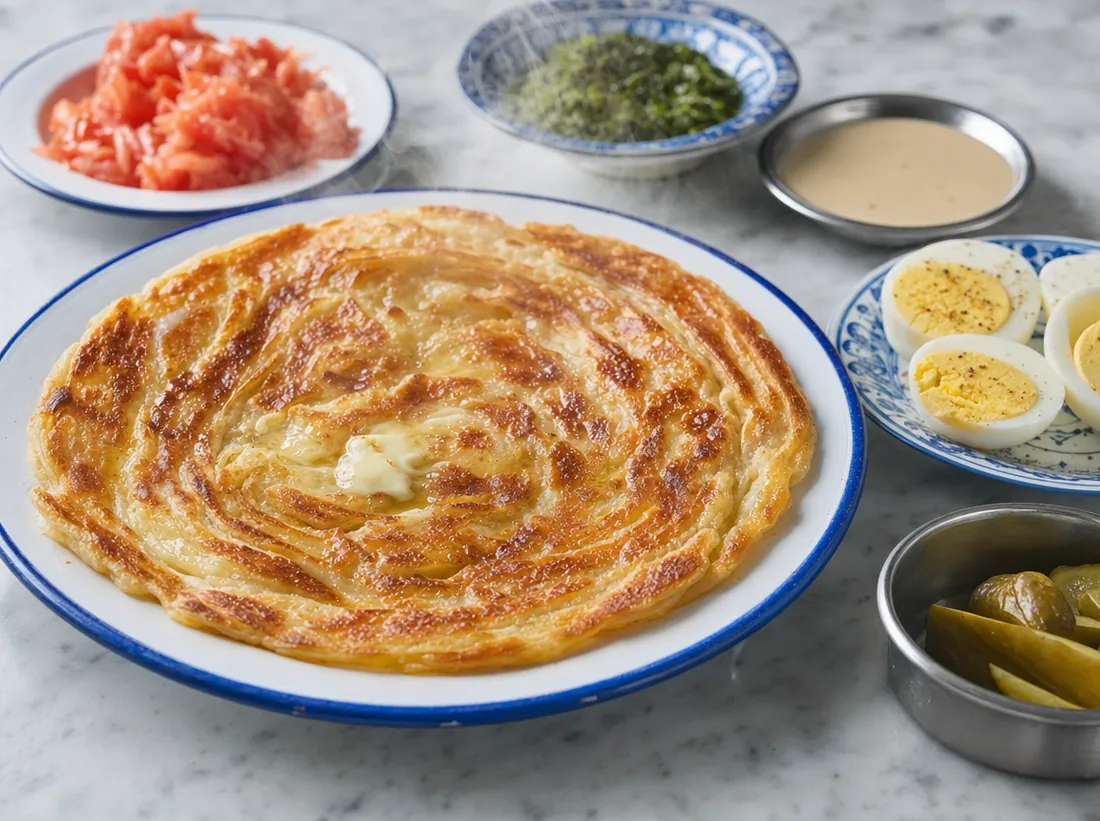
Malawach is a Yemenite layered flatbread fried in a pan: dough stretched until translucent, spread with margarine, coiled into a snail and flattened into a round that comes out crisp outside and soft and flaky inside. One batch of dough makes 8 rounds, which wait in the freezer and go into the pan without thawing.

Quantity calculatorOrder Malawach

VegetarianDairy freeParveAllergens:GlutenEggs

Updated

MalawachIllustration
Time4 h 15 minCook 30 min
Amount8 portions2.1 kg
Per portion540 kcal15 g protein · a 260 g portion
Cost of the pot₪30for the pot, about ₪3.7 a bowl

The story of Malawach

Malawach came to Israel with the Jews of Yemen, who made it at home as a fried layered bread for weekday mornings, the everyday cousin of the jachnun baked for Shabbat. The dough is almost the same: flour, water, a little sugar and salt and plenty of fat, samneh in Yemen and margarine in Israel. The difference is time and vessel: jachnun waits all night in a sealed pot, while malawach is ready in a pan in five minutes.

In the 1980s malawach left the home kitchen. Frozen rounds between sheets of baking paper reached supermarket freezers, and stalls and Yemenite restaurants served it hot with egg, tomato and schug. From there it was a short step to malawach as street food, to the pizza version, and to a rolled malawach with cheese, born in Israel and called ziva. Today it is a breakfast of every community, and anyone raised in Israel knows the smell of malawach in a pan from across the street.

What makes Malawach itself

Malawach is a laminated bread with no yeast and no oven: all its lift comes from steam trapped between dozens of thin sheets of dough and fat. The secret is cold: a frozen round hits a hot pan, the outside sets fast, and the layers inside open away from one another. The result is golden and crisp outside, soft and chewy inside, and it peels apart like the pages of a book.
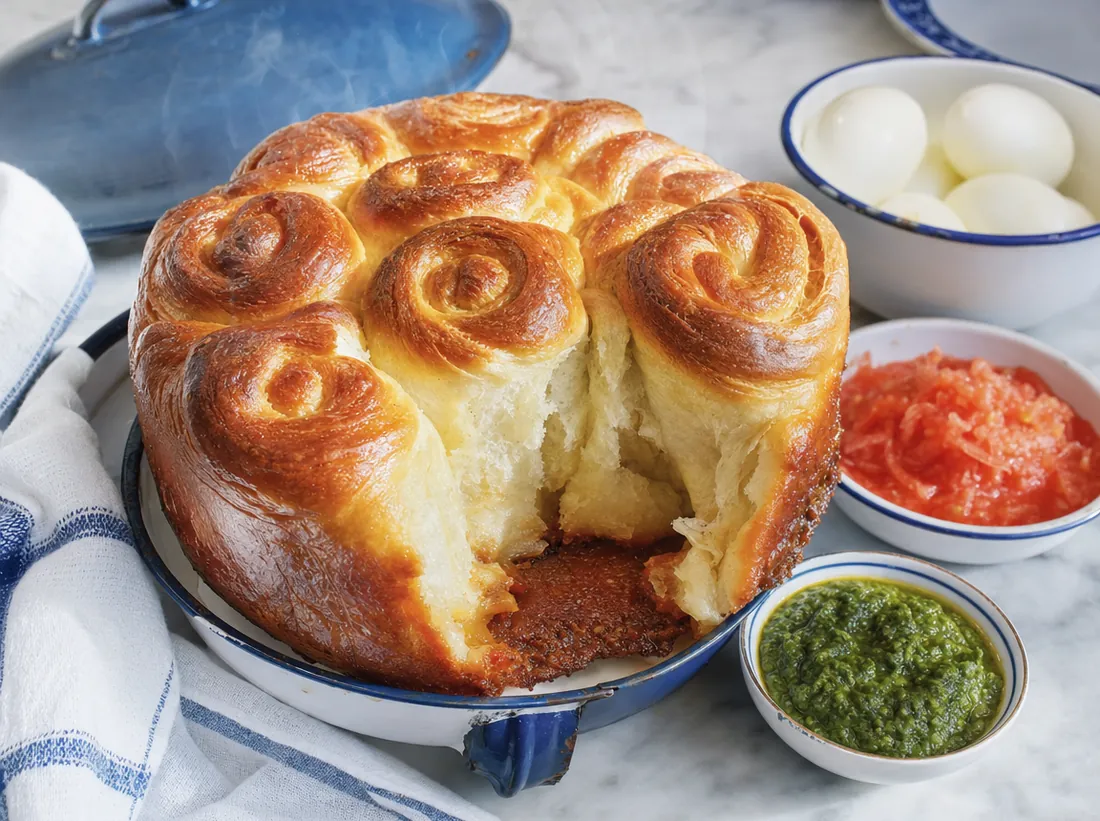
Malawach for any number of people

Change the number of people and the portion size, and every ingredient updates in grams, with the cost, calories and protein per portion.

Portion size
Units
2.1kg of food
3Pot to use, litres
₪30Cost of the pot
₪3.7per portion
540kcal per portion
15.0g protein per portion
IngredientAmountCost
The dough
Plain white flour500 g₪3.0
Sugar15 g₪0.1
Salt10 g₪0.0
Room temperature water300 g
The fat for the layers
Very soft margarine, at room temperature200 g₪6.3
On the side
Eggs, for hard boiling480 g · 8 pcs₪12
Ripe tomatoes, for grating600 g · 5 pcs₪4.7
Salt for the tomato3 g₪0.0
Quick schug
Coriander40 g₪2.0
Hot green chillies30 g · 3 pcs₪0.4
Garlic cloves10 g · 3 pcs₪0.4
Ground cumin2 g₪0.2
Olive oil20 g₪1.1
Salt2 g
Send on WhatsApp

Shelf prices at a large Israeli chain and specialty shops, October 2026. Nutrition from the ingredients in grams, before cooking.

How many calories in Malawach? Nutrition facts and calorie calculator

Change the amount of any ingredient, drop one, or pick a lighter version, and the numbers per serving update at once: calories, fat, carbs, protein, sodium and fibre.

Malawach has 208 calories per 100 g. A 260 g serving made with our recipe has 540 calories: 15 g protein, 28.9 g fat and 51.1 g carbohydrates.

Lighter

Ingredients, for the whole recipe

  • 500 g228 kcal per serving
  • 15 g7 kcal per serving
  • 10 g0 kcal per serving
  • 200 g180 kcal per serving
  • 8 pcs86 kcal per serving
  • 5 pcs14 kcal per serving
  • 3 g0 kcal per serving
  • 40 g1 kcal per serving
  • 3 pcs2 kcal per serving
  • 3 pcs2 kcal per serving
  • 2 g1 kcal per serving
  • 20 ml20 kcal per serving
  • 2 g0 kcal per serving

What each add-on adds to Malawach

Values for the amount in the row, from the national food database.

Add-onCaloriesProtein, gFat, g
One large egg837.35.5
A tablespoon of oil122013.8

How to make Malawach

In cook mode the screen stays on, tap a step when it is done, and the timers run next to each step.
  1. Mix the flour, sugar and salt in a bowl, add the water and knead for 8 to 10 minutes, until the dough is soft, smooth and no longer sticks to your hands. Cover and rest for 20 minutes.
  2. Divide into 8 balls of about 100 g, roll each in a teaspoon of margarine and set them in a greased box. Cover and rest for two hours at room temperature, or overnight in the fridge.
  3. Grease a work surface with margarine. Flatten a ball and stretch it with greased palms into a very thin sheet about 40 cm across, until it is almost translucent.
  4. Spread about 20 g of margarine over the sheet in a thin, even layer. Fold both sides into the centre to make a long strip, roll the strip into a tight snail and tuck the end underneath.
  5. Let the snails rest for 15 minutes. Flatten each with a greased palm on baking paper into a round 20 to 22 cm across and about half a centimetre thick.
  6. Stack the rounds with baking paper between them and freeze them flat for at least an hour.
  7. Heat a heavy frying pan over medium heat, with no oil. Put in a malawach straight from the freezer, cover and fry for 3 minutes until it puffs and turns golden underneath. Flip and fry uncovered for another 2 to 3 minutes.
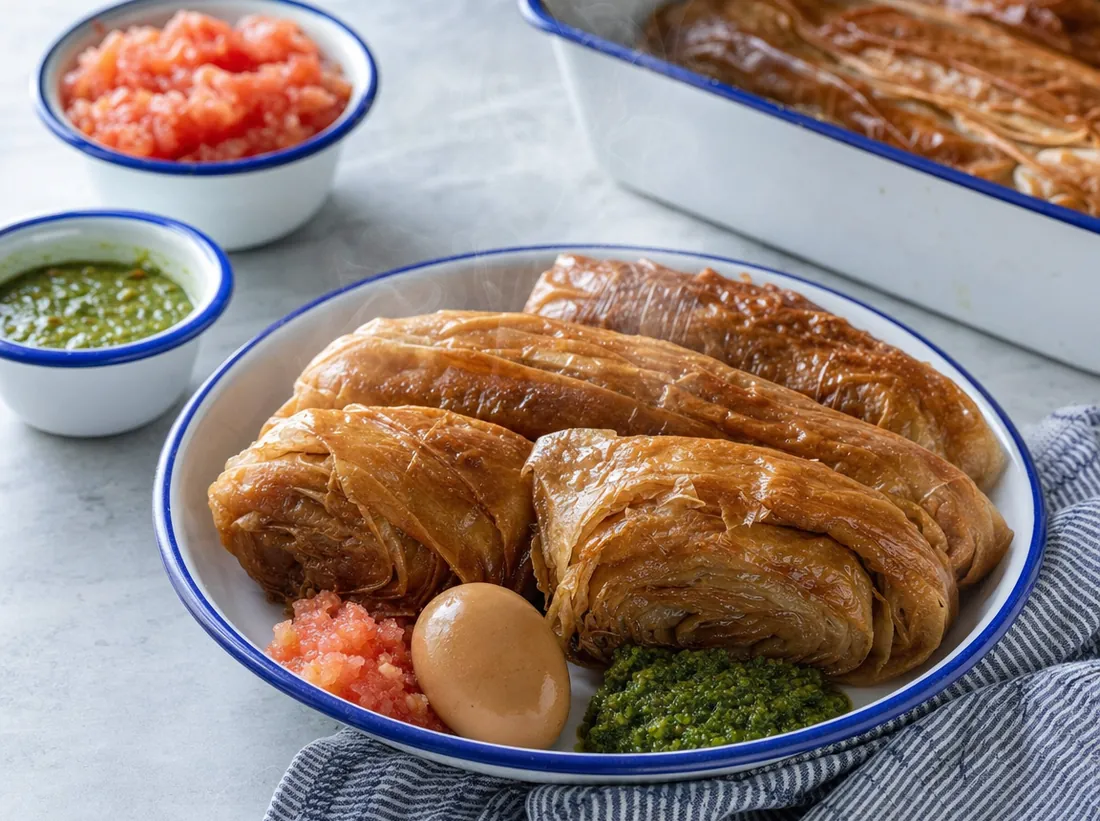
  8. Move it to a plate and, with both hands, push the edges in towards the centre a few times to crack the crust and open the layers.
  9. While frying, boil the eggs for 10 minutes, grate the tomatoes and season with salt, and pulse the schug ingredients to a coarse paste. Serve each hot malawach with an egg, tomato and schug.

The science of Malawach

Kitchen science

Why malawach is frozen before frying

Frozen margarine is solid. When a frozen malawach touches a hot pan, the outer layers set before the fat inside melts, and the water in the dough and the margarine turns to steam that pushes the layers apart. A thawed round is already soft: the fat soaks into the dough, the layers stick together and the malawach comes out flat and heavy.

Kitchen science

Stretching and resting

Kneading builds a strong gluten network, and freshly kneaded dough springs back when stretched. During two hours of rest the network relaxes, while the coat of margarine keeps the dough from drying out. Dough rested overnight in the fridge stretches thinnest, and the thinner the sheet, the more layers in the round.

Kitchen science

What happens in the pan

Over medium heat the surface of the pan reaches roughly 180°C. At that heat the sugar and proteins in the dough brown through the Maillard reaction, and the margarine fries the outer layer into a crust. Inside, the flour's starch absorbs water and cooks, a process called gelatinisation, and the lid on the first side traps steam that cooks the centre before the outside burns.

Kitchen science

Why you squeeze malawach at the end

After frying there is hot steam between the layers. Pushing from the edges to the centre cracks the crust and lets it out, so the layers are not softened by steam condensing inside, and the malawach opens into layers you can peel one by one.

Malawach in every kitchen

Yemenite, homemade

In Yemenite Jewish homes the layers are spread with samneh, a clarified butter, and the malawach comes out heavier and more fragrant. It is eaten in the morning with tomato, egg and schug.

Israeli, from the freezer

Ready rounds between sheets of baking paper, fried straight from frozen. This is how malawach became a breakfast and a street food all over the country.

Sweet, with honey

Hot malawach with honey or silan and a dusting of icing sugar. A sweet breakfast that children especially love.

Malawach pizza

Fry one side, flip, spread with tomato sauce and scatter grated yellow cheese, then cover until the cheese melts. Dairy, quick, and it also works in a 200°C oven.

Rice paper malawach

A trend of recent years: wet rice paper sheets dipped in egg, folded in layers and fried until crisp. There is no wheat in it, and none of the layers of a real dough either.

Indian paratha

In India a layered bread is made with a very similar technique: dough stretched, spread with ghee, coiled into a spiral and flattened for the pan. The taste differs, the logic of the layers is the same.

Common Malawach problems and how to fix them

My malawach came out hard and not flaky

The dough was not stretched thin enough, there was too little fat between the layers, or the snail was crushed under the rolling pin. Stretch until translucent, spread about 20 g of margarine per round, and flatten with your palm.

Malawach burnt outside and doughy inside

The heat was too high. Medium heat and a lid on the first side cook the centre before the crust darkens. A round thicker than half a centimetre needs an extra minute on each side.

The malawach dough shrinks back when I stretch it

The gluten is still tight. Cover and wait another half hour, and next time rest the balls overnight in the fridge.

My malawach is soaked in oil

Oil was added to the pan. Malawach has enough fat of its own and is fried in a dry pan. If it is still greasy, the round thawed before frying.

The rounds stuck together in the freezer

There was no baking paper between them, or they were stacked before they firmed up. Put paper between every two rounds, freeze them flat, and only then move them to a bag.

Storing, freezing and reheating

2 days for unfried rounds

In the fridge

3 months for unfried rounds

In the freezer

2+4

To cool

Bring it from 60 to 21 °C within two hours and down to 5 °C within four more. Split a big pot into shallow boxes.

75 °C

Reheating

Reheat fried malawach in a dry pan over medium heat, a minute on each side. In a microwave it goes soft and loses its crispness.

Nutrition of Malawach

From our recipe, per bowl and per 100 g, next to the national food database.

ServingkcalProtein, gFat, gCarbs, gFibre, g
Our recipe, a 260 g portion54015.028.951.12.8
Our recipe, 100 g2085.811.119.71.1
Typical Malawach, 100 g3955.821.245.71.5
Typical Malawach, 100 g (2)3955.821.245.71.5

What the ingredients of Malawach cost

What each ingredient costs in one pot, and where to buy it.

IngredientPriceIn this potWhere to buy
Eggs, for hard boiling₪1.4 each₪12Supermarket
Very soft margarine, at room temperature₪32 per kg₪6.3Supermarket
Ripe tomatoes, for grating₪7.9 per kg₪4.7Greengrocer
Plain white flour₪5.9 per kg₪3Supermarket
Coriander₪4.9 each₪2Greengrocer
Olive oil₪53 per litre₪1.1Supermarket
Hot green chillies₪13 per kg₪0.4Greengrocer
Garlic cloves₪34 per kg₪0.3Greengrocer
Ground cumin₪86 per kg₪0.2Supermarket
Sugar₪5.5 per kg₪0.1Supermarket
Salt₪2.1 per kg₪0Supermarket

Shelf prices at a large Israeli chain and specialty shops, October 2026, VAT included. Vegetable prices change with the season.

Malawach and its culture

In Yemenite homes malawach is the weekday breakfast, and above all the Friday one: rounds made in advance come out of the freezer, the pan heats up, and everyone gets a hot malawach with a hard boiled egg, grated tomato and schug. Children eat it sweet, with honey or silan, and grown ups like it hot with chilli. Many families make dozens of rounds at once and fill the freezer for a whole month.

Outside Israel, frozen malawach is sold in kosher and Israeli shops across Europe and North America, and Israeli restaurants abroad serve it at brunch. At events and in offices it is ideal for a live station: a hot pan, a stack of frozen rounds, and bowls of tomato, eggs, schug and honey beside them, so every guest gets a fresh malawach within minutes.

Make Malawach a meal

Shabbat

Ready Shabbat food

Soup, hamin, mains and sides, with a quantity calculator and prices.

Plan Shabbat
Hosting

Hosting trays

9 trays to go with the soup, with a planner by number of guests.

Tray planner
Events

Catering

A whole menu in grams per guest, with a reheating table.

Menus

What to serve with Malawach

Serve malawach hot from the pan, right after squeezing it into layers, with grated tomato, a hard boiled egg and schug. A chopped vegetable salad fits alongside, and for a sweet tooth, a little dish of honey.

The cuisine behind Malawach

Yemenite

Yemenite cuisine

Malawach came to Israel with the Jews of Yemen, who made it at home as a fried layered bread for weekday mornings, the everyday cousin of…

Yemenite cuisine

Malawach in large quantities: events, offices and communities

How much of everything by number of guests, at a 260 g portion. For trays, catering and community kitchens.

Guestskg of food3 kg traysCost of ingredients
256.53₪93
50135₪185
100269₪370
2005218₪741
50013044₪1,852

Every ingredient for any number of guests is in the calculator above: type the number of people.

Order Malawach

A ready pot for Shabbat, an event or the office, ordered ahead.

  • Cooked to order, for Shabbat, an event or the office.
  • Tell us how many people and when, and we send a quote.
  • Delivery in Tel Aviv from ₪35, free over ₪750.

Order Malawach for a large event

Large orders in Israel and abroad: events, offices, synagogues, communities and institutions.

  • In Israel: cooked in Tel Aviv and delivered to events in the area, and to large events anywhere in the country on a quote.
  • Abroad: for communities, events and restaurants. Tell us where, how many and when, and we come back with a quote and options.
  • Institutional quantities and a shopping list for any number of guests, in the calculator above.

Frequently asked questions

How do you fry frozen malawach?

Straight from the freezer, without thawing and without oil, in a pan over medium heat: 3 minutes covered on one side, then 2 to 3 minutes on the other.

Can malawach be baked in the oven?

Yes. On baking paper at 200°C for 12 to 15 minutes, flipping halfway. It comes out even and is handy for quantities, but less crisp than malawach from the pan.

What do you eat with malawach?

Grated tomato, a hard boiled egg and schug, the classic Yemenite trio. The sweet version is served with honey or silan.

What is the difference between malawach and jachnun?

Almost the same dough, two methods. Malawach is flattened into a round and fried in a pan for a few minutes, while jachnun is rolled into a log and baked overnight in a sealed pot.

Is rice paper malawach real malawach?

No. It is wet rice paper dipped in egg, folded into several layers and fried. The result is crisp and chewy with no wheat, tasty in its own right, but without the layers of malawach dough.

Is malawach parve or dairy?

With margarine, as in our recipe, it is parve. With butter, and in cheese versions such as malawach pizza and ziva, it is dairy.

Can malawach be made gluten free?

It can, with a gluten free bread flour blend, but without gluten the dough will not stretch until translucent and the layers come out thicker and less crisp. Rice paper is the usual way to get something similar without wheat.

How many calories are in Malawach?

A 260 g portion of Malawach made with our recipe has about 540 calories and 15 g of protein. Per 100 g: 208 calories.

How much does it cost to make Malawach at home?

A tray or pot of 8 portions costs about ₪30 at Israeli shelf prices in October 2026, about ₪3.7 a portion. The calculator above works it out for any number of people.

Every dish

Home dishes of every community, each with a calculator, a price list and the science.

All the dishes