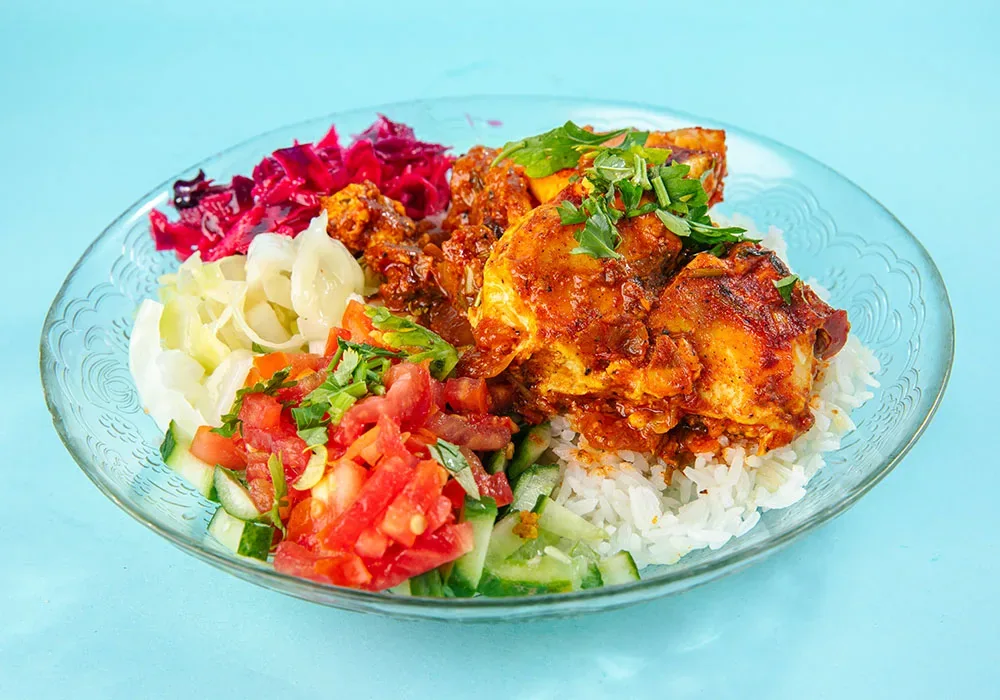
Shakshuka

Shakshuka is eggs poached right in a thick sauce of tomatoes, peppers and garlic, brought to the table in the pan they cooked in. It came to Israel with the Jews of Tunisia and Libya and became everyone's breakfast, lunch and supper, with pita or bread for mopping up.

Quantity calculatorOrder Shakshuka

VegetarianGluten freeDairy freeParveAllergens:Eggs

Updated

Shakshuka
Time53 minCook 35 min
Amount4 portions1.6 kg
Per portion382 kcal19.8 g protein · a 400 g portion
Cost of the pot₪32for the pot, about ₪8 a bowl

The story of Shakshuka

The word shakshuka comes from North African Arabic and means roughly a mixture, something stirred and tossed together; even its sound recalls a sauce bubbling in a pan. Stews of peppers and tomatoes with eggs are known across the Maghreb, from Tunisia and Libya to Algeria and Morocco. Tomatoes reached North Africa only after they were brought from the Americas to Europe, so the shakshuka we know is a fairly young dish. Who invented it is still argued over, with Tunisia and Libya the leading candidates.

It reached Israel in the 1950s with the great wave of immigration from North Africa, and it was home food: cheap, filling and ready in a quarter of an hour from whatever was in the fridge. Over the years it moved from home kitchens to cafés and breakfast places, and from there to the rest of the world. Outside Israel today it is one of the dishes most closely tied to Israeli cooking.

What makes Shakshuka itself

A good shakshuka is really two dishes that meet at one moment: a sauce cooked slowly until it is sweet, thick and deep, and eggs that need only a few minutes. The whole secret is timing. You reduce the sauce until a spoon leaves a trail in it, and only then make wells and crack the eggs in. You turn off the heat when the whites are fully set and the yolks still wobble. In the classic Israeli version the peppers stay soft but do not melt, and the garlic and paprika are fried in the oil before the tomatoes go in.
Shakshuka for any number of people

Change the number of people and the portion size, and every ingredient updates in grams, with the cost, calories and protein per portion.

Portion size
Units
1.6kg of food
3Pot to use, litres
₪32Cost of the pot
₪8.0per portion
382kcal per portion
19.8g protein per portion
IngredientAmountCost
The base
Olive oil45 g₪2.4
Medium onion, chopped150 g · 1 pcs₪0.9
Red bell pepper, in strips150 g · 1 pcs₪1.5
Green pepper, in strips100 g · 1 pcs₪0.9
Green chilli, thinly sliced15 g · 1 pcs₪0.2
Garlic cloves, sliced15 g · 5 pcs₪0.5
The sauce
Tomato paste30 g₪1.1
Sweet paprika6 g₪0.5
Ground cumin3 g₪0.3
Crushed tomatoes, one large can800 g₪9.9
Ripe tomatoes, diced300 g · 2 pcs₪2.4
Sugar4 g₪0.0
Salt7 g₪0.0
Black pepper1 g₪0.1
The eggs and the finish
Large eggs440 g · 8 pcs₪11
Parsley or coriander, chopped15 g₪0.7
Send on WhatsApp

Shelf prices at a large Israeli chain and specialty shops, October 2026. Nutrition from the ingredients in grams, before cooking.

How many calories in Shakshuka? Nutrition facts and calorie calculator

Change the amount of any ingredient, drop one, or pick a lighter version, and the numbers per serving update at once: calories, fat, carbs, protein, sodium and fibre.

Shakshuka has 96 calories per 100 g. A 400 g serving made with our recipe has 382 calories: 19.8 g protein, 22.2 g fat and 27.1 g carbohydrates.

Lighter

Ingredients, for the whole recipe

  • 45 ml91 kcal per serving
  • 1 pcs15 kcal per serving
  • 1 pcs6 kcal per serving
  • 1 pcs4 kcal per serving
  • 1 pcs2 kcal per serving
  • 5 pcs6 kcal per serving
  • 30 g10 kcal per serving
  • 6 g4 kcal per serving
  • 3 g3 kcal per serving
  • 800 g64 kcal per serving
  • 2 pcs14 kcal per serving
  • 4 g4 kcal per serving
  • 7 g0 kcal per serving
  • 1 g1 kcal per serving
  • 8 pcs157 kcal per serving
  • 15 g1 kcal per serving

What each add-on adds to Shakshuka

Values for the amount in the row, from the national food database.

Add-onCaloriesProtein, gFat, g
One large egg837.35.5
A tablespoon of oil122013.8

How to make Shakshuka

In cook mode the screen stays on, tap a step when it is done, and the timers run next to each step.
  1. Heat the olive oil in a wide, heavy 28 cm frying pan over medium heat. Add the onion and fry for 6 minutes, until soft and translucent.
  2. Add the red and green pepper strips and the chilli and fry for 8 minutes, stirring now and then, until soft and starting to brown at the edges.
  3. Add the garlic, tomato paste, paprika and cumin and stir for one minute only, until fragrant. Paprika burns quickly, so do not wait longer.
  4. Add the crushed tomatoes, the diced tomatoes, the sugar, salt and black pepper. Bring to a boil and cook for 15 to 18 minutes over medium low heat, uncovered, until the sauce is thick and a spoon leaves a trail that does not close at once.
  5. Taste and correct the salt. The sauce must be well seasoned now, because the eggs will add no flavour of their own.
  6. Make 8 wells in the sauce with the back of a spoon. Crack each egg into a small cup and slide it into a well, so the yolk stays whole. Sprinkle a pinch of salt over each egg.
  7. Cover the pan and cook over low heat for 5 to 7 minutes, until the whites are completely opaque, even around the yolks, and the yolks are still soft and wobbly.
  8. Turn off the heat, scatter over the parsley or coriander and serve at once, in the pan, with pita or fresh bread.

The science of Shakshuka

Kitchen science

When the eggs in shakshuka are done

Egg white and yolk are made of different proteins that set at different temperatures. Some white proteins begin to set at about 62 °C and others only near 80 °C, while the yolk thickens at about 65 °C and turns solid above 70 °C. So there is a short window when the white is already set and the yolk still runny. The lid traps hot steam that cooks the top of the white without leaving the yolk on the heat too long.

Kitchen science

Why the sauce is reduced before the eggs

A tomato is mostly water. When the sauce bubbles uncovered the water evaporates and the tomato's sugars, acids and natural glutamate concentrate, so the taste becomes sweeter and deeper. A watery sauce also cannot hold the eggs: the white spreads into the liquid instead of sitting in its well.

Kitchen science

Acidity, sugar and paprika

Canned tomatoes are fairly acidic, and short cooking leaves them sharp. A pinch of sugar does not sweeten shakshuka, it balances the acid, and longer cooking rounds it off further. Paprika is rich in sugars and pigments that dissolve in oil, so it gets one minute in the hot oil to release colour and aroma. Any longer and it burns and turns bitter.

Kitchen science

Why the chilli goes into the oil

Capsaicin, the compound behind chilli heat, dissolves far better in fat than in water. Frying the chilli in oil at the start spreads the heat evenly through the whole sauce. Chilli added at the end gives sharper, patchier heat.

Shakshuka in every kitchen

Tunisian

Harissa in place of some of the fresh chilli, cumin and sometimes caraway, and now and then cubes of potato or zucchini in the sauce. Some families beat the eggs into the sauce, and some make the pepper and tomato stew with no eggs at all and eat it cold, as a salad.

Libyan

Plenty of garlic, sweet and hot paprika and cumin, and a sauce cooked slowly until the oil floats red on top, like the Tripolitan sauces of hraime. It is hotter and deeper than café shakshuka.

Moroccan, on matbucha

First comes matbucha, a cooked salad of tomatoes, roasted peppers and garlic simmered for an hour or more, and only then are the eggs cracked into it. The sauce is especially concentrated and sweet, and it is a common way to use matbucha left over from Shabbat.

Green shakshuka

Swiss chard, spinach, leek, garlic and herbs instead of tomatoes, cooked in olive oil until soft, with the eggs cracked into the green. The dairy version adds feta or cream; the version without cream finishes with a spoonful of tahini and a little lemon juice.

Turkish, menemen

In Turkey green peppers and tomatoes are cooked down and the eggs are stirred in until softly set, with no wells. The result is closer to scrambled eggs in sauce, eaten with fresh bread.

Italian, eggs in purgatory

In southern Italy eggs are cracked into a tomato sauce with garlic, olive oil and basil, sometimes with hard cheese grated on top. There are no peppers, and the taste is clean and all tomato.

Common Shakshuka problems and how to fix them

My shakshuka is watery

The sauce was not reduced enough before the eggs went in, or the fresh tomatoes were watery. Cook uncovered until a spoon leaves a trail, and only then make the wells. If the eggs are already in, lift them gently onto a plate, reduce the sauce for a few minutes and return them.

The whites are still raw but the yolks are hard

The heat came only from below. Cover the pan as soon as the eggs are in and cook over low heat. You can also spoon hot sauce over the whites around each yolk so they set from the top.

The shakshuka is too sour

The tomatoes did not cook long enough, or they were particularly acidic. Cook for 5 more minutes and add a pinch of sugar, no more than half a teaspoon at a time, until the sourness rounds off.

The yolk breaks when I add the egg

Crack each egg into a small cup first and slide it gently into the well. Fresh eggs have a taller yolk and a firmer white, so they behave better in the pan.

The shakshuka burnt on the bottom

The heat was too high once the sauce had thickened. A thick sauce needs low heat and an occasional stir, and a heavy based pan spreads the heat better. If it smells burnt, move the top part to a clean pan without scraping the bottom.

My shakshuka tastes bland

Most of the flavour must be in the sauce before the eggs go in. Taste the sauce and season it until it is good on its own, and put a pinch of salt straight onto each egg.

Storing, freezing and reheating

3 days for the sauce, 1 day with eggs

In the fridge

3 months, sauce only

In the freezer

2+4

To cool

Bring it from 60 to 21 °C within two hours and down to 5 °C within four more. Split a big pot into shallow boxes.

75 °C

Reheating

Heat the sauce in a pan until it bubbles and add fresh eggs. Shakshuka that already has eggs in it is reheated over very low heat with a lid, and the yolks will firm up.

Nutrition of Shakshuka

From our recipe, per bowl and per 100 g, next to the national food database.

ServingkcalProtein, gFat, gCarbs, gFibre, g
Our recipe, a 400 g portion38219.822.227.17.5
Our recipe, 100 g964.95.66.81.9
Typical Shakshuka, 100 g944.06.83.31.2
Typical Shakshuka, 100 g (2)1014.46.74.71.4

What the ingredients of Shakshuka cost

What each ingredient costs in one pot, and where to buy it.

IngredientPriceIn this potWhere to buy
Large eggs₪1.4 each₪11Supermarket
Crushed tomatoes, one large can₪12 per kg₪9.9Supermarket
Olive oil₪53 per litre₪2.4Supermarket
Ripe tomatoes, diced₪7.9 per kg₪2.4Greengrocer
Red bell pepper, in strips₪9.9 per kg₪1.5Greengrocer
Tomato paste₪35 per kg₪1.1Supermarket
Green pepper, in strips₪8.9 per kg₪0.9Greengrocer
Medium onion, chopped₪5.9 per kg₪0.9Greengrocer
Parsley or coriander, chopped₪4.9 each₪0.7Greengrocer
Sweet paprika₪86 per kg₪0.5Supermarket
Garlic cloves, sliced₪34 per kg₪0.5Greengrocer
Ground cumin₪86 per kg₪0.3Supermarket
Green chilli, thinly sliced₪13 per kg₪0.2Greengrocer
Black pepper₪139 per kg₪0.1Supermarket
Sugar₪5.5 per kg₪0Supermarket
Salt₪2.1 per kg₪0Supermarket

Shelf prices at a large Israeli chain and specialty shops, October 2026, VAT included. Vegetable prices change with the season.

Shakshuka and its culture

In the homes of Tunisian and Libyan Jews shakshuka was an everyday meal: one pan in the middle of the table, bread, and the whole family dipping into the same sauce. In Israel it became everyone's dish. Soldiers cook it on a camping stove, students at the end of the month, and cafés serve it on Friday mornings. It is also a dish for hosting: a huge pan for an office brunch, for kiddush after synagogue or for the morning after a wedding.

Abroad, shakshuka is one of the flagships of Israeli food and appears on brunch menus in London, New York, Berlin and Paris. In Jewish communities it suits every table, because it is parve and can be served at a meat meal or a dairy one. For dozens of guests the sauce is made in advance and the eggs are added in wide trays close to serving, so it arrives hot and fresh.

Make Shakshuka a meal

Shabbat

Ready Shabbat food

Soup, hamin, mains and sides, with a quantity calculator and prices.

Plan Shabbat
Hosting

Hosting trays

9 trays to go with the soup, with a planner by number of guests.

Tray planner
Events

Catering

A whole menu in grams per guest, with a reheating table.

Menus

What to serve with Shakshuka

Serve in the pan in the middle of the table, with pita, challah or country bread for mopping up, and a chopped vegetable salad. Tahini, olives and hot sauce on the side let everyone finish their own.

The cuisine behind Shakshuka

Tunisian

Tunisian cuisine

The word shakshuka comes from North African Arabic and means roughly a mixture, something stirred and tossed together; even its sound…

Tunisian cuisine
Moroccan

Moroccan cuisine

Moroccan cuisine

Shakshuka in large quantities: events, offices and communities

How much of everything by number of guests, at a 400 g portion. For trays, catering and community kitchens.

Guestskg of food3 kg traysCost of ingredients
25104₪200
50207₪400
1004014₪801
2008027₪1,601
50020067₪4,003

Every ingredient for any number of guests is in the calculator above: type the number of people.

Order Shakshuka

A ready pot for Shabbat, an event or the office, ordered ahead.

  • Cooked to order, for Shabbat, an event or the office.
  • Tell us how many people and when, and we send a quote.
  • Delivery in Tel Aviv from ₪35, free over ₪750.

Order Shakshuka for a large event

Large orders in Israel and abroad: events, offices, synagogues, communities and institutions.

  • In Israel: cooked in Tel Aviv and delivered to events in the area, and to large events anywhere in the country on a quote.
  • Abroad: for communities, events and restaurants. Tell us where, how many and when, and we come back with a quote and options.
  • Institutional quantities and a shopping list for any number of guests, in the calculator above.
Skip the map
Loading the map

Where we are

Complete99, 99 Ibn Gabirol, Tel Aviv

03-523-1810

What is near the restaurant

  • Gan HaIr MallShopping · 390 m
  • Yitzhak Rabin MemorialMemorial · 440 m
  • Tel Aviv-Yafo City HallCity hall · 460 m
  • Rabin SquareSquare · 610 m
  • Holocaust MemorialMemorial · 640 m
  • Masaryk SquarePark · 880 m
All food businesses on Ibn Gabirol Street

Frequently asked questions

How do you make shakshuka?

Fry onion, peppers and garlic, add tomatoes and cook for about 15 minutes until the sauce is thick. Make wells, crack in the eggs, cover and cook for 5 to 7 minutes over low heat, until the whites are set and the yolks soft.

How long do the eggs cook in shakshuka?

5 to 7 minutes, covered, over low heat for soft yolks, and 9 to 10 minutes for firm ones. Count from the moment the eggs go into the hot sauce.

Fresh or canned tomatoes for shakshuka?

Both work. Ripe summer tomatoes give a fresh, sweet taste, and canned crushed tomatoes give a steady result all year. This recipe uses some of each.

What is green shakshuka?

Shakshuka without tomatoes, built on Swiss chard, spinach, leek and garlic cooked in olive oil, with the eggs cracked into the greens. There is a dairy version with feta or cream, and one without cream finished with tahini and lemon.

Is shakshuka parve or dairy?

Plain shakshuka is parve: eggs, vegetables and oil. It becomes dairy only when cheese or cream is added, and meat when sausages go in.

How much shakshuka do I need for 30 people?

About 60 eggs, two per guest, and 8 to 9 kg of sauce. For an event the sauce is made ahead and the eggs are added in wide trays just before serving, so the yolks stay soft.

Where does shakshuka come from?

From North Africa. Tunisia and Libya are the leading candidates, and it reached Israel in the 1950s with North African Jews. The name comes from Maghrebi Arabic and means roughly a mixture.

How many calories are in Shakshuka?

A 400 g portion of Shakshuka made with our recipe has about 382 calories and 19.8 g of protein. Per 100 g: 96 calories.

How much does it cost to make Shakshuka at home?

A tray or pot of 4 portions costs about ₪32 at Israeli shelf prices in October 2026, about ₪8 a portion. The calculator above works it out for any number of people.

Order now

Price, extras and availability are set in the ordering menu. You can also call.

Every dish

Home dishes of every community, each with a calculator, a price list and the science.

All the dishes