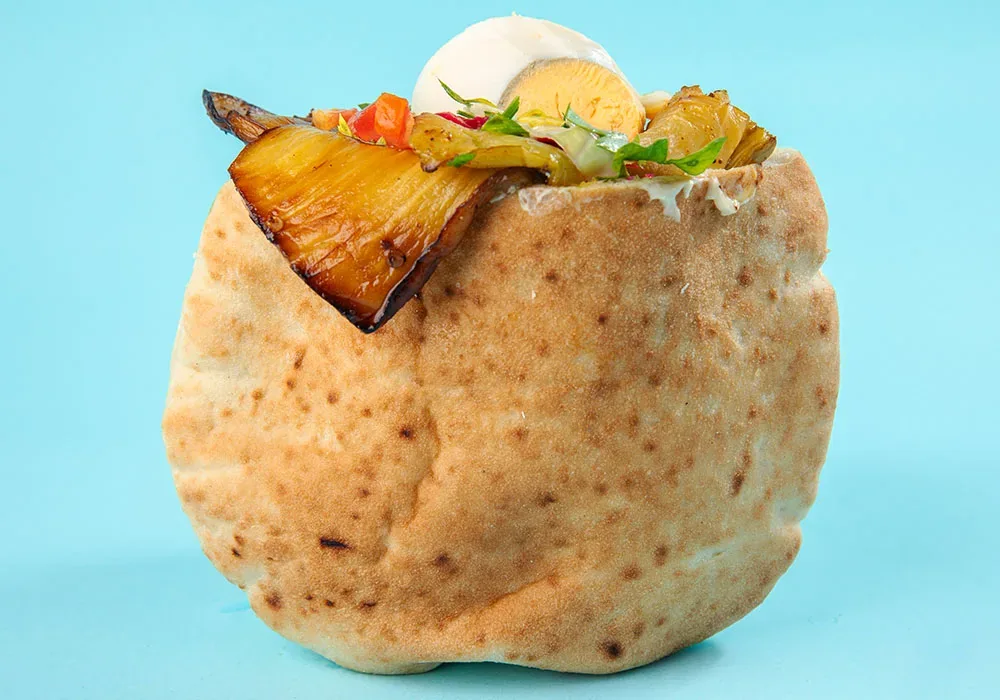
Sabich

Sabich is a pita filled with fried aubergine, hard boiled egg, potato, chopped salad, tahini and amba, with a little schug for those who like heat. It is the Shabbat breakfast of Iraqi Jews, which went into a pita in Ramat Gan in the early 1960s and became one of Israel's great street foods.

Quantity calculatorOrder Sabich

VegetarianDairy freeParveAllergens:EggsSesame

Updated

Sabich
Time1 h 20 minCook 45 min
Amount4 portions2 kg
Per portion889 kcal26 g protein · a 500 g portion
Cost of the pot₪32for the pot, about ₪7.9 a bowl

The story of Sabich

In Baghdad, on Shabbat morning after prayers, Jewish families ate a meal prepared in advance: aubergines fried on Friday, brown eggs cooked all night in the tbit pot, boiled potatoes, a vegetable salad and amba, a mango pickle with fenugreek and turmeric that Jewish merchants from Baghdad had met in India and brought home. Each part was served on its own plate and eaten with bread.

In 1961 Sabich Tzvi Halabi, born in Baghdad, and his wife Rina opened a small kiosk on Uziel Street in Ramat Gan. The drivers of bus line 63, whose last stop was beside the kiosk, asked for something filling, and Halabi put the Iraqi Shabbat breakfast into a single pita. Customers asked him for a portion of sabich, and the seller's name became the dish's name. Some explain the name through sabah, Arabic for morning, or as an acronym of salad, egg, more aubergine in Hebrew, but those are later stories. In 1982 the stand moved to the corner of HaRoeh and Negba Streets, and from there sabich spread across the country.

What makes Sabich itself

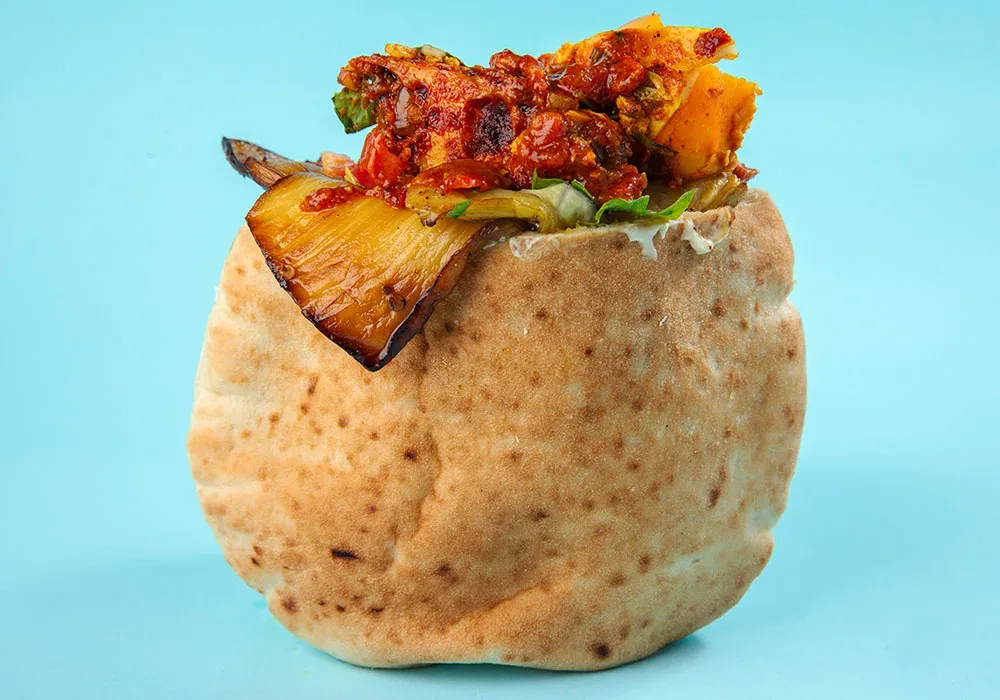
In sabich every part has its own job. The aubergine brings fat and softness, the egg body, the potato a gentle sweetness, the salad freshness and the tahini ties it together. Amba, sour, bitter and fragrant, is what turns it into sabich rather than just a pita with vegetables. Nothing is fried except the aubergine, and it is built in layers: tahini at the bottom, aubergine, sliced egg and potato, salad, then more tahini and amba on top, so every bite gets everything.
Sabich for any number of people

Change the number of people and the portion size, and every ingredient updates in grams, with the cost, calories and protein per portion.

Portion size
Units
2kg of food
3Pot to use, litres
₪32Cost of the pot
₪7.9per portion
889kcal per portion
26.0g protein per portion
IngredientAmountCost
The aubergine
Medium aubergines (eggplants), in 1.5 cm slices600 g · 2 pcs₪4.1
Salt for salting the aubergine8 g₪0.0
Canola oil for frying, the amount absorbed (about 500 ml in the pan)90 g₪1.3
The eggs and potatoes
Eggs220 g · 4 pcs₪5.3
Medium potatoes300 g · 2 pcs₪1.8
The tahini
Raw tahini100 g₪3.0
Cold water100 g
Lemon juice30 g₪0.6
Garlic clove, crushed5 g · 1 pcs₪0.2
Salt2 g
The salad
Tomatoes, finely diced150 g · 1 pcs₪1.2
Cucumbers, finely diced150 g · 2 pcs₪1.2
Parsley, chopped10 g₪0.5
Lemon juice10 g₪0.2
Olive oil10 g₪0.5
Salt2 g
The green schug
Green chillies25 g · 2 pcs₪0.3
Coriander, leaves and stems20 g₪1.0
Garlic clove4 g · 1 pcs₪0.1
Ground cumin1 g₪0.1
Ground cardamom1 g₪0.3
Olive oil20 g₪1.1
Salt1 g
To serve
Pitas400 g · 4 pcs₪7.5
Amba (pickled mango sauce)60 g₪1.4
Send on WhatsApp

Shelf prices at a large Israeli chain and specialty shops, October 2026. Nutrition from the ingredients in grams, before cooking.

How many calories in Sabich? Nutrition facts and calorie calculator

Change the amount of any ingredient, drop one, or pick a lighter version, and the numbers per serving update at once: calories, fat, carbs, protein, sodium and fibre.

Sabich has 178 calories per 100 g. A 500 g serving made with our recipe has 889 calories: 26 g protein, 50.8 g fat and 78.4 g carbohydrates.

Lighter

Ingredients, for the whole recipe

  • 2 pcs36 kcal per serving
  • 8 g0 kcal per serving
  • 90 ml183 kcal per serving
  • 4 pcs79 kcal per serving
  • 2 pcs58 kcal per serving
  • 100 g166 kcal per serving
  • 30 ml2 kcal per serving
  • 1 pcs2 kcal per serving
  • 2 g0 kcal per serving
  • 1 pcs7 kcal per serving
  • 2 pcs4 kcal per serving
  • 10 g1 kcal per serving
  • 10 ml1 kcal per serving
  • 10 ml20 kcal per serving
  • 2 g0 kcal per serving
  • 2 pcs3 kcal per serving
  • 20 g1 kcal per serving
  • 1 pcs1 kcal per serving
  • 1 g1 kcal per serving
  • 1 g1 kcal per serving
  • 20 ml41 kcal per serving
  • 1 g0 kcal per serving
  • 4 pcs278 kcal per serving
  • 60 g6 kcal per serving

What each add-on adds to Sabich

Values for the amount in the row, from the national food database.

Add-onCaloriesProtein, gFat, g
One large egg837.35.5
A tablespoon of oil122013.8
A whole pita27892.3
Half a pita1394.51.1
A tablespoon of raw tahini1003.69

How to make Sabich

In cook mode the screen stays on, tap a step when it is done, and the timers run next to each step.
  1. Aubergine: sprinkle the slices with salt on both sides, lay them in a colander for 30 minutes, then pat them very dry with paper towels.
  2. Potatoes: boil them in their skins in salted water for 25 to 30 minutes, until a knife slides in easily. Cool a little, peel and slice.
  3. Eggs: lower them into boiling water, cook for 10 minutes and move them to cold water. For true haminados, see the tips.
  4. Tahini: mix the raw tahini with the garlic, salt and lemon juice, then add the water gradually while stirring. At first it will seize into a paste, then it will lighten and turn smooth and pourable.
  5. Schug: blend the chillies, coriander, garlic, cumin, cardamom, salt and olive oil in a small blender to a coarse paste.
  6. Heat about 500 ml canola oil in a deep frying pan, 1.5 cm deep, to 175 °C. Fry the aubergine slices in a single layer for 3 to 4 minutes per side, until golden brown and completely soft inside.
  7. Move the aubergine to a rack set over a tray, not into a pile on paper, and let it rest for 5 minutes. Peel and slice the eggs.
  8. Salad: toss the tomatoes, cucumbers and parsley with lemon juice, olive oil and salt just before serving.
  9. Assemble: open a warm pita, spread tahini on the bottom, add 2 to 3 aubergine slices, a sliced egg and potato slices, fill with salad and finish with more tahini, amba and schug. Serve at once.

The science of Sabich

Kitchen science

Why the aubergine in sabich soaks up so much oil

Aubergine flesh is full of air pockets between the cells, so it behaves like a sponge. As frying begins the air escapes and oil takes its place. Salt draws water out of the cells by osmosis, the tissue shrinks and the pockets partly close, so salted and dried aubergine absorbs less oil and turns creamy. In oil that is too cool the aubergine sits for a long time before it softens, drinking more and more.

Kitchen science

Why haminados eggs turn brown and creamy

Egg white contains a little glucose. Over hours of gentle heat that sugar reacts with the proteins in the Maillard reaction, the same reaction that browns a bread crust, and the white turns tan with a deep, nutty taste. The low heat keeps the yolk creamy rather than chalky, while the onion skins mainly colour the shell.

Kitchen science

Why tahini thickens when you add water

Raw tahini is ground sesame particles suspended in their own oil. The particles, which contain proteins and carbohydrates, absorb the first water and swell, and the mixture seizes into a thick paste. More water pushes the particles apart and the tahini becomes smooth, pale and pourable. Lemon juice also thickens it at first, which is why the water goes in slowly.

Kitchen science

Why there is a green ring around the yolk

When an egg cooks too long at high heat, sulphur from the white joins with iron in the yolk to form iron sulphide, a grey green layer at the edge of the yolk. It adds a sulphur smell and a tired look. Ten minutes from the boil and straight into cold water prevents it.

Kitchen science

Amba: sour, bitter and fragrant

Amba is green mango pickled with salt and vinegar and spiced with fenugreek, turmeric and chilli. Fenugreek gives its typical bitterness and smell, turmeric the yellow colour, and the acid and salt preserve the mango. A little is enough, because its acidity cuts through the fat of the aubergine and tahini.

Sabich in every kitchen

Iraqi, Shabbat morning

On a plate rather than in a pita: aubergine fried on Friday, haminados eggs from the tbit pot, potatoes, salad and amba, with bread alongside. It is eaten slowly, after synagogue.

Ramat Gan, in pita

The 1960s kiosk version: everything in one pita with tahini, amba and chopped salad, plus parsley, onion and chilli for those who ask. This is the version that spread across Israel.

On a plate

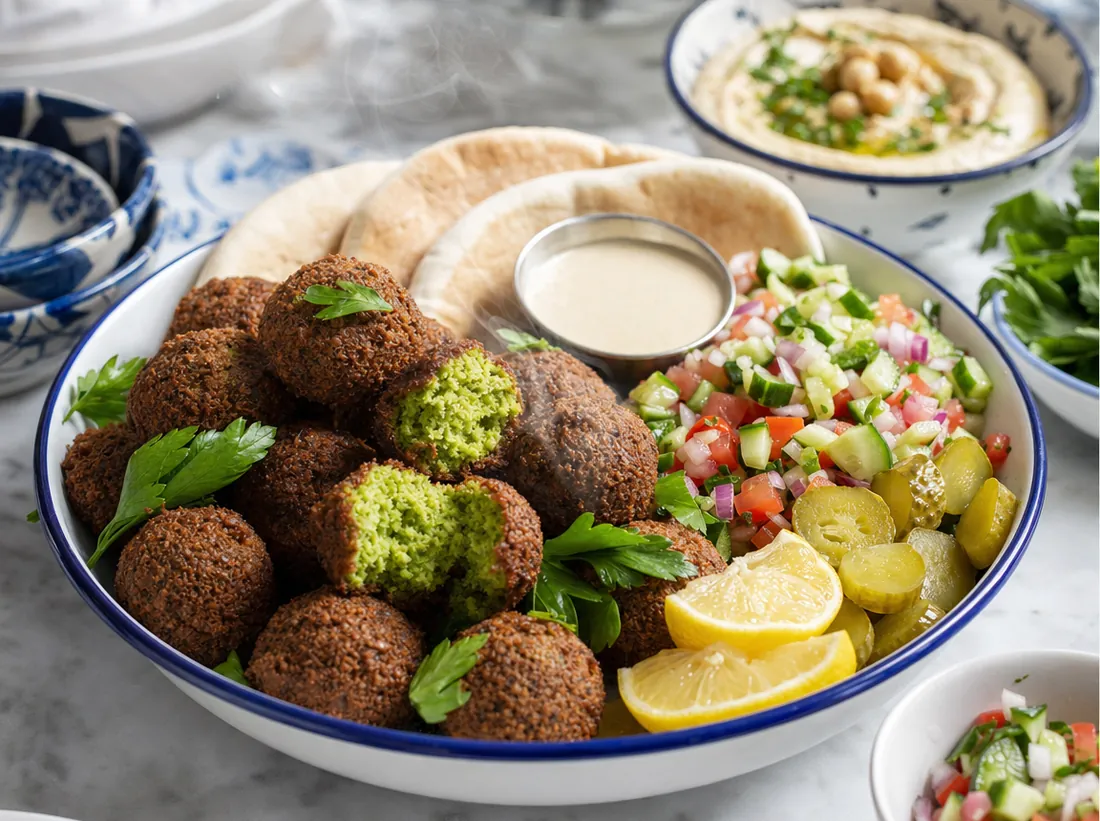
All the parts arranged on a plate with pita on the side and tahini and amba on top. It is the easy way to serve sabich to a group, because everyone builds their own.

In laffa

A large soft laffa holds more of everything, sometimes with hummus or shredded cabbage too. It is rolled tightly and wrapped in paper so it stays closed.

Vegan

No egg, more potato, and sometimes fried cauliflower or hummus. Everything else stays: aubergine, tahini, amba and salad.

Abroad

In cities with large Israeli communities, such as New York, London and Paris, sabich is a fixture of Israeli restaurants, sometimes in a sourdough pita or another flatbread. The aubergine and amba always stay.

Common Sabich problems and how to fix them

The aubergine soaked up a lot of oil

The oil was not hot enough, or the aubergine was not salted and dried. Salt for 30 minutes, dry well and fry at 175 °C in a single layer without crowding the pan. Drain on a rack, not in a pile.

The aubergine tastes bitter

Bitterness comes mostly from old aubergines or ones full of large seeds. Choose light, shiny aubergines with taut skin, and salt them before frying: the salt draws out some of the liquid and balances the taste.

The aubergine is burnt outside and raw inside

The oil was too hot or the slices too thick. Cut them 1.5 cm thick and lower the heat a little once the first side is golden. It is ready when it is completely soft and creamy in the middle.

The tahini turned into a thick paste

That is a stage on the way, not a failure. Keep adding cold water a spoonful at a time and stir until the tahini lightens and becomes pourable. If it tastes bitter, add a little lemon and salt.

The sabich pita tears and goes soggy

The salad was dressed too early and released water, or the pita was cold. Dress the salad just before serving, warm the pita for a few seconds, and put tahini in first and aubergine next, so the liquids do not touch the bread directly.

The hard boiled eggs have a green ring

They cooked too long. Boil for 10 minutes and move them straight into cold water. Haminados, cooked at very low heat, rarely get it.

Storing, freezing and reheating

3 days, each part separately

In the fridge

Not suitable for freezing

In the freezer

2+4

To cool

Bring it from 60 to 21 °C within two hours and down to 5 °C within four more. Split a big pot into shallow boxes.

75 °C

Reheating

Sabich is eaten at room temperature. Take the aubergine, potatoes and eggs out of the fridge half an hour ahead, warm only the pita, and make the salad fresh.

Nutrition of Sabich

From our recipe, per bowl and per 100 g, next to the national food database.

ServingkcalProtein, gFat, gCarbs, gFibre, g
Our recipe, a 500 g portion88926.050.878.412.4
Our recipe, 100 g1785.210.215.72.5

What the ingredients of Sabich cost

What each ingredient costs in one pot, and where to buy it.

IngredientPriceIn this potWhere to buy
Pitas₪1.6 each₪7.5Supermarket
Eggs₪1.4 each₪5.3Supermarket
Medium aubergines (eggplants), in 1.5 cm slices₪6.9 per kg₪4.1Greengrocer
Raw tahini₪30 per kg₪3Supermarket
Medium potatoes₪5.9 per kg₪1.8Greengrocer
Olive oil₪53 per litre₪1.6Supermarket
Amba (pickled mango sauce)₪24 per kg₪1.4Supermarket
Canola oil for frying, the amount absorbed (about 500 ml in the pan)₪15 per litre₪1.3Supermarket
Tomatoes, finely diced₪7.9 per kg₪1.2Greengrocer
Cucumbers, finely diced₪7.9 per kg₪1.2Greengrocer
Coriander, leaves and stems₪4.9 each₪1Greengrocer
Lemon juice₪20 per litre₪0.8Supermarket
Parsley, chopped₪4.9 each₪0.5Greengrocer
Green chillies₪13 per kg₪0.3Greengrocer
Garlic clove, crushed₪34 per kg₪0.3Greengrocer
Ground cardamom₪300 per kg₪0.3Spice shop
Ground cumin₪86 per kg₪0.1Supermarket
Salt for salting the aubergine₪2.1 per kg₪0Supermarket

Shelf prices at a large Israeli chain and specialty shops, October 2026, VAT included. Vegetable prices change with the season.

Sabich and its culture

Sabich is one of the few Israeli dishes whose birthplace is known exactly: Ramat Gan in the 1960s, a city that was home to many immigrants from Iraq. Ramat Gan and neighbouring Givatayim still have stands people travel across town for, and Iraqi families still eat the original meal on Shabbat morning: aubergine, haminados from the tbit pot and amba, on a plate and without hurrying.

Because it is parve, sabich suits almost any occasion: an office breakfast, a kiddush, a youth movement gathering or a Shabbat before a wedding. Abroad it has become in recent years one of the dishes that stand for Israeli street food, and Jewish communities order it deconstructed on trays: aubergine, eggs, potatoes, salads and sauces apart, with warm pitas, so everyone builds their own sabich.

Make Sabich a meal

Shabbat

Ready Shabbat food

Soup, hamin, mains and sides, with a quantity calculator and prices.

Plan Shabbat
Hosting

Hosting trays

9 trays to go with the soup, with a planner by number of guests.

Tray planner
Events

Catering

A whole menu in grams per guest, with a reheating table.

Menus

What to serve with Sabich

Serve in a warm pita, or on a plate with pita on the side, with pickles, green chillies and extra amba and tahini. A glass of tea with cardamom or a cold lemonade completes the meal.

The cuisine behind Sabich

Iraqi

Iraqi cuisine

In Baghdad, on Shabbat morning after prayers, Jewish families ate a meal prepared in advance: aubergines fried on Friday, brown eggs cooked…

Iraqi cuisine

Sabich in large quantities: events, offices and communities

How much of everything by number of guests, at a 500 g portion. For trays, catering and community kitchens.

Guestskg of food3 kg traysCost of ingredients
25125₪199
50259₪397
1005017₪795
20010034₪1,590
50025084₪3,974

Every ingredient for any number of guests is in the calculator above: type the number of people.

Order Sabich

A ready pot for Shabbat, an event or the office, ordered ahead.

  • Cooked to order, for Shabbat, an event or the office.
  • Tell us how many people and when, and we send a quote.
  • Delivery in Tel Aviv from ₪35, free over ₪750.

Order Sabich for a large event

Large orders in Israel and abroad: events, offices, synagogues, communities and institutions.

  • In Israel: cooked in Tel Aviv and delivered to events in the area, and to large events anywhere in the country on a quote.
  • Abroad: for communities, events and restaurants. Tell us where, how many and when, and we come back with a quote and options.
  • Institutional quantities and a shopping list for any number of guests, in the calculator above.
Skip the map
Loading the map

Where we are

Complete99, 99 Ibn Gabirol, Tel Aviv

03-523-1810

What is near the restaurant

  • Gan HaIr MallShopping · 390 m
  • Yitzhak Rabin MemorialMemorial · 440 m
  • Tel Aviv-Yafo City HallCity hall · 460 m
  • Rabin SquareSquare · 610 m
  • Holocaust MemorialMemorial · 640 m
  • Masaryk SquarePark · 880 m
All food businesses on Ibn Gabirol Street

Frequently asked questions

What is in sabich?

Fried aubergine, hard boiled or haminados egg, boiled potato, chopped salad, tahini and amba, in pita. Many add schug, parsley and onion too.

Why is it called sabich?

After Sabich Tzvi Halabi, born in Baghdad, who in 1961 put the Iraqi Shabbat breakfast into a pita at his kiosk in Ramat Gan. The explanations from the Arabic word for morning or from a Hebrew acronym for salad, egg, more aubergine came later.

What is amba?

A pickled green mango sauce with fenugreek, turmeric and chilli, sour and slightly bitter. Jewish merchants from Baghdad met it in India and brought it to Iraq, and Iraqi Jews brought it to Israel.

How do I fry aubergine for sabich without it soaking up oil?

Salt the slices for 30 minutes, dry them and fry at 175 °C in a single layer. Drain on a rack, not on paper. You can also bake the slices with a little oil, which gives a drier result.

Is sabich parve?

Yes. Everything in it is parve: vegetables, eggs, tahini and pita, so it can be served at a meat meal or a dairy one.

How do I make haminados eggs at home?

Cook eggs with onion skins, a spoonful of oil and water on the lowest heat for 5 to 6 hours, or overnight in the oven at 100 °C. The white turns brown and creamy and the yolk stays soft.

How much sabich do I need for 50 people?

Per guest, one pita, one egg, about 150 g of fresh aubergine and 75 g of potato. For 50 that is 7.5 kg of aubergine, 50 eggs, 4 kg of potatoes and 50 pitas, with tahini, amba and salad on the side. At events each part is served separately.

How many calories are in Sabich?

A 500 g portion of Sabich made with our recipe has about 889 calories and 26 g of protein. Per 100 g: 178 calories.

How much does it cost to make Sabich at home?

A tray or pot of 4 portions costs about ₪32 at Israeli shelf prices in October 2026, about ₪7.9 a portion. The calculator above works it out for any number of people.

Order now

Price, extras and availability are set in the ordering menu. You can also call.

Every dish

Home dishes of every community, each with a calculator, a price list and the science.

All the dishes