Iraqi Jewish food: 39 dishes from Baghdad, tbit to kleicha
Iraqi (Iraqi-Jewish) cuisine: 19 dishes, from Tbit to Kubba hamusta, 14 ingredients and spices, 5 dates in the holiday calendar, and the community’s story in Israel. Every dish that has a page here is linked, with every ingredient in grams.
 Illustration
The dishes of Iraqi (Iraqi-Jewish) cuisine
By when they are eaten: Shabbat, holidays, everyday and the street.
Iraqi (Iraqi-Jewish) cuisine, for shabbat
4 dishes
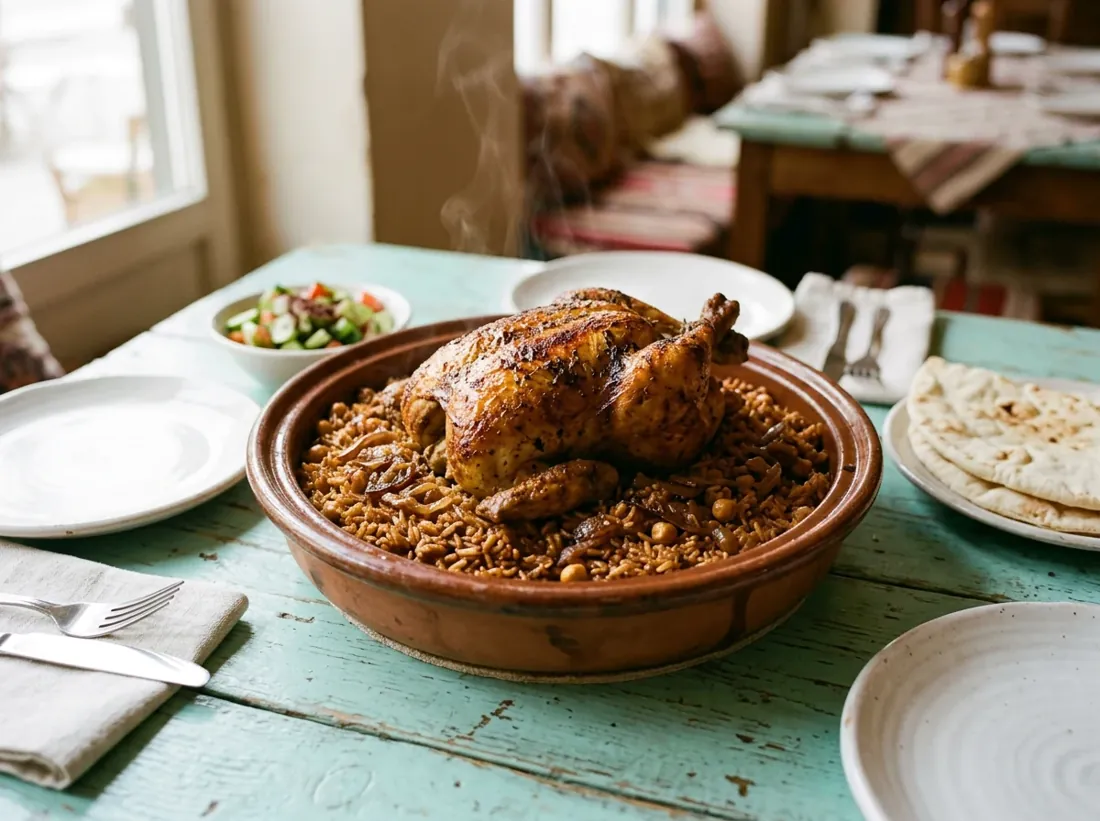
- Tbit: Chicken stuffed with rice and giblets, cooked overnight on low heat with rice seasoned with baharat, cardamom, cinnamon and tomatoes; Iraq's version of hamin
- Kubba hamusta: Lemon-sour soup with kubbeh (bulgur and semolina) and vegetables; a Friday soup in Kurdish-Iraqi families
- Beet kubba (shwander): Red beet-and-tomato soup with kubbeh; our page: beet kubbeh
- Shlarm: Turnips cooked overnight in tea and sugar for Shabbat
Iraqi (Iraqi-Jewish) cuisine, for holidays
6 dishes
- Rice kubba: Kubbeh in a rice shell, a Passover dish
- Qouzi: Lamb cooked slowly over rice
- Meshsheh: Quince or apricot stew with meat; confirm the occasion before publishing
- Kleicha: Ancient date-filled cookie or cake; for holidays
- Ma'amoul: Cookies filled with dates or nuts
- Baklava and halva: Iraqi desserts; fruit is the everyday dessert
Iraqi (Iraqi-Jewish) cuisine, everyday
6 dishes
- Okra kubba soup: Red okra soup with kubbeh
- Kubba Mosul: A large, flat kubbeh named after Mosul, filled with spiced meat
- Kitchri: Rice and red lentils, a Thursday dish
- Mahshi: Vegetables stuffed with rice and meat; in the north the version includes pomegranate
- Yaprakh: Stuffed vine leaves
- Masgouf: Carp from the Tigris, split open and grilled beside a fire; associated with southern Iraq (Basra)
Iraqi (Iraqi-Jewish) cuisine, street food
3 dishes
- Sabich: Pita with fried aubergine, hard-boiled egg, hummus or tahini, amba and salad; rooted in the Shabbat breakfast in Iraq; Ramat Gan stand, 1961
- Sambusak: Half-moon pastry; in Iraq filled with chickpeas, meat or cheese
- Amba: Pickled-mango sauce with pepper paste and spices
This cuisine’s dishes in our kitchen
Each has a page with a photo, what is in it and every ingredient in grams.
IllustrationTabit
Tabit is the hamin of Iraqi Jews: a whole chicken over rice spiced with cardamom, cinnamon and baharat, cooked slowly all night until the ri
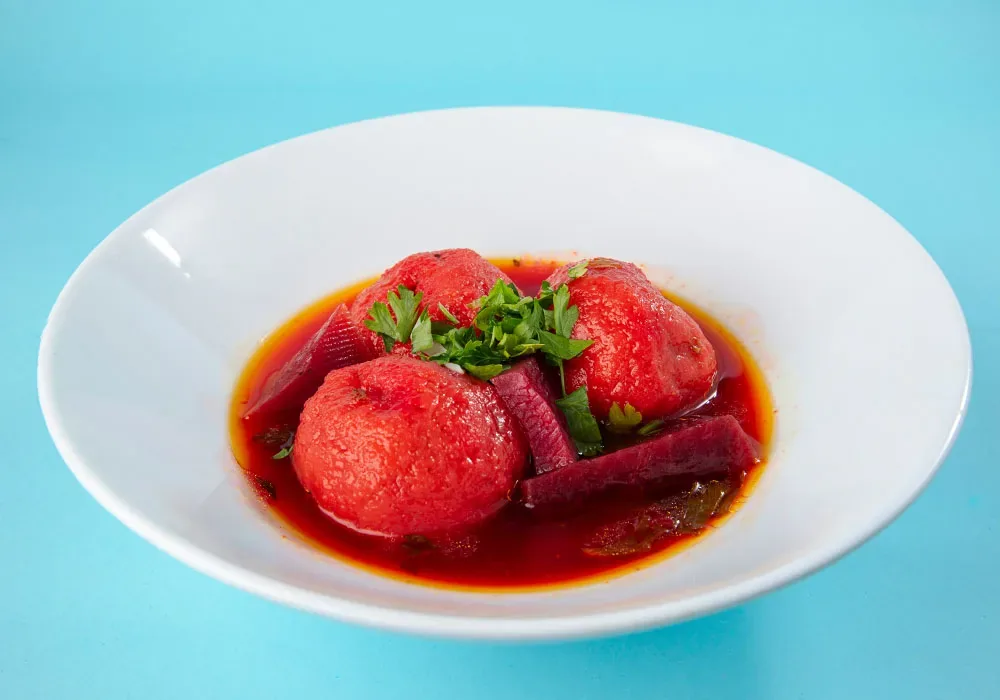
Beet Kubbeh
Sweet and sour beet soup with meat-filled kubbeh, served as a warm, generous bowl from the pots.
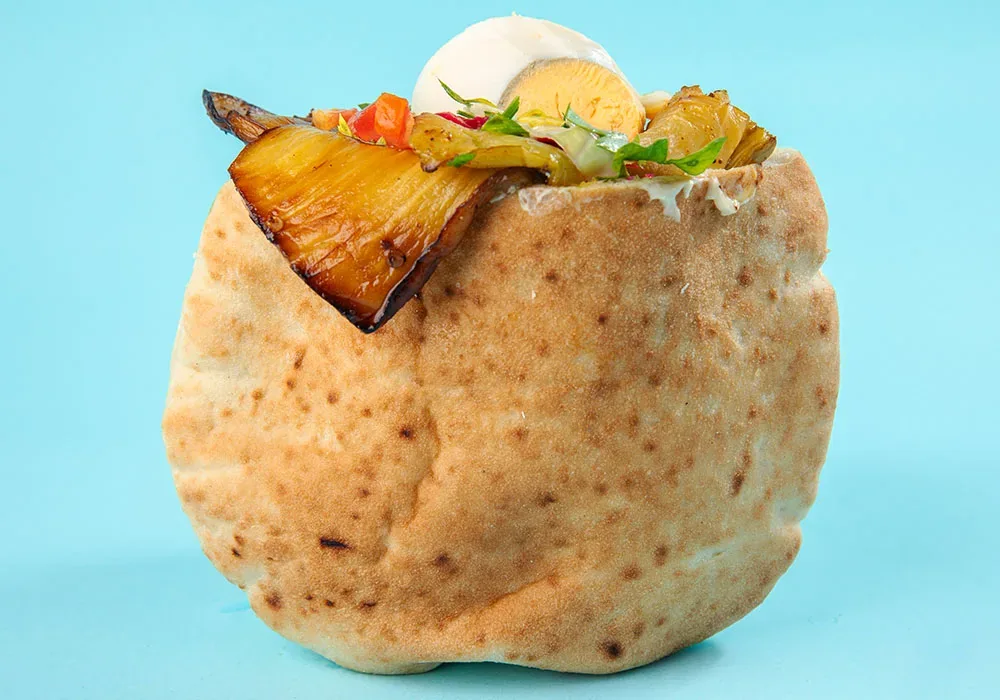
The 99 Sabich
Aubergine, egg, potato, salad, tahini, amba and hot sauce, in a pita or on a plate.
 Illustration
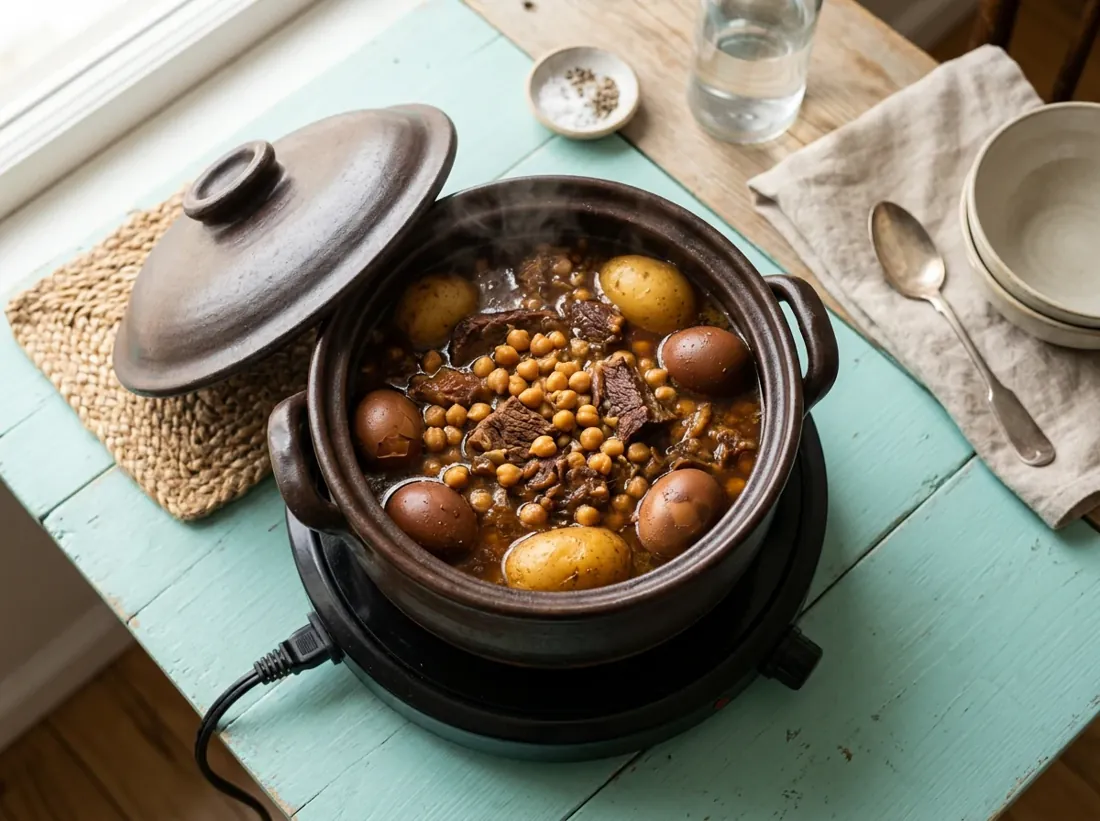
Hamin and cholent: one Shabbat pot, three communities
The Shabbat stew: legumes, potatoes and meat cooked slowly all night, until everything melts into one pot.
Iraqi Jewish food in one minute
What it is
Iraqi Jewish food is the cooking of the Jews of Baghdad, Basra and the towns of the north, a community that lived in Mesopotamia for some 2,600 years until almost all of it moved to Israel in the early 1950s. Rice is the centre of the table, kubba comes in dozens of forms, stews are sweet and sour, and the week is set by fixed dishes: kitchri on Thursday, kubba soup on Friday and tbit for Shabbat lunch.
How it differs from Iraqi cooking in general
It shares most dishes with Muslim and Christian Iraqi homes, from masgouf to kleicha. The differences come from the Shabbat clock and from kashrut: dishes that wait overnight, such as tbit and brown eggs; oil instead of butter or ghee in meat dishes; and dairy kept for separate meals, such as Thursday kitchri and the Shavuot breakfast of kahi and geymar.
The names
Families spoke Judeo-Arabic, so the dishes carry Baghdadi names: timman for rice, beid hamine for the overnight eggs, hamudh for sour, helu for sweet, silan for date syrup. Amba and silan came to Israel with the community and entered everyday Hebrew.
The neighbours
The Iraqi and Kurdish Jewish kitchens overlap, above all in kubba soups. Persian touches show in the rice and the sour fruit, and Indian ones in amba, which arrived through traders who lived in Bombay and Calcutta.
Iraqi Jewish food in numbers
years of Jewish life in Iraq
From the Babylonian exile to the airlift of the early 1950s.
dishes in the atlas below
From the Shabbat pot to the Hanukkah fritters, with what is in each and how it is eaten.
dishes that set the week
Kitchri on Thursday night, kubba soup on Friday, beid hamine on Shabbat morning and tbit for Shabbat lunch.
ways to make it sour
Lemon, dried lime, tamarind, pomegranate molasses and sumac.
Iraqi Jewish food atlas: 39 dishes and how they are eaten
The dish, what is in it, when it is served and how it is eaten.
| Dish | What is in it | When | How it is eaten |
|---|---|---|---|
| Tbit | A whole chicken stuffed with rice, giblets and spices, set on more rice with tomato and cardamom, cooked overnight | Shabbat lunch | The crisp rice from the bottom of the pot is the prize |
| Beid hamine | Eggs cooked overnight in the tbit or hamin pot until the whites turn brown | Shabbat morning | Halved, in pita with fried aubergine and amba |
| Sabich | Pita with fried aubergine, hard-boiled egg, tahini, salad and amba | Street food, every day | The Shabbat breakfast that became a stand in Ramat Gan |
| Kubba burghul | A bulgur shell around minced meat, onion, parsley and almonds or pine nuts | Holidays, parties | Fried, with amba and pickles |
| Kubba halab | A shell of cooked rice, often yellow with turmeric, around spiced meat | Weekdays and Passover | Fried, or poached in soup |
| Kubba Mosul | A large flat disc of bulgur with a spiced meat filling | Family meals | Boiled or fried, and cut into wedges |
| Kubba patata (chap) | A mashed potato shell around spiced minced meat, breaded and fried | Weekdays, parties | With amba and pickles |
| Kubba hamudh | Semolina kubba in a sour soup of turnip, chard, celery and mint with lemon | Friday | Over white rice |
| Kubba shwander | Kubba in a sweet and sour beet and tomato soup | Friday, winter | Over white rice |
| Kubba bamia | Kubba in a red okra and tomato soup | Weekdays, Friday | Over white rice |
| M'hasha | Onions, courgettes, peppers, aubergines, tomatoes and vine leaves stuffed with rice and meat in a sweet and sour sauce | Friday night, holidays | Layered in the pot and turned out |
| Bamia | Okra and beef in tomato sauce with lemon and a little sugar | Weekdays | Over white rice |
| Fasoulia | White or green beans with beef in tomato sauce | Weekdays | Over white rice |
| Ingriyi | Beef or lamb with aubergine and tamarind, sweet and sour | Family dinners | With white rice |
| Mishmishiya | Chicken or meat with dried apricots, almonds and sweet spices | Holidays | With yellow rice |
| Qouzi | Lamb or chicken over spiced rice with almonds and raisins | Weddings, big holidays | Carved over the rice on one platter |
| Masgouf | Carp split open and grilled upright beside a fire | Evenings by the river | With amba, onion, tomato and bread |
| Shifta | Minced beef with onion and parsley, shaped into patties | Weekdays | In pita with amba, or with rice |
| Shorbat adas | Red lentil soup with cumin and lemon | Winter | With bread and lemon |
| Kitchri | Rice and red lentils cooked together with garlic | Thursday night, a dairy dinner | With yogurt, a fried egg and pickles |
| Timman | Long-grain amber rice, rinsed and cooked to separate grains | Every meal | Under every stew |
| Timman ahmar | Rice cooked with tomato paste | Weekdays | With fried kubba or chicken |
| Timman b'sha'riya | Rice with toasted vermicelli | Weekdays and Shabbat | With stews |
| Sambusak b'tawa | Half-moon pastries filled with mashed chickpeas, onion and cumin | Shabbat, holidays | Fried, warm, with amba |
| Sambusak b'jibn | Pastries filled with salty white cheese | Shavuot and dairy meals | Baked or fried, warm |
| Kahi and geymar | Thin layered pastry, fried, with clotted cream and date syrup or sugar syrup | Shavuot morning, festive breakfasts | Torn by hand and dipped |
| Ka'ak | Savoury rings covered in sesame | With tea, all year | Dipped in tea |
| Kleicha | Cookies filled with dates or walnuts, scented with cardamom and rose water | Holidays, Purim | With tea |
| Hadgi badah | Almond and cardamom cookies, flourless for Passover | Passover and Purim | With tea or coffee |
| Zengoula | Spirals of batter fried and soaked in lemon syrup | Hanukkah | Warm and sticky, by hand |
| Mahallabi | Milk or almond-milk pudding with rose water | Summer, dairy meals, Shavuot | Cold, with pistachios |
| Halek | Date syrup with chopped walnuts | The Passover seder | The Iraqi haroset, spread on matzah |
| Silan and rashi | Date syrup with tahini | Breakfast and dessert | Scooped up with bread |
| Amba | Pickled mango sauce with fenugreek, turmeric and chilli | Every day | Over sabich, kubba, eggs and fish |
| Turshi | Turnips turned pink by beet, cauliflower, cucumbers and peppers in brine | Every table | Between bites of rice and stew |
| Khubz (Iraqi pita, laffa) | A large, thin flatbread from a clay oven | Every day | Wrapped around sabich and kebab |
| Chai with hel | Strong black tea brewed with cardamom pods | After every meal | In small glasses, sweet |
| Aloo makala (Calcutta) | Whole potatoes fried slowly until crisp outside and soft inside | Friday night in Calcutta | Beside the chicken, with a fenugreek relish |
| Chitarnee (Calcutta) | Chicken in a sweet and sour spiced sauce, Baghdadi in shape and Indian in spice | Shabbat and holidays in Calcutta | With rice |
Names as they sound in the Judeo-Arabic of Baghdad. Every family has its own spelling and its own measures.
Hamudh helu: the sweet and sour code
Lemon
The everyday sour of kubba hamudh, bamia and m'hasha.
Dried lime (noomi basra)
Named after Basra, it gives stews and rice a deep, almost smoky sourness.
Tamarind
Dark and fruity, in ingriyi and some stuffed vegetables.
Pomegranate molasses
Sour and sweet at once, in m'hasha and kubba soups.
Silan (date syrup)
The Iraqi sweetener, in sauces, on the Rosh Hashanah table and in the Passover halek.
Sugar and dried fruit
A spoon of sugar in the beet soup, apricots and raisins in holiday dishes.
Cardamom, cinnamon and baharat
Warm, not hot: the spice of the tbit rice, of tea and of the sweets.
Taste, then adjust
A good cook tastes the pot and adds lemon or sugar until neither one wins. That balance is what Iraqi families mean when they say a dish came out right.
The Iraqi Jewish holiday table, beyond Shabbat
What goes on the table at each holiday, and the custom behind it.
| When | What is on the table | The custom |
|---|---|---|
| Rosh Hashanah, first night | Dates, pomegranate, apple in silan, leek, chard, pumpkin, black-eyed peas, a fish or lamb head | A seder of blessings: a bite of each with its wish for the year; silan takes the place of honey |
| Hanukkah | Zengoula | Fried in oil for the miracle of the oil, then soaked in lemon syrup |
| Tu Bishvat | Dried fruit, nuts and fresh fruit | A large tray for the new year of the trees |
| Purim | Kleicha, hadgi badah and other sweets | Trays of cookies sent to family and friends |
| Passover | Halek, rice dishes, rice kubba, flourless hadgi badah | Halek is the haroset; like most Mizrahi families, Iraqi Jews eat rice on Passover after sorting it grain by grain |
| Shavuot | Kahi and geymar, cheese sambusak, mahallabi | A dairy breakfast; in Iraq families also made a pilgrimage to the tomb of the prophet Ezekiel and feasted outside it |
Thursday, Friday, Shabbat and the Passover basics are in the holiday calendar above.
The Iraqi pantry: 13 things beyond baharat
The English name, the name you will hear in the kitchen, the Hebrew name and what it does.
| English | Name you will hear | Hebrew | What it does |
|---|---|---|---|
| Tamarind | tamar hindi | תמרהינדי | A dark, sour paste for ingriyi and sweet and sour stews |
| Pomegranate molasses | dibs rumman | דבס רימונים | Sour-sweet syrup for m'hasha and soups |
| Tahini | rashi | טחינה | Mixed with silan for breakfast, or loosened into a sauce |
| Clotted cream | geymar | שמנת קרושה (גימאר) | Thick cream for kahi on dairy mornings |
| Amber rice | timman anbar | אורז ענבר | Fragrant long-grain rice, the pride of the Iraqi pot |
| Dried apricots | mishmish | משמש מיובש | Sweetness for holiday chicken and meat |
| Turnip | shalgham | לפת | In sour kubba soup and in the pink pickles |
| Chard | silq | מנגולד (סלק עלים) | In kubba hamudh and on the Rosh Hashanah table |
| Okra | bamia | במיה | For bamia stew and the red kubba soup |
| Chickpeas | hummus | גרגרי חומוס | Mashed for sambusak and cooked into broths |
| Vermicelli | sha'riya | אטריות דקות | Toasted golden and cooked with rice |
| Dried mint | na'na' yabis | נענע יבשה | Rubbed into soups and into kubba hamudh |
| Black tea | chai | תה שחור | Brewed strong with cardamom after every meal |
Amba, baharat, silan and dried lime are in the glossary above.
An Iraqi Jewish feast, course by course
- Mezze
Pickles, amba, chopped salad, fried aubergine and a basket of warm khubz.
- Fried pastries
Kubba burghul, kubba patata and sambusak b'tawa, straight from the oil.
- Soup
A kubba soup, sour with lemon or sweet and sour with beet, served with white rice.
- Rice and stews
A large dish of timman with one or two stews, bamia or fasoulia, and a tray of m'hasha turned out of the pot.
- The centrepiece
Tbit on Shabbat; qouzi or mishmishiya at a holiday or a wedding.
- Fruit
Watermelon, grapes, dates or pomegranate, depending on the season.
- Tea and sweets
Small glasses of tea with cardamom, kleicha, ka'ak and, on a dairy day, mahallabi.
From Baghdad to Bombay, Calcutta, Singapore and Shanghai
Bombay, from the 1830s
Baghdadi merchants settled in Bombay and built synagogues, schools and trading houses. The kitchen kept its rice and kubba and took in Indian spice.
Calcutta, from the late 18th century
The Baghdadi community of Calcutta gave the world aloo makala, whole fried potatoes for Friday night, and chitarnee, a sweet and sour chicken for Shabbat.
Singapore
The Maghain Aboth synagogue, built in 1878, served a Baghdadi community whose Shabbat tables mixed Iraqi rice dishes with local ingredients.
Shanghai
Baghdadi trading families arrived in the 1840s, and their homes kept the Iraqi Jewish holiday foods far from Baghdad.
Ramat Gan and Or Yehuda
Most of the community arrived in the early 1950s. Amba, sabich and silan moved from Iraqi homes into everyday Israeli food.
A sauce that travelled both ways
Pickled mango reached Iraq from India in the 19th century through this trade, then travelled with Iraqi Jews to Israel.
Iraqi food: myths and facts
What people say, and what is true.
| You may have heard | The fact |
|---|---|
| Kubba is one dish | It is a family of dozens: fried and boiled, round and flat, with shells of bulgur, semolina, rice or potato, and soups of every colour. |
| Iraqi food is very spicy | It is warm, with cardamom, cinnamon and turmeric, but it has little chilli. The heat comes from amba and pickles at the table. |
| Amba was always Iraqi | Pickled mango came from India in the 19th century and became Iraqi on the way. |
| Tbit is just Iraqi cholent | Cholent is beans, barley and beef. Tbit is a stuffed chicken over rice, with eggs on top and a crisp rice crust. |
| Kitchri is an Iraqi invention | Its name and idea match khichdi, the rice and lentils of India; in Baghdad it became the Thursday-night dairy dinner. |
| Silan is a new product | Date syrup is one of the oldest sweeteners of Mesopotamia, and it has always stood on the Iraqi Jewish table. |
Start here: 10 Iraqi dishes, easiest first
- 1. Timman b'sha'riya
Toast vermicelli in oil until golden, add rinsed rice and water, and cook covered.
- 2. Silan and rashi
Pour tahini into a dish, swirl date syrup through it and eat it with warm bread.
- 3. Kitchri
Rice and red lentils cooked with garlic and cumin, served with yogurt and a fried egg.
- 4. Shorbat adas
Red lentils, onion and cumin, cooked soft and finished with lemon.
- 5. Fasoulia
Beef and white beans simmered in tomato until thick, over rice.
- 6. Bamia
Okra and beef in tomato, with lemon and a spoon of sugar.
- 7. Sabich at home
Fry aubergine slices, boil eggs, and fill pita with tahini, salad and amba.
- 8. M'hasha
Hollow out onions and courgettes, stuff them with rice and meat, and cook them in a sweet and sour sauce.
- 9. Kubba hamudh
Semolina shells filled with meat, poached in a sour soup of turnip and chard.
- 10. Tbit
Stuff a chicken with rice, set it on more rice and cook it overnight at low heat.
The holiday calendar of Iraqi (Iraqi-Jewish) cuisine
What goes on the table on each date.
| Date | Dishes | Note |
|---|---|---|
| Shabbat | Tbit, Shlarm, Sabich (breakfast) | Sabich is the Shabbat breakfast that became a street-food stand |
| Thursday | Kitchri | |
| Friday | Kubba hamusta | |
| Passover | Rice kubba | |
| Rosh Hashanah and the holidays | Qouzi, Meshsheh, Kleicha |
Spice and ingredient glossary
The name in Hebrew, in the local language and in English, and what it is for.
| English | Local name | Hebrew | What it is |
|---|---|---|---|
| Amba | عمبة | Amba | Pickled mango with spices |
| Baharat | بهارات | Baharat | Spice blend |
| Cardamom | هيل | Cardamom | |
| Cinnamon | قرفة | Cinnamon | |
| Turmeric | كركم | Turmeric | |
| Ginger | زنجبيل | Ginger | |
| Nutmeg | جوزة الطيب | Nutmeg | |
| Date syrup | دبس | Date syrup | Sweet sauces |
| Rose water | ماء الورد | Rose water | |
| Dried lime | نومي بصرة | Dried lime | For a sour sauce |
| Bulgur | برغل | Bulgur | Kubbeh shell |
| Semolina | سميد | Semolina | |
| Beet | شوندر | Beet | Shwander soup |
| Rice | رز | Rice | The backbone of the cuisine |
Techniques and vessels
How it is cooked, and in what.
Overnight Shabbat cooking
Tbit and shlarm on a low flame or in a closed oven; hamin usually 12 to 18 hours
Hand-shaping kubba
A shell of bulgur, semolina or rice around a filling
Deep frying
Fried kubbeh, sambusak
Sour broth
Lemon or dried lime
Tandoor baking
Flatbread baked in a clay oven
Stuffing and pot layering
Mahshi and yaprakh
Open-fire grilling
Masgouf
Pickling
Amba
Regions and variants
The same dish, another city, another taste.
| Region | What is special |
|---|---|
| North (Mosul, Kurdistan) | Stuffed dishes with pomegranate; Mosul kubbeh |
| Centre (Baghdad) | Rice dishes and desserts |
| South (Basra) | Fish, masgouf |
Iraqi (Iraqi-Jewish) cuisine in Israel
How they came
Operation Ezra and Nehemiah: April 1950 to January 1952, about 110,618 by air (about 119,970 in total), about 900 flights; 138,000 Jews in Iraq beforehand
Where they settled
Transit camps, Or Yehuda, Ramat Gan, Givatayim, Kiryat Gat
Markets and places
HaTikva Market: Iraqi cookie shops. The sabich stand on Uziel Street in Ramat Gan (1961): A kiosk run by Halabi, a Baghdad native; the story is disputed. Sabich Oved (7 Sirkin St, Givatayim): Featured in the Time Out guide.
Iraqi (Iraqi-Jewish) cuisine in numbers
Airlifted to Israel in the operation (April 1950 to January 1952)
Jews of Iraqi origin in Israel
Neighbouring cuisines
The same pots, other spices.
Moroccan (Moroccan-Jewish) cuisine
22 dishes, a spice glossary, a holiday calendar and the story in Israel.
To the pageYemenite cuisine
21 dishes, a spice glossary, a holiday calendar and the story in Israel.
To the pageKurdish (Kurdish-Jewish) cuisine
21 dishes, a spice glossary, a holiday calendar and the story in Israel.
To the pagePersian (Iranian-Jewish) cuisine
21 dishes, a spice glossary, a holiday calendar and the story in Israel.
To the pageSyrian (Aleppo and Damascus Jewish) and Lebanese cuisine
25 dishes, a spice glossary, a holiday calendar and the story in Israel.
To the pageTunisian and Tripolitan (Libyan-Jewish) cuisine
28 dishes, a spice glossary, a holiday calendar and the story in Israel.
To the pageFrequently asked questions
What is tbit?
The Iraqi version of hamin: chicken stuffed with rice and giblets, cooked overnight, with rice seasoned with baharat, cardamom, cinnamon and tomatoes.
Who invented sabich?
The accepted story points to Halabi, a Baghdad native, who opened a kiosk on Uziel Street in Ramat Gan in the early 1960s. The story is disputed, and the dish has its roots in the Shabbat breakfast in Iraq.
What is amba?
A spiced pickled-mango sauce, a standard component of sabich.
What is the difference between kubba hamusta and beet kubba?
In hamusta the soup is lemon-sour with green vegetables, while in beet kubba the soup is red from beet and tomatoes.
Why is kitchri eaten on Thursday?
A simple Iraqi-Jewish dish of rice and red lentils, traditionally eaten on Thursday.
What is shlarm?
Turnips cooked overnight in tea and sugar, for Shabbat.
What is the difference between Iraqi and Kurdish food?
The cuisines are close and share kubbeh, but the Kurdish stresses sour kubbeh soups and bread baked on a saj, while the Iraqi stresses rice, stuffed vegetables and tbit.
Which spices stand out in Iraqi food?
Baharat, cardamom, cinnamon, turmeric, ginger, nutmeg, amba and rose water.
How long do you cook tbit?
All night; hamin is usually cooked for 12 to 18 hours.
Where can you eat Iraqi food in Israel?
In Ramat Gan and Givatayim (sabich), at HaTikva Market and Mahane Yehuda Market in Jerusalem, and in restaurants listed on sites such as 2eat.
A meal from this cuisine, for a team or an event
How many people, when and what they like. We come back with a proposal.