Matbucha

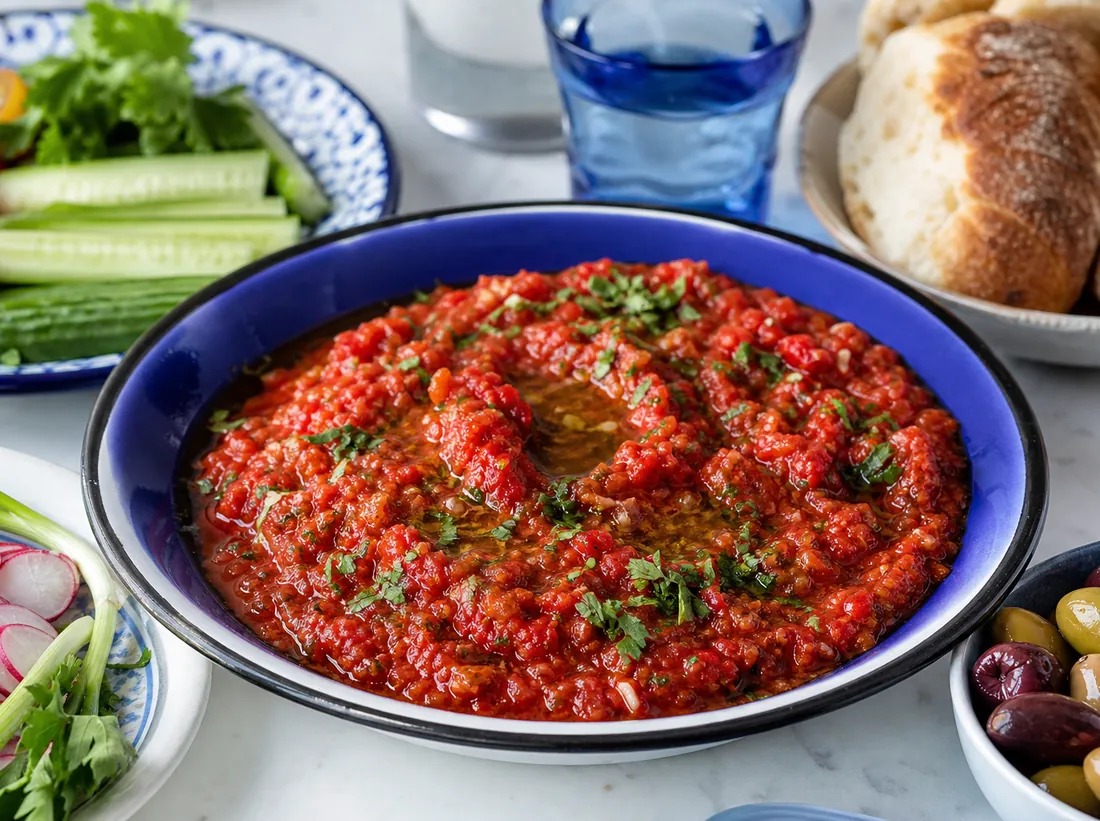
Matbucha is a cooked salad of ripe tomatoes and roasted red peppers, with garlic, hot chilli, paprika and plenty of oil, simmered slowly for two hours until it is as thick as jam. In the kitchen of Moroccan Jews it is the first salad on the Shabbat table, and in Israel it is in almost every fridge.

Quantity calculatorOrder Matbucha

VeganVegetarianGluten freeDairy freeParve

Updated

MatbuchaIllustration
Time4 hCook 2 h 30 min
Amount6 portions0.9 kg
Per portion188 kcal3.7 g protein · a 150 g portion
Cost of the pot₪21for the pot, about ₪3.6 a bowl

The story of Matbucha

Matbucha means cooked in Arabic, and the name sets it apart from fresh salads: this is a salad that stands on the stove. In Moroccan Jewish homes, where French was spoken too, it was called salade cuite, cooked salad. It belongs to the big family of small salads that open the Moroccan Friday night meal, and it is made ahead, on Thursday or Friday, because it only improves as it sits.

With the great immigration from Morocco in the 1950s and 1960s, matbucha arrived in Israel, and within a generation it moved from Moroccan homes to every Shabbat table, to Middle Eastern restaurants and onto supermarket shelves. In many homes it is also the base of shakshuka: matbucha in a pan, eggs on top, and a lid.

What makes Matbucha itself

Matbucha is patience in a pot. Tomatoes that are mostly water cook slowly, uncovered, until most of that water has evaporated and the flavour concentrates into a sweet, tangy, deep spread. The peppers are charred over a flame first and peeled, so they add sweetness and smoke. The oil is not only for frying: at the end of cooking it separates from the vegetables and rises red, and that is the sign the matbucha is ready.
Matbucha for any number of people

Change the number of people and the portion size, and every ingredient updates in grams, with the cost, calories and protein per portion.

Portion size
Units
0.9kg of food
3Pot to use, litres
₪21Cost of the pot
₪3.6per portion
188kcal per portion
3.7g protein per portion
IngredientAmountCost
The vegetables
Very ripe tomatoes1.5 kg · 10 pcs₪12
Red peppers600 g · 3 pcs₪5.9
Fresh hot chillies, red or green30 g · 2 pcs₪0.4
Garlic cloves, sliced30 g · 10 pcs₪1.0
Oil and spices
Canola oil80 g₪1.2
Sweet paprika8 g₪0.7
Hot paprika2 g₪0.2
Salt10 g₪0.0
Sugar, only if the tomatoes are sharp5 g₪0.0
Send on WhatsApp

Shelf prices at a large Israeli chain and specialty shops, October 2026. Nutrition from the ingredients in grams, before cooking.

How many calories in Matbucha? Nutrition facts and calorie calculator

Change the amount of any ingredient, drop one, or pick a lighter version, and the numbers per serving update at once: calories, fat, carbs, protein, sodium and fibre.

Matbucha has 125 calories per 100 g. A 150 g serving made with our recipe has 188 calories: 3.7 g protein, 13.2 g fat and 12.3 g carbohydrates.

Lighter

Ingredients, for the whole recipe

  • 10 pcs45 kcal per serving
  • 3 pcs17 kcal per serving
  • 2 pcs2 kcal per serving
  • 10 pcs7 kcal per serving
  • 80 ml108 kcal per serving
  • 8 g4 kcal per serving
  • 2 g1 kcal per serving
  • 10 g0 kcal per serving
  • 5 g3 kcal per serving

How to make Matbucha

In cook mode the screen stays on, tap a step when it is done, and the timers run next to each step.
  1. Char the whole peppers over a gas flame or under a 250 degree grill for 20 to 25 minutes, turning until the skin is black all over. Transfer to a covered bowl for 10 minutes.
  2. Peel the peppers, remove the seeds and stems, and cut into 1 cm dice. Keep the juice that collected in the bowl.
  3. Score a cross in the base of each tomato, dip in boiling water for 30 to 60 seconds and transfer to cold water. Peel and chop. You can also grate them on a coarse grater; the skin stays in your hand.
  4. In a wide, heavy based pot, warm the oil over low heat, add the garlic and chilli and fry for one minute without browning.
  5. Add the tomatoes, paprika and salt, bring to a boil and lower the heat. Cook uncovered for an hour, stirring every 10 minutes.
  6. Add the roasted peppers with their juice and keep cooking over very low heat for 60 to 90 minutes. As the matbucha thickens, stir more often and scrape the bottom.
  7. The matbucha is ready when it is as thick as jam, a spoon drawn across the bottom leaves a clean path, and red oil separates at the edges. Taste, and add the sugar if it is sharp.
  8. Cool in the open pot to room temperature, for no more than two hours, then move to a closed jar in the fridge. It tastes even better the next day.

The science of Matbucha

Kitchen science

Why matbucha cooks for two hours

A fresh tomato is more than 90 per cent water. In long, uncovered cooking that water evaporates, and the tomato's sugars, acids and natural glutamate concentrate, which is why the flavour turns sweet, tangy and deep. The pectin holding the vegetables together breaks down, and the texture becomes a spread. Once little water is left, the bottom of the pot climbs above 100 degrees, and the Maillard reaction and caramelisation begin, adding depth.

Kitchen science

The red oil of matbucha

The red of tomato is lycopene and the red of pepper is capsanthin, and both dissolve in fat, not water. Capsaicin, which gives the heat, dissolves in oil too. Over the long cooking they move into the oil and colour it. Once most of the water has evaporated, the oil no longer stays dispersed among the vegetables and separates at the edges, the most reliable sign that the matbucha is done.

Kitchen science

Charring the peppers

Over an open flame the pepper's skin chars, and a layer of steam forms between skin and flesh, pushing them apart. Ten minutes in a covered bowl continues the steaming, and the skin slips off easily. The charred flesh loses water, softens and turns sweeter and slightly smoky, while the tough skin, which never softens even in long cooking, stays out of the salad.

Kitchen science

Matbucha with garlic in oil: food safety

Garlic covered in oil is a low oxygen environment, and at room temperature bacteria that do not need oxygen can grow in it. Tomatoes are acidic, but not enough to rely on. So cool matbucha within two hours, keep it in a closed jar below 5 degrees Celsius and eat it within 5 days. For longer storage, freeze it.

Matbucha in every kitchen

Classic Moroccan

Peeled ripe tomatoes, roasted red peppers, garlic, hot chilli, paprika and oil, cooked for two hours or more. Some homes add a pinch of cumin.

Spicy matbucha

Twice the fresh chilli, seeds and all, and hot paprika in place of some of the sweet. Eaten in small amounts, with plenty of challah.

Matbucha with aubergine

Cubes of fried aubergine go into the pot for the last half hour, making the matbucha fuller and richer.

With green pepper

Some homes make matbucha with green peppers, or half green and half red. The taste is sharper and less sweet, and the colour darker.

Quick, from cans

Canned peeled tomatoes instead of fresh, and roasted peppers from a jar. Cooking drops to about an hour, and the result is very good in winter, when fresh tomatoes are pale.

Tunisian cousin

In Tunisia, salata mechouia is made from peppers and tomatoes charred over a flame and chopped, without long cooking, sometimes served topped with tuna and a hard boiled egg.

Common Matbucha problems and how to fix them

My matbucha is watery

It has not cooked long enough, the pot was covered or narrow, or the tomatoes were watery. Keep cooking uncovered over low heat, and move to a wider pot if needed. Matbucha is ready only when the oil separates at the edges.

My matbucha burnt on the bottom

The heat was too high in the thick stage, or it was not stirred enough. At once move the top part to a clean pot without scraping the burnt bottom, and carry on over a heat diffuser, stirring often.

My matbucha is too sour

The tomatoes were not ripe, usually in winter. Add a teaspoon of sugar, cook for another half hour, and next time use very ripe tomatoes or canned peeled ones.

My matbucha turned brown, not red

The paprika burnt in hot oil, or the matbucha cooked over too high a heat at the end. Add the paprika with the tomatoes, not to the bare oil, and keep the heat very low for the last hour.

My matbucha is too spicy

Most of the heat sits in the seeds and white ribs of the chilli. Add more roasted pepper or tomato and cook a little longer; next time remove the seeds and add chilli gradually.

Storing, freezing and reheating

5 days in a closed jar

In the fridge

3 months

In the freezer

2+4

To cool

Bring it from 60 to 21 °C within two hours and down to 5 °C within four more. Split a big pot into shallow boxes.

75 °C

Reheating

Serve cold or at room temperature, taken out of the fridge half an hour ahead. For shakshuka, heat it in a pan over medium heat until it bubbles, and only then add the eggs.

Nutrition of Matbucha

From our recipe, per bowl and per 100 g, next to the national food database.

ServingkcalProtein, gFat, gCarbs, gFibre, g
Our recipe, a 150 g portion1883.713.212.35.2
Our recipe, 100 g1252.48.88.23.5
Typical Matbucha, 100 g481.22.84.21.4
Typical Matbucha, 100 g (2)481.22.84.21.4

What the ingredients of Matbucha cost

What each ingredient costs in one pot, and where to buy it.

IngredientPriceIn this potWhere to buy
Very ripe tomatoes₪7.9 per kg₪12Greengrocer
Red peppers₪9.9 per kg₪5.9Greengrocer
Canola oil₪15 per litre₪1.2Supermarket
Garlic cloves, sliced₪34 per kg₪1Greengrocer
Sweet paprika₪86 per kg₪0.7Supermarket
Fresh hot chillies, red or green₪13 per kg₪0.4Greengrocer
Hot paprika₪86 per kg₪0.2Supermarket
Sugar, only if the tomatoes are sharp₪5.5 per kg₪0Supermarket
Salt₪2.1 per kg₪0Supermarket

Shelf prices at a large Israeli chain and specialty shops, October 2026, VAT included. Vegetable prices change with the season.

Matbucha and its culture

In a Moroccan home the Friday night meal opens with a row of small bowls: matbucha, carrots with cumin, beetroot, peppers, aubergine. The matbucha cooks on Thursday or Friday morning, and the house fills with the smell of tomatoes and garlic. Every family is sure that mother's matbucha is the real one, and each has something a little different: more garlic, more heat, longer on the stove.

In the Moroccan Jewish communities of France, Canada and Israel matbucha is part of identity, and at celebrations it is on every salad table: at weddings, bar mitzvahs, henna nights and the Shabbat before a wedding. It is parve and vegan, it improves after a day in the fridge and it keeps well chilled, which makes it one of the easiest salads to order in large quantities for an event, an office or a community.

Make Matbucha a meal

Shabbat

Ready Shabbat food

Soup, hamin, mains and sides, with a quantity calculator and prices.

Plan Shabbat
Hosting

Hosting trays

9 trays to go with the soup, with a planner by number of guests.

Tray planner
Events

Catering

A whole menu in grams per guest, with a reheating table.

Menus

What to serve with Matbucha

Serve in a small bowl with challah or pita, next to Moroccan carrot salad, fried aubergine and beetroot, or warm it in a pan and crack eggs over it for shakshuka.

The cuisine behind Matbucha

Moroccan

Moroccan cuisine

Matbucha means cooked in Arabic, and the name sets it apart from fresh salads: this is a salad that stands on the stove. In Moroccan Jewish…

Moroccan cuisine

Matbucha in large quantities: events, offices and communities

How much of everything by number of guests, at a 150 g portion. For trays, catering and community kitchens.

Guestskg of food3 kg traysCost of ingredients
253.82₪89
507.53₪178
100155₪355
2003010₪711
5007525₪1,776

Every ingredient for any number of guests is in the calculator above: type the number of people.

Order Matbucha

A ready pot for Shabbat, an event or the office, ordered ahead.

  • Cooked to order, for Shabbat, an event or the office.
  • Tell us how many people and when, and we send a quote.
  • Delivery in Tel Aviv from ₪35, free over ₪750.

Order Matbucha for a large event

Large orders in Israel and abroad: events, offices, synagogues, communities and institutions.

  • In Israel: cooked in Tel Aviv and delivered to events in the area, and to large events anywhere in the country on a quote.
  • Abroad: for communities, events and restaurants. Tell us where, how many and when, and we come back with a quote and options.
  • Institutional quantities and a shopping list for any number of guests, in the calculator above.

Frequently asked questions

What is matbucha?

A Moroccan cooked salad of tomatoes and roasted peppers with garlic, hot chilli, paprika and oil, simmered slowly until thick. The name means cooked in Arabic.

How long does matbucha take to cook?

Two to two and a half hours over low heat, uncovered: an hour for the tomatoes alone, then 60 to 90 minutes after the roasted peppers go in, until the oil separates at the edges.

Can I make matbucha with canned tomatoes?

Yes, and it makes a good quick matbucha. Use canned peeled tomatoes and roasted peppers from a jar, and cooking drops to about an hour. In winter it is often tastier than matbucha made from pale fresh tomatoes.

Which spices go into matbucha?

Garlic, sweet paprika, fresh hot chilli or hot paprika, and salt. Some homes add a pinch of cumin, and a pinch of sugar only if the tomatoes are sharp.

How long does matbucha keep in the fridge?

Up to 5 days in a closed jar, below 5 degrees Celsius. Because of the garlic in oil, do not leave it out for more than two hours, and for longer storage freeze it in portions.

What is the difference between matbucha and shakshuka?

Matbucha is a thick cooked salad served cold. Shakshuka is a hot dish of eggs cooked in a tomato and pepper sauce. Many homes make shakshuka straight on a base of matbucha.

How much matbucha do I need for an event?

As one of several salads, 60 to 80 g per guest, because the flavour is concentrated. For fifty people, about 3.5 kg, which takes around 9 kg of fresh vegetables. Cook it a day ahead, because it improves as it sits.

How many calories are in Matbucha?

A 150 g portion of Matbucha made with our recipe has about 188 calories and 3.7 g of protein. Per 100 g: 125 calories.

How much does it cost to make Matbucha at home?

A tray or pot of 6 portions costs about ₪21 at Israeli shelf prices in October 2026, about ₪3.6 a portion. The calculator above works it out for any number of people.

Every dish

Home dishes of every community, each with a calculator, a price list and the science.

All the dishes