Israeli salad

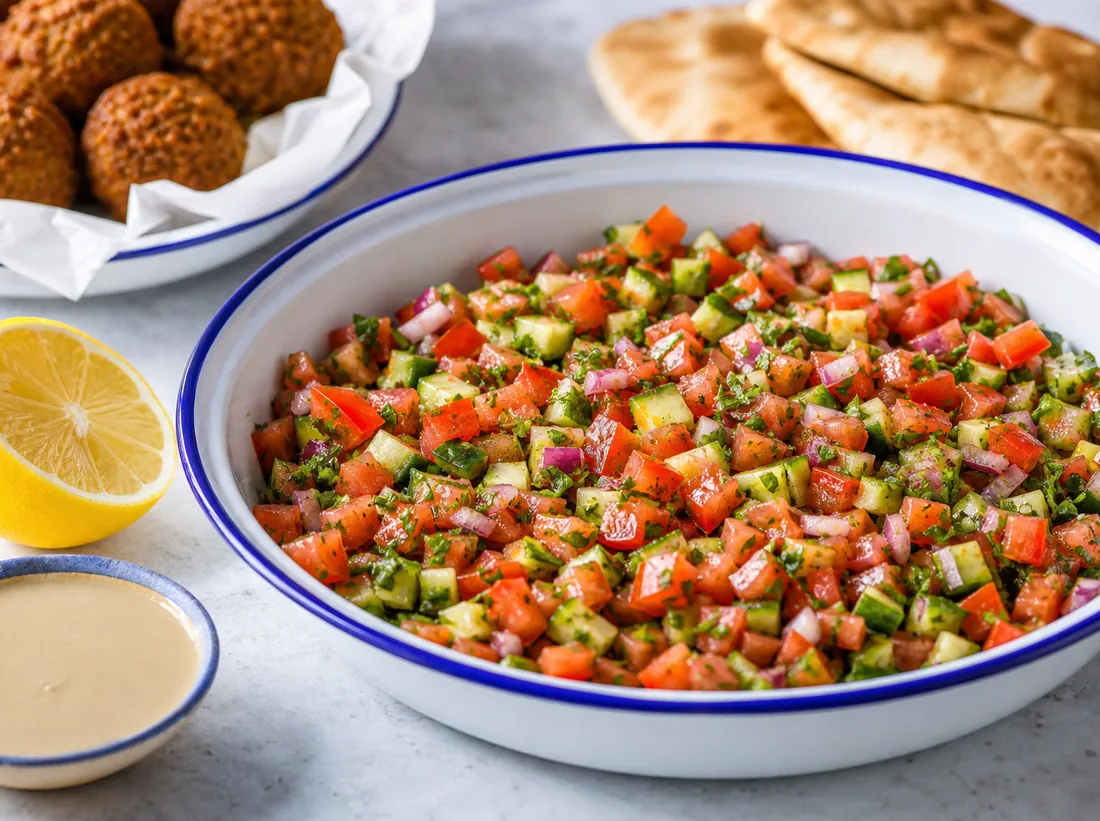
Israeli salad is a finely chopped salad of tomato, cucumber and onion in small, even dice, dressed with olive oil, lemon and salt. There is almost nothing in it, so everything depends on three things: good vegetables, a sharp knife, and salt that goes in at the very last moment.

Quantity calculatorOrder Israeli salad

VeganVegetarianGluten freeDairy freeParve

Updated

Israeli saladIllustration
Time25 min
Amount6 portions1.2 kg
Per portion95 kcal1.6 g protein · a 200 g portion
Cost of the pot₪13for the pot, about ₪2.2 a bowl

The story of Israeli salad

Tomato, cucumber, onion, lemon and oil are a combination shared by the whole region. Arab villages in the Land of Israel, Lebanon and Syria eat a chopped salata arabiya, Turkey has its shepherd's salad, and Iran its shirazi salad. The Jewish pioneers who arrived early in the twentieth century met this salad at their neighbours' tables, and on the kibbutzim it became part of every day: vegetables from the farm's own fields, which each member cut for himself on his plate at breakfast.

From the kibbutz dining room the salad moved into the hotels, which built the Israeli breakfast around it, and from there into every home, every falafel stand and every schnitzel plate. The name sometimes stirs an argument, because the same salad was eaten in the villages of the region long before anyone called it Israeli, and in Israel itself most people simply say salad, or chopped salad. What really became Israeli is the cut: small, even dice, and real pride in whoever cuts the finest.

What makes Israeli salad itself

In Israeli salad the cut is the recipe. Every vegetable is diced to about 5 mm, all the same size, so that each spoonful holds a little of everything: juicy tomato, crisp cucumber and sharp onion. There is no lettuce, no vinegar and no bottled dressing, only fresh lemon, olive oil and salt. And the pink juice that gathers at the bottom of the bowl is not a flaw but part of the pleasure: Israelis wipe it up with pita or a slice of challah.
Israeli salad for any number of people

Change the number of people and the portion size, and every ingredient updates in grams, with the cost, calories and protein per portion.

Portion size
Units
1.2kg of food
3Pot to use, litres
₪13Cost of the pot
₪2.2per portion
95kcal per portion
1.6g protein per portion
IngredientAmountCost
The vegetables
Ripe, firm tomatoes, in 5 mm dice560 g · 4 pcs₪4.4
Small cucumbers, unpeeled, in 5 mm dice440 g · 4 pcs₪3.5
Small white onion, very finely chopped90 g · 1 pcs₪0.5
Parsley, leaves only, finely chopped25 g₪1.2
The dressing
Fresh lemon juice45 g₪0.9
Salt6 g₪0.0
Ground black pepper1 g₪0.1
Olive oil45 g₪2.4
Send on WhatsApp

Shelf prices at a large Israeli chain and specialty shops, October 2026. Nutrition from the ingredients in grams, before cooking.

How many calories in Israeli salad? Nutrition facts and calorie calculator

Change the amount of any ingredient, drop one, or pick a lighter version, and the numbers per serving update at once: calories, fat, carbs, protein, sodium and fibre.

Israeli salad has 48 calories per 100 g. A 200 g serving made with our recipe has 95 calories: 1.6 g protein, 7.3 g fat and 5.3 g carbohydrates.

Lighter

Ingredients, for the whole recipe

  • 4 pcs17 kcal per serving
  • 4 pcs8 kcal per serving
  • 1 pcs6 kcal per serving
  • 25 g2 kcal per serving
  • 45 ml2 kcal per serving
  • 6 g0 kcal per serving
  • 1 g0 kcal per serving
  • 45 ml61 kcal per serving

How to make Israeli salad

In cook mode the screen stays on, tap a step when it is done, and the timers run next to each step.
  1. Take the tomatoes out of the fridge an hour ahead, or better, never put them in. Wash all the vegetables and dry them well on a towel.
  2. Chop the onion very finely, into 2 to 3 mm dice. Rinse it in a sieve under cold water, shake it and leave it to drain.
  3. Trim the ends of the cucumbers and taste a slice from the stem end. Slice each cucumber lengthwise into 5 mm slices, cut the slices into strips and the strips into cubes.
  4. Cut the core out of the tomatoes and dice them the same way, into 5 mm cubes, with a very sharp or serrated knife. Move them to the bowl together with their juice and seeds.
  5. Dry the parsley, pick the leaves and chop them finely.
  6. Combine the tomatoes, cucumbers, onion and parsley in a wide bowl, with no salt and no dressing. At this point you can cover the bowl and keep it in the fridge for a few hours.
  7. Just before serving, squeeze in the lemon, sprinkle with salt and black pepper, pour over the olive oil and toss gently with a large spoon.
  8. Taste and correct the salt and lemon. Serve within a quarter of an hour, while the vegetables are still crisp and the juice is only starting to gather at the bottom.

The science of Israeli salad

Kitchen science

Salt and osmosis: why Israeli salad is dressed at the last minute

The cells of tomato and cucumber hold a lot of water and few dissolved substances. When salt lands on the cut surface, the concentration outside is higher than inside, and water leaves the cells through their walls to even it out. Within 10 to 15 minutes a pink liquid pools at the bottom and the vegetables lose the internal pressure that makes them crisp. So the salad waits unsalted, and is seasoned only on its way to the table.

Kitchen science

Why a 5 mm dice

The smaller the cube, the more cut surface per gram. A 5 mm cube has three times the surface per gram of a 15 mm cube. More surface means every piece gets coated in dressing and every spoonful carries all the flavours. But the same surface also leaks juice faster once salted. 5 mm is the balance: fine enough for a spoonful with everything in it, large enough for a cube to stay a cube and not turn to pulp.

Kitchen science

A sharp knife keeps the juice inside

A sharp knife splits a single row of cells with each cut. A blunt knife or a food processor crushes and bursts many cells around the cut, and the juice runs out before the salt has even touched the vegetables. That is why a salad cut with a sharp knife stays dry and crisp for longer, with clean, neat cubes.

Kitchen science

Why raw onion bites, and how to tame it

In a whole onion, the sulphur compounds and the enzyme that breaks them down are kept in separate cells. Cutting mixes them, and within seconds the sharp compounds form, the same ones that make you cry. They dissolve in water and evaporate easily, so rinsing the chopped onion under cold water removes much of the bite and leaves the sweetness and crunch.

Kitchen science

Tomatoes stay out of the fridge

In the cold of the fridge a tomato loses some of its aroma compounds, and after a few days its texture turns mealy. A tomato kept on the counter tastes better in the salad. The jelly around the seeds is rich in glutamate, which carries the umami taste, so at home it stays in, even if the salad comes out a little juicier.

Israeli salad in every kitchen

Arab salad

Many Israelis call the very same salad Arab salad. When the two are told apart, Arab salad is cut even finer, close to 3 mm, with plenty of parsley, sometimes mint and a green chilli, and more lemon. Some villages add sumac, others stir in tahini.

Persian shirazi salad

Named after the city of Shiraz in Iran: cucumber, tomato and onion in small dice with dried mint and lemon juice or sour grape juice, and little or no oil. Sharper and fresher than the Israeli one, and served with rice and kebabs.

With tahini

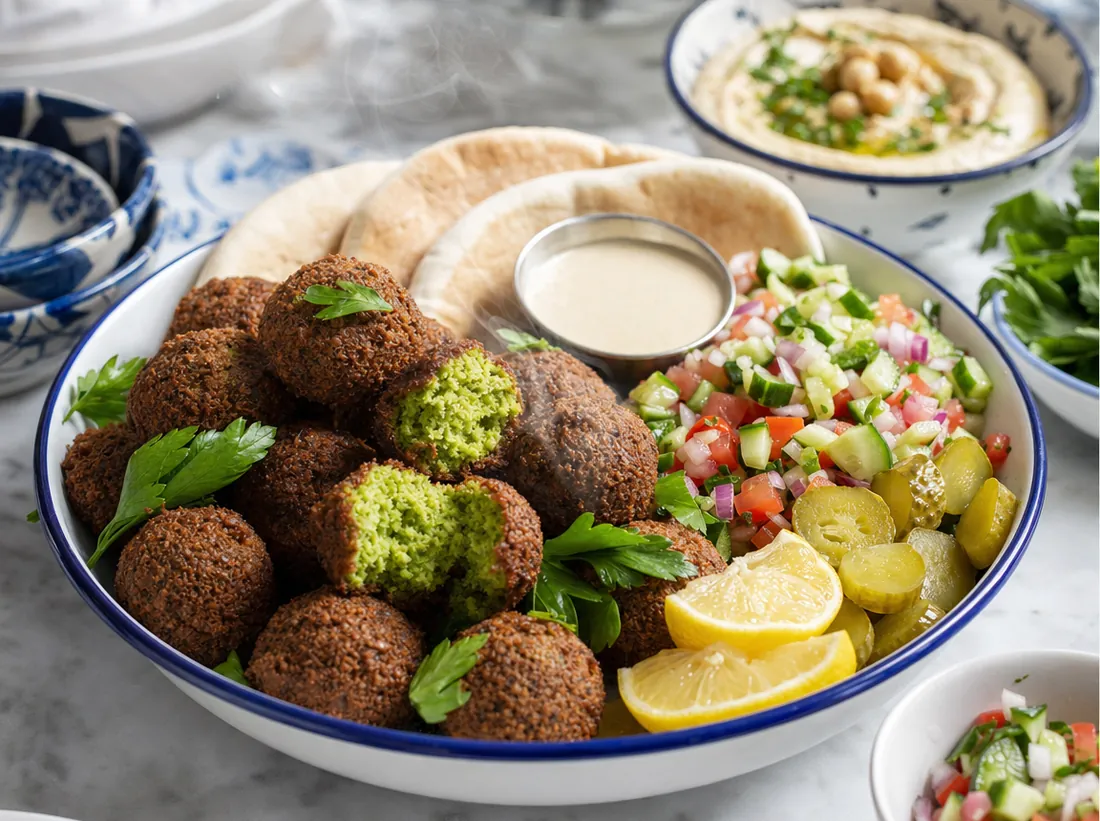
At falafel stands and in many homes a few spoonfuls of prepared tahini go into the salad. The tahini turns the juice at the bottom into a creamy dressing that clings to the vegetables, and this is the salad that goes into a pita.

Iraqi, with amba

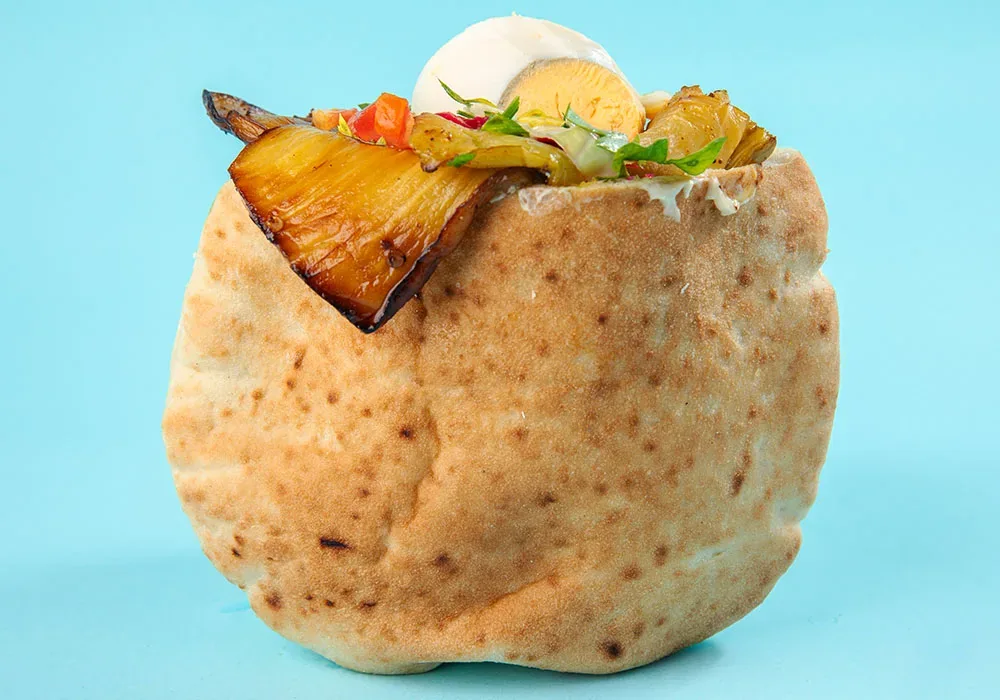
In Iraqi Jewish homes and at sabich stands the chopped salad meets amba, the sour pickled mango sauce: a spoonful over the salad or in the pita, next to fried aubergine and egg. Its sourness stands in for part of the lemon.

Yemenite, with zhug

In a Yemenite home the salad comes to the table with zhug, and many stir a teaspoon of green zhug into the dressing in place of the black pepper. The salad turns hot and green, and it is perfect next to malawach, jachnun or Yemenite soup.

Kibbutz breakfast

The original form: whole tomatoes, cucumbers, onions, peppers and radishes on the table, and every diner cuts his own salad on the plate, with a little oil, lemon and salt. It sits next to eggs, white cheese and fresh bread.

Common Israeli salad problems and how to fix them

My Israeli salad is watery

The salad was salted too early, the tomatoes were soft and very juicy, or the knife was blunt. Salt and dress only just before serving, choose firm tomatoes and cut with a sharp knife. If juice has already pooled, serve with a slotted spoon and keep the juice for wiping up with pita.

The onion takes over the salad

There was too much onion, or it was cut too coarsely. One small onion per kilo of vegetables is plenty, chopped to 2 to 3 mm and rinsed in cold water. For a milder salad use red onion or spring onion.

My Israeli salad tastes bland

The tomatoes were cold from the fridge or pale winter ones, or the salt and lemon fell short. Keep tomatoes on the counter, pick fully red and ripe ones, and taste before serving: a good salad is gently salty and clearly sour.

The cubes came out mushy and uneven

The knife was not sharp, or the vegetables were chopped back and forth. Cut in slices, strips and cubes, one stroke per cut, and sharpen the knife before you start. A food processor does not suit this salad.

The cucumber in my salad is bitter

Bitterness usually sits in the stem end and the skin. Trim the end, taste a slice before you dice the whole cucumber, and peel it if it is bitter.

Storing, freezing and reheating

Chopped vegetables without dressing: up to 1 day in a closed box. Dressed salad is best eaten the same day, as by the next day it is soft and watery

In the fridge

Israeli salad does not freeze

In the freezer

2+4

To cool

Bring it from 60 to 21 °C within two hours and down to 5 °C within four more. Split a big pot into shallow boxes.

75 °C

Reheating

Israeli salad is never heated. Drain any leftovers and add them to shakshuka or an omelette, or blend them with a little olive oil and bread into a quick gazpacho style cold soup.

Nutrition of Israeli salad

From our recipe, per bowl and per 100 g, next to the national food database.

ServingkcalProtein, gFat, gCarbs, gFibre, g
Our recipe, a 200 g portion951.67.35.32.0
Our recipe, 100 g480.83.62.71.0
Typical Israeli salad, 100 g500.84.02.81.0
Typical Israeli salad, 100 g (2)170.80.22.91.0

What the ingredients of Israeli salad cost

What each ingredient costs in one pot, and where to buy it.

IngredientPriceIn this potWhere to buy
Ripe, firm tomatoes, in 5 mm dice₪7.9 per kg₪4.4Greengrocer
Small cucumbers, unpeeled, in 5 mm dice₪7.9 per kg₪3.5Greengrocer
Olive oil₪53 per litre₪2.4Supermarket
Parsley, leaves only, finely chopped₪4.9 each₪1.2Greengrocer
Fresh lemon juice₪20 per litre₪0.9Supermarket
Small white onion, very finely chopped₪5.9 per kg₪0.5Greengrocer
Ground black pepper₪139 per kg₪0.1Supermarket
Salt₪2.1 per kg₪0Supermarket

Shelf prices at a large Israeli chain and specialty shops, October 2026, VAT included. Vegetable prices change with the season.

Israeli salad and its culture

In the kibbutz dining room, breakfast was the big meal of the day, after hours of work in the fields. Whole tomatoes, cucumbers, onions and peppers stood on the tables next to eggs, white cheese and bread, and everyone cut a salad on his own plate with a small knife, a little oil and salt. Whoever cut the finest earned respect, and in many Israeli homes there is still a grandfather who dices the salad in the palm of his hand, straight into the bowl.

The hotels turned that meal into the Israeli breakfast, and from there it spread to cafes and homes. The chopped salad went into every pita, next to falafel, hummus, sabich and schnitzel, and onto every Shabbat table. In Jewish communities abroad and in Israeli restaurants from New York to London, Israeli salad is one of the dishes most tied to the country. It is parve and vegan, so it fits any meal, meat or dairy.

Make Israeli salad a meal

Shabbat

Ready Shabbat food

Soup, hamin, mains and sides, with a quantity calculator and prices.

Plan Shabbat
Hosting

Hosting trays

9 trays to go with the soup, with a planner by number of guests.

Tray planner
Events

Catering

A whole menu in grams per guest, with a reheating table.

Menus

What to serve with Israeli salad

Serve at once in a wide bowl: at breakfast with eggs, white cheese and bread, in a pita with falafel, hummus, sabich or schnitzel, and next to any meal of grilled meat and rice.

Israeli salad in large quantities: events, offices and communities

How much of everything by number of guests, at a 200 g portion. For trays, catering and community kitchens.

Guestskg of food3 kg traysCost of ingredients
255.02₪55
50104₪109
100207₪218
2004014₪436
50010034₪1,091

Every ingredient for any number of guests is in the calculator above: type the number of people.

Order Israeli salad

A ready pot for Shabbat, an event or the office, ordered ahead.

  • Cooked to order, for Shabbat, an event or the office.
  • Tell us how many people and when, and we send a quote.
  • Delivery in Tel Aviv from ₪35, free over ₪750.

Order Israeli salad for a large event

Large orders in Israel and abroad: events, offices, synagogues, communities and institutions.

  • In Israel: cooked in Tel Aviv and delivered to events in the area, and to large events anywhere in the country on a quote.
  • Abroad: for communities, events and restaurants. Tell us where, how many and when, and we come back with a quote and options.
  • Institutional quantities and a shopping list for any number of guests, in the calculator above.

Frequently asked questions

What is Israeli salad?

A finely chopped salad of tomato, cucumber and onion, often with parsley, dressed with lemon juice, olive oil and salt. In Israel it is simply called salad, or chopped salad, and it appears at breakfast, in pita and next to almost every meal.

What is the difference between Israeli salad, Arab salad and shirazi salad?

They are the same idea with different accents. Many Israelis use both names for the very same dish, and when people do tell them apart, Arab salad is cut finer, with more parsley and lemon. Shirazi salad is the Persian version, with dried mint, lemon or sour grape juice and very little oil.

How small should Israeli salad be cut?

About 5 mm dice, with every vegetable the same size, and the onion finer still, 2 to 3 mm. At that size every spoonful gets a bit of everything, and the cubes still hold their shape.

When should you salt Israeli salad?

Right before serving. Salt pulls water out of the vegetables within minutes, so a salad salted an hour ahead reaches the table soft and swimming in juice.

What is the dressing for Israeli salad?

Only lemon juice, olive oil, salt and black pepper. For every kilo of chopped vegetables use about 3 tablespoons of olive oil, 3 tablespoons of lemon juice and a level teaspoon of salt. For a sharper, Arab style salad, add half as much lemon again.

Can I make Israeli salad ahead?

Yes, without the dressing. Chop the vegetables up to a day ahead and keep them in closed boxes in the fridge, with the onion in its own box. Add the lemon, salt and oil only when you serve.

How much Israeli salad do I need for a crowd?

As one of several salads, 100 to 120 g per guest, so about 6 kg for fifty people. That takes about 2.8 kg tomatoes, 2.2 kg cucumbers, 450 g onion, 125 g parsley, a cup each of olive oil and lemon juice, and 30 g salt. When it is the main salad, as at breakfast, double it.

How many calories are in Israeli salad?

A 200 g portion of Israeli salad made with our recipe has about 95 calories and 1.6 g of protein. Per 100 g: 48 calories.

How much does it cost to make Israeli salad at home?

A tray or pot of 6 portions costs about ₪13 at Israeli shelf prices in October 2026, about ₪2.2 a portion. The calculator above works it out for any number of people.

Every dish

Home dishes of every community, each with a calculator, a price list and the science.

All the dishes