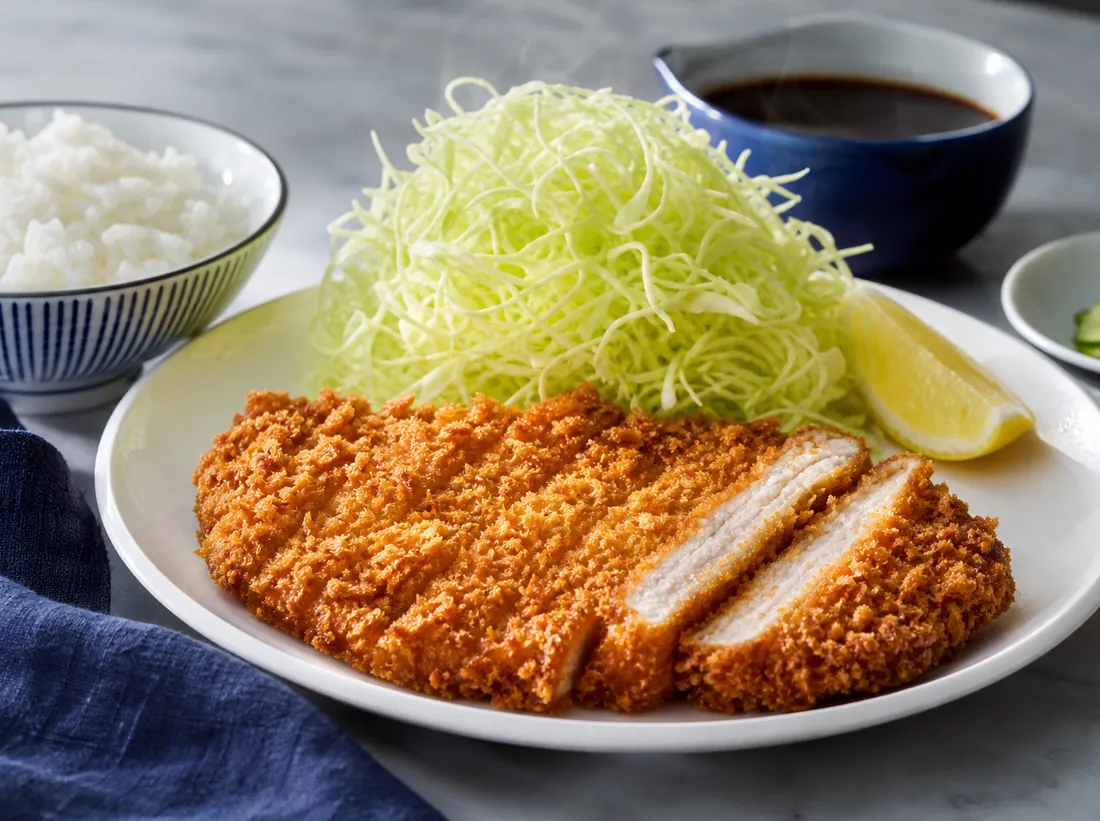
Chicken katsu

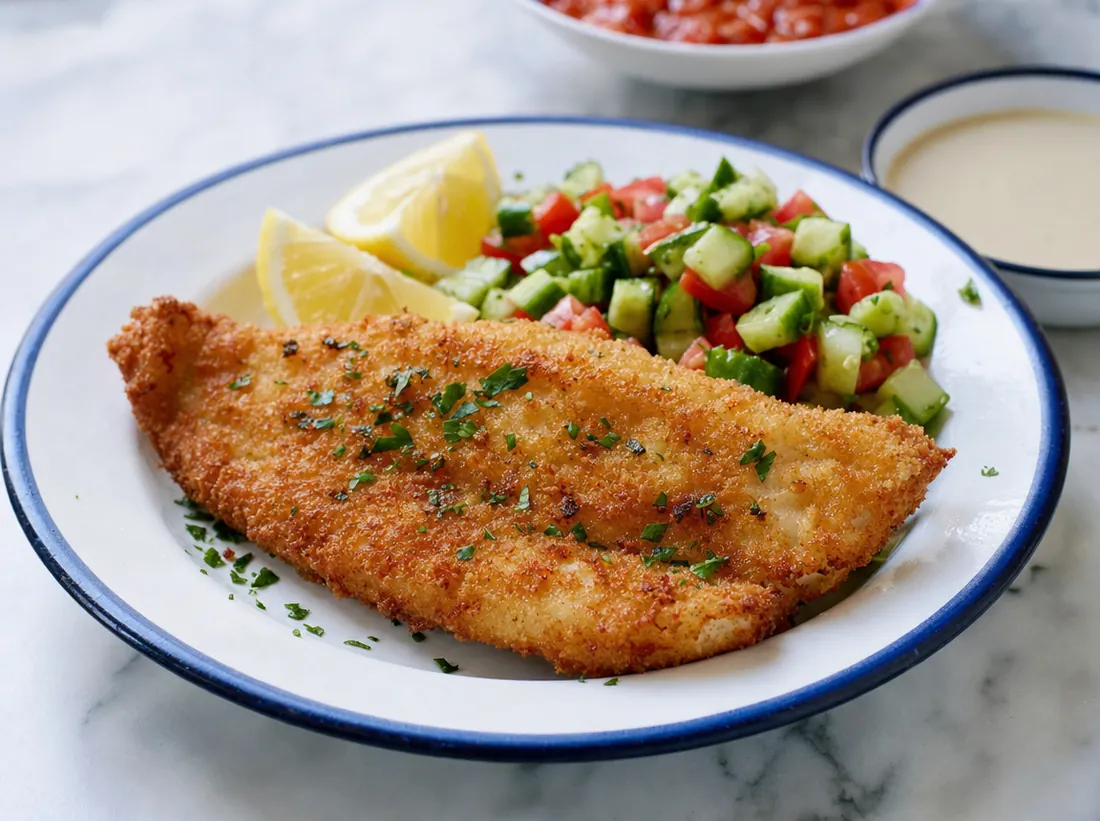
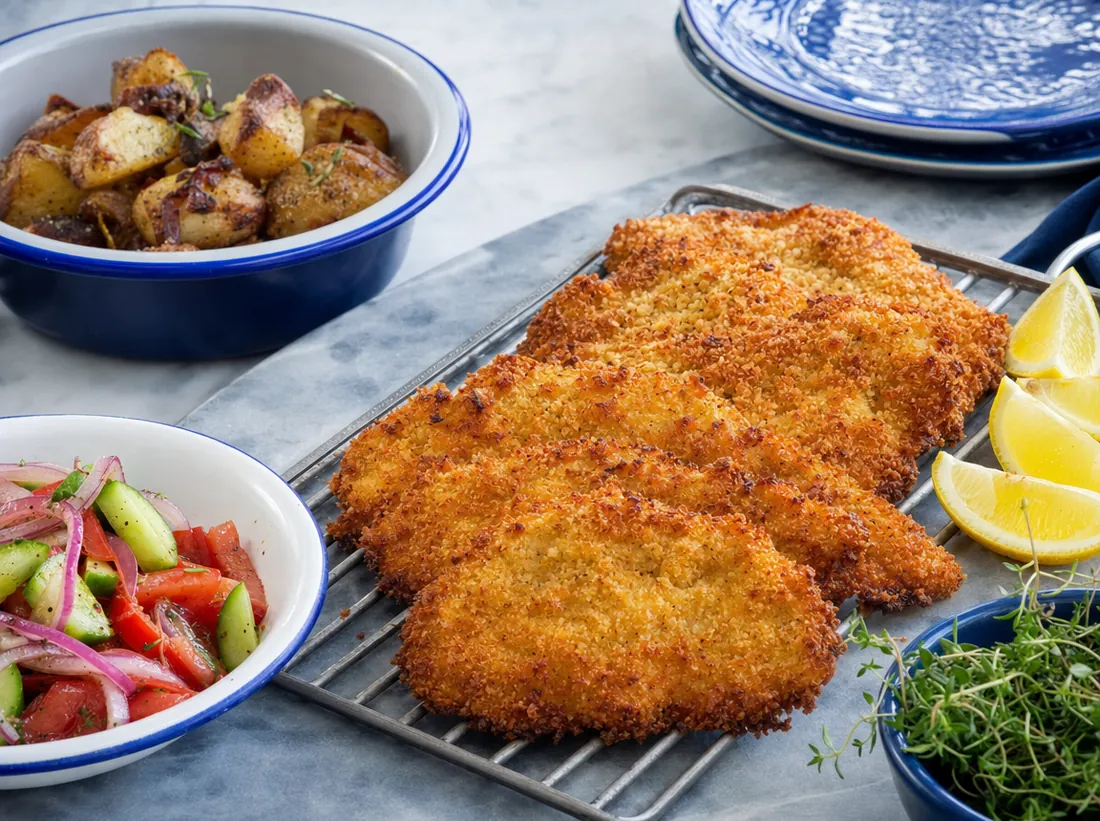
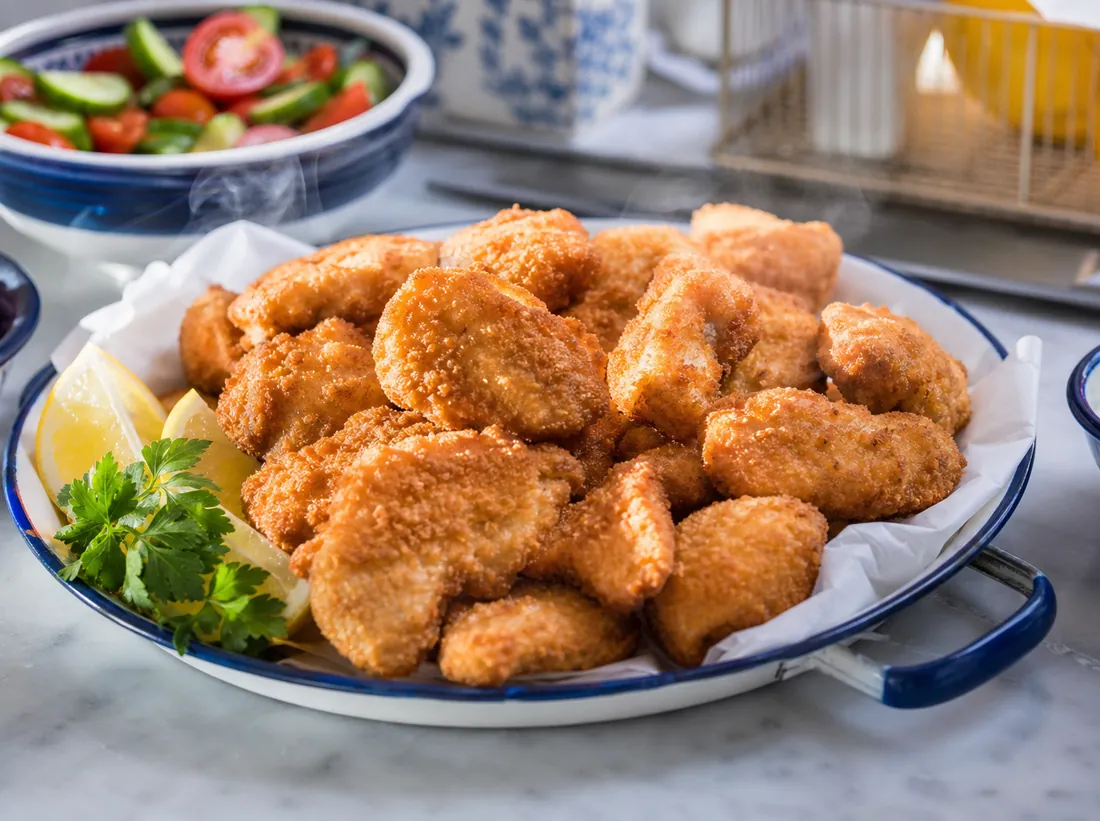
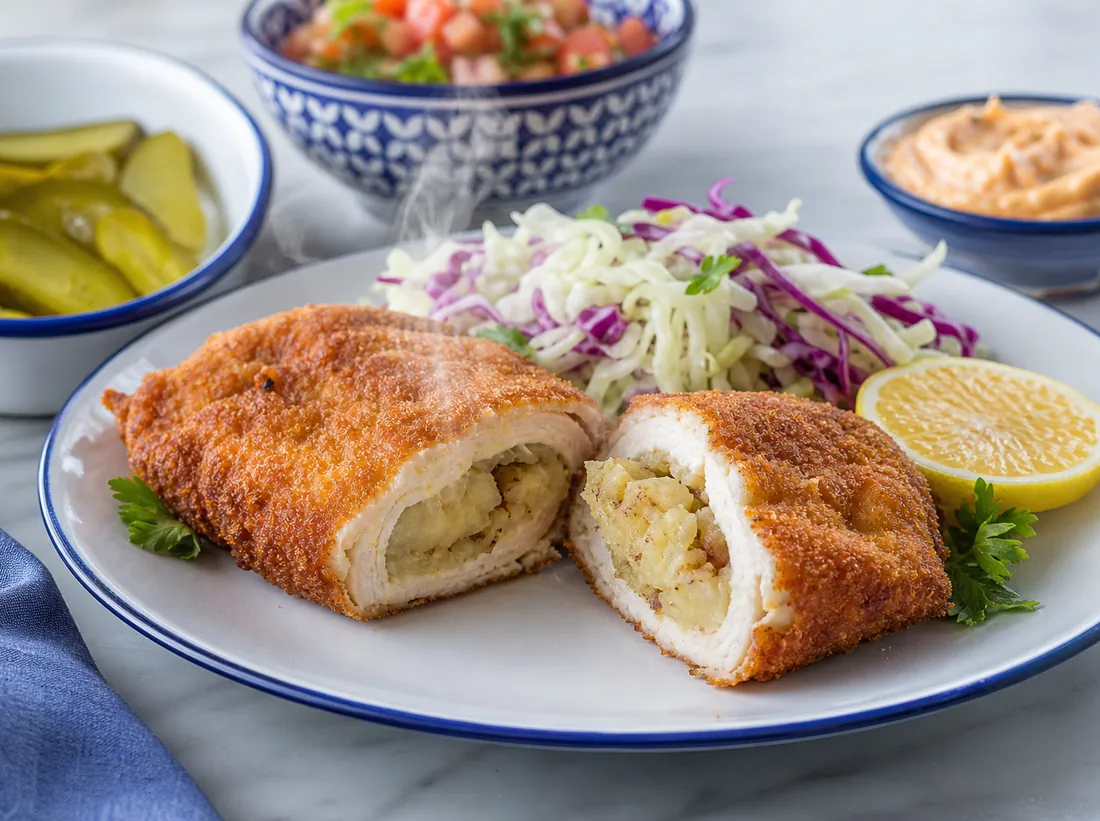
Chicken katsu is the Japanese chicken cutlet: a thick piece of chicken breast coated in flour, egg and coarse panko, fried until golden and crisp, sliced into strips and served with a pile of shredded cabbage, white rice and a thick, sweet and tangy sauce. It is a close cousin of the Israeli schnitzel, and in a kosher kitchen it is simple: chicken, a parve coating and a sauce with no fish in it.

Quantity calculatorOrder Chicken katsu

Dairy freeMeatAllergens:GlutenEggsSoy

Updated

Chicken katsuIllustration
Time1 h 5 minCook 25 min
Amount4 portions1.2 kg
Per portion619 kcal50.1 g protein · a 300 g portion
Cost of the pot₪53for the pot, about ₪13 a bowl

The story of Chicken katsu

The name katsu comes from katsuretsu, the Japanese pronunciation of the English word cutlet. The European cutlet reached Japan at the end of the 19th century, in the Meiji era, along with the Western-style cooking the Japanese call yoshoku. Tokyo cooks remade it from the ground up: they cut it thicker, fried it in plenty of oil instead of a little butter in a pan, coated it in panko, and sliced it into strips so it could be eaten with chopsticks, next to rice, miso soup and finely shredded raw cabbage.

The first version to take hold was made with pork, tonkatsu, and chicken katsu, beef katsu and fish katsu followed. Today katsu is everyday food in Japan: some restaurants serve nothing else, it is sold in bento boxes and convenience stores, and it turns up in curry, in sandwiches and on rice bowls. In the United States and Britain chicken katsu and katsu curry are fixtures on the menus of Japanese restaurants and lunch counters.

What makes Chicken katsu itself

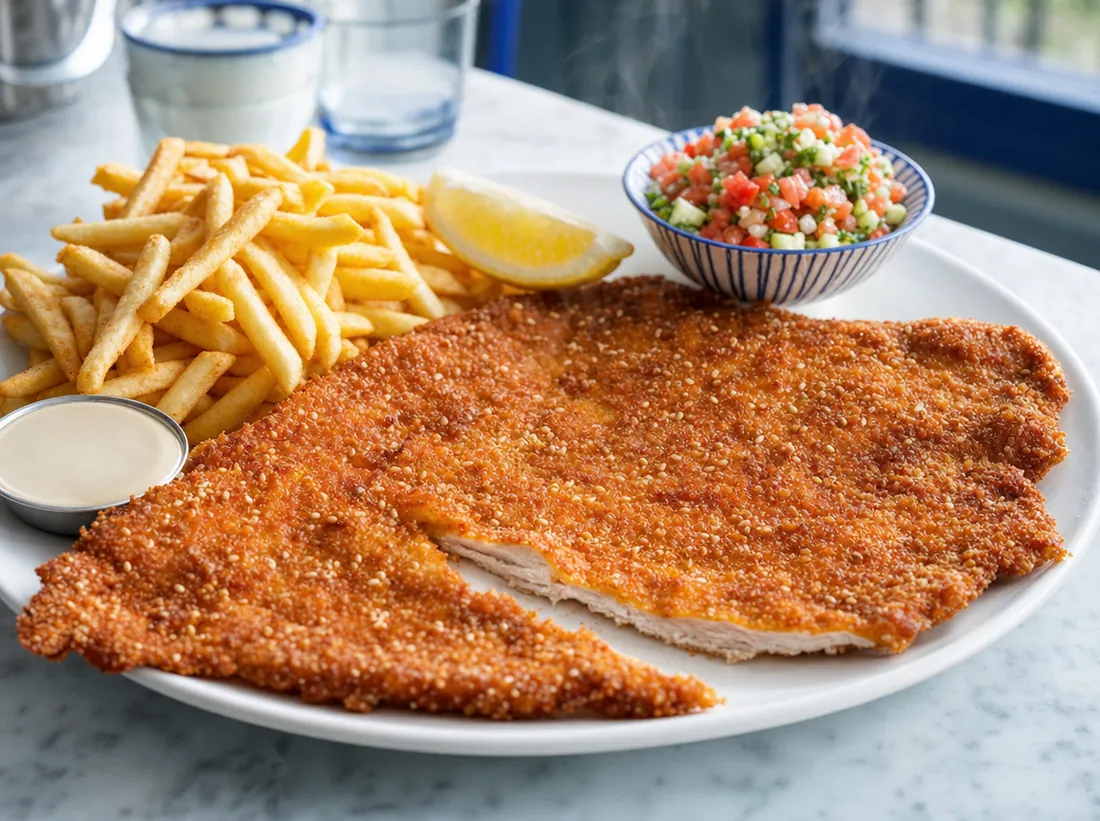
Chicken katsu and the Israeli schnitzel are cousins from the same European cutlet, and the difference lives in the details. The Israeli schnitzel is thin, large and cut from real chicken breast, pounded to half a centimetre, coated in fine breadcrumbs, often with sesame, and fried in a pan. It is eaten whole, in a pita with hummus and salad, or next to mashed potatoes. Katsu is thicker, 1 to 1.5 cm, so it stays juicy under a coat of coarse panko that fries up light and craggy. It is fried in deeper oil at a steady 170 °C, sliced into strips, and served with raw cabbage, rice and a dark, sweet katsu sauce.
Chicken katsu for any number of people

Change the number of people and the portion size, and every ingredient updates in grams, with the cost, calories and protein per portion.

Portion size
Units
1.2kg of food
3Pot to use, litres
₪53Cost of the pot
₪13per portion
619kcal per portion
50.1g protein per portion
IngredientAmountCost
The chicken
Chicken breast, 4 whole breast halves720 g · 4 pcs₪28
Salt, a light hand (kosher chicken is already salted)4 g₪0.0
White pepper1 g₪0.3
The coating
Plain flour35 g₪0.2
Eggs, beaten with a spoonful of water110 g · 2 pcs₪2.7
Panko (coarse Japanese breadcrumbs)100 g₪4.5
Frying
Canola oil for frying, 3 cm deep in a deep pan or pot700 g₪10
Katsu sauce
Ketchup80 g₪1.4
Soy sauce25 g₪1.0
Honey15 g₪0.7
Rice vinegar10 g₪0.4
Mustard, hot if you have it, on the side10 g₪0.3
To serve
White cabbage, shredded very fine300 g₪1.5
Lemon, in wedges110 g · 1 pcs₪1.4
Send on WhatsApp

Shelf prices at a large Israeli chain and specialty shops, October 2026. Nutrition from the ingredients in grams, before cooking.

How many calories in Chicken katsu? Nutrition facts and calorie calculator

Change the amount of any ingredient, drop one, or pick a lighter version, and the numbers per serving update at once: calories, fat, carbs, protein, sodium and fibre.

Chicken katsu has 206 calories per 100 g. A 300 g serving made with our recipe has 619 calories: 50.1 g protein, 27.5 g fat and 38.3 g carbohydrates.

Lighter

Ingredients, for the whole recipe

  • 4 pcs216 kcal per serving
  • 4 g0 kcal per serving
  • 1 g1 kcal per serving
  • 35 g32 kcal per serving
  • 2 pcs39 kcal per serving
  • 100 g93 kcal per serving
  • 700 ml171 kcal per serving
  • 80 g22 kcal per serving
  • 25 ml4 kcal per serving
  • 15 g11 kcal per serving
  • 10 ml1 kcal per serving
  • 10 g3 kcal per serving
  • 300 g19 kcal per serving
  • 1 pcs8 kcal per serving

What each add-on adds to Chicken katsu

Values for the amount in the row, from the national food database.

Add-onCaloriesProtein, gFat, g
One large egg837.35.5
A tablespoon of oil122013.8
Chicken breast, 100 g raw12022.52.6
Chicken thigh, 100 g raw12119.74.1

How to make Chicken katsu

In cook mode the screen stays on, tap a step when it is done, and the timers run next to each step.
  1. Shred the cabbage as finely as you can with a sharp knife or a mandoline, checking and rinsing the leaves as a kosher kitchen does. Soak it in iced water for 10 minutes, drain, dry well and keep it in the fridge until serving.
  2. Lay each breast half on a board. If the thick end is very thick, open it like a book with a horizontal cut, then pound it gently between two sheets of cling film to an even 1 to 1.5 cm. Season both sides with salt and white pepper.
  3. Set out three plates: flour, eggs beaten with a spoonful of water, and panko. Dredge each breast in flour and shake it off, dip it in egg and let the excess drip, then lay it in the panko. Cover with panko and press gently, without packing it down.
  4. Set the coated cutlets on a rack and let them rest for 10 minutes. In that time the flour soaks up the egg, the coating sets and it will not fall off in the oil.
  5. Heat the oil to 170 °C. Without a thermometer, drop in a crumb of panko: it should sizzle and rise to the surface at once without browning fast.
  6. Fry two cutlets at a time for 3 to 4 minutes a side, turning only once, until golden and crisp. The centre of the breast should read 70 to 72 °C, and it keeps rising as it rests.
  7. Move them to a rack, standing on their edge, and rest for 3 minutes. Between batches, skim out the floating panko crumbs so they do not burn.
  8. Stir the ketchup, soy sauce, honey and rice vinegar together in a small bowl until the honey dissolves and the sauce is smooth and glossy.
  9. Slice each katsu into 2 cm strips with one stroke of a sharp knife and set it back in shape on the plate. Serve with the cabbage, a lemon wedge, the katsu sauce on top or on the side, and mustard.

The science of Chicken katsu

Kitchen science

Why panko stays crisp

Panko is made from crustless bread ground into large, jagged flakes and dried. There is a lot of air between the flakes, so the steam leaving the chicken escapes instead of soaking the coating. Fine breadcrumbs pack into a dense layer that takes up more oil and goes soft sooner.

Kitchen science

The flour, egg and panko glue

Flour dries the surface of the meat and gives the egg something to grip. Egg proteins set at 62 to 70 °C and lock the panko in place. The 10 minute rest lets the flour absorb moisture and turn tacky, which is why the coating neither falls off in the oil nor separates when you slice.

Kitchen science

Oil temperature and absorption

In oil at 170 °C the water at the surface turns to steam, and that steam flows outward and pushes the oil away from the food. Most of the oil actually goes in when the food leaves the pot and cools, because the steam stops. So you drain on a rack, not on paper, and never fry in cool oil, where frying drags on and oil soaks in.

Kitchen science

How chicken breast stays juicy

The muscle proteins in breast meat tighten and squeeze out water once the heat passes about 65 °C. A thick katsu gives the coating time to brown before the centre dries, and it comes out when the centre is around 70 °C. As it rests the heat keeps moving inward, the centre reaches about 74 °C, and the juices settle instead of running onto the board.

Chicken katsu in every kitchen

Tonkatsu

The Tokyo original: a thick pork cutlet in panko. It is not kosher, and in a kosher kitchen chicken breast, turkey or veal takes its place, as in this recipe.

Katsu curry

Sliced katsu on white rice with thick Japanese curry sauce alongside. One of the best loved pairings in Japan and abroad, and our Japanese curry is built for it, with a dairy-free roux that suits chicken.

Katsudon

Sliced katsu simmered for a minute or two with onion and beaten egg in a sweet soy and mirin broth, then slid over a bowl of rice. In a kosher kitchen the broth is made with kombu dashi, without bonito flakes, because fish is not cooked with meat.

Katsu sando

A katsu sandwich between two slices of soft white bread with sauce and cabbage, crusts off, cut into neat rectangles. Perfect for a lunchbox, and still good cold.

Gyukatsu

Beef katsu: a tender cut of beef fried for only a minute or two so it stays pink inside, and in Japan sometimes finished on a hot stone at the table. Made with kosher, properly prepared beef.

Fish katsu

White fish or salmon in panko, with a tartar sauce of mayonnaise and pickles. This version is parve, so it also suits a dairy meal.

Common Chicken katsu problems and how to fix them

The panko falls off my katsu

The chicken was wet, the katsu did not rest after coating, or it was turned more than once. Dry the chicken, use a thin coat of flour and shake it off, rest the cutlets 10 minutes on a rack, and turn once.

My katsu is greasy

The oil was too cool, or too many cutlets went in at once and the temperature dropped. Fry two at a time, wait for the oil to come back to 170 °C, and drain on a rack.

Burnt outside and raw inside

The oil was too hot or the breast was too thick. Pound it to 1 to 1.5 cm, fry at 170 °C, and if the coating colours too fast, turn the heat down a little and fry longer.

The chicken came out dry

The breast was pounded too thin for deep frying, or fried too long. In katsu the thickness is the protection, and the chicken comes out when the centre is about 70 °C, because it keeps cooking as it rests.

The bottom of the katsu went soggy

It was laid flat on paper towel or straight on the plate, and steam got trapped underneath. Stand it on a rack, and put it on the cabbage only at the moment of serving, with the sauce on the side.

Storing, freezing and reheating

2 days

In the fridge

2 months, coated and unfried

In the freezer

2+4

To cool

Bring it from 60 to 21 °C within two hours and down to 5 °C within four more. Split a big pot into shallow boxes.

75 °C

Reheating

On a rack in a 200 °C oven for 8 to 10 minutes, or in an air fryer at 180 °C for 5 minutes. Not in the microwave, which turns the panko soft.

Nutrition of Chicken katsu

From our recipe, per bowl and per 100 g, next to the national food database.

ServingkcalProtein, gFat, gCarbs, gFibre, g
Our recipe, a 300 g portion61950.127.538.34.9
Our recipe, 100 g20616.79.212.81.6
Typical Chicken katsu, 100 g26326.011.212.31.0

What the ingredients of Chicken katsu cost

What each ingredient costs in one pot, and where to buy it.

IngredientPriceIn this potWhere to buy
Chicken breast, 4 whole breast halves₪39 per kg₪28Supermarket
Canola oil for frying, 3 cm deep in a deep pan or pot₪15 per litre₪10Supermarket
Panko (coarse Japanese breadcrumbs)₪44 per kg₪4.5Supermarket
Eggs, beaten with a spoonful of water₪1.4 each₪2.7Supermarket
White cabbage, shredded very fine₪4.9 per kg₪1.5Greengrocer
Lemon, in wedges₪1.4 each₪1.4Greengrocer
Ketchup₪17 per kg₪1.4Supermarket
Soy sauce₪42 per litre₪1Supermarket
Honey₪45 per kg₪0.7Supermarket
Rice vinegar₪40 per litre₪0.4Supermarket
Mustard, hot if you have it, on the side₪30 per kg₪0.3Supermarket
White pepper₪250 per kg₪0.2Supermarket
Plain flour₪5.9 per kg₪0.2Supermarket
Salt, a light hand (kosher chicken is already salted)₪2.1 per kg₪0Supermarket

Shelf prices at a large Israeli chain and specialty shops, October 2026, VAT included. Vegetable prices change with the season.

Chicken katsu and its culture

In Japanese the word katsu sounds exactly like the verb to win, so students eat katsudon the night before an exam and athletes before a match. At lunchtime katsu restaurants fill with office workers eating teishoku, a tray of katsu, rice, soup and cabbage that is often refilled on request, and in convenience stores the katsu sando sits next to the onigiri.

In Israel most children grow up on schnitzel, so katsu feels familiar from the first bite, only thicker, crisper and with a different sauce. A kosher kitchen takes to it easily: kosher chicken breast instead of pork, panko with a kosher mark and no milk, and a homemade sauce, because bottled tonkatsu sauce is usually based on Worcestershire sauce, which contains anchovies, and fish is not eaten with meat.

From the pantry: what Chicken katsu needs

Pantry

Soy sauce

Make Chicken katsu a meal

Shabbat

Ready Shabbat food

Soup, hamin, mains and sides, with a quantity calculator and prices.

Plan Shabbat
Hosting

Hosting trays

9 trays to go with the soup, with a planner by number of guests.

Tray planner
Events

Catering

A whole menu in grams per guest, with a reheating table.

Menus

What to serve with Chicken katsu

In Japan katsu is served as a full meal: short-grain white rice, miso soup, a pile of shredded cabbage and pickles, with katsu sauce and mustard. It is just as good over Japanese curry, in a sandwich or on a rice bowl.

The cuisine behind Chicken katsu

Japanese

Japanese cuisine

The name katsu comes from katsuretsu, the Japanese pronunciation of the English word cutlet. The European cutlet reached Japan at the end…

Japanese cuisine

Chicken katsu in large quantities: events, offices and communities

How much of everything by number of guests, at a 300 g portion. For trays, catering and community kitchens.

Guestskg of food3 kg traysCost of ingredients
257.53₪329
50155₪658
1003010₪1,317
2006020₪2,633
50015050₪6,583

Every ingredient for any number of guests is in the calculator above: type the number of people.

Order Chicken katsu

A ready pot for Shabbat, an event or the office, ordered ahead.

  • Cooked to order, for Shabbat, an event or the office.
  • Tell us how many people and when, and we send a quote.
  • Delivery in Tel Aviv from ₪35, free over ₪750.

Order Chicken katsu for a large event

Large orders in Israel and abroad: events, offices, synagogues, communities and institutions.

  • In Israel: cooked in Tel Aviv and delivered to events in the area, and to large events anywhere in the country on a quote.
  • Abroad: for communities, events and restaurants. Tell us where, how many and when, and we come back with a quote and options.
  • Institutional quantities and a shopping list for any number of guests, in the calculator above.

Frequently asked questions

What is chicken katsu?

Chicken katsu is a Japanese chicken cutlet: thick chicken breast in a coat of flour, egg and panko, fried until golden and crisp and sliced into strips. It is served with shredded cabbage, rice and katsu sauce.

What is the difference between chicken katsu and schnitzel?

The Israeli schnitzel is thin, coated in fine breadcrumbs and fried in a pan. Katsu is thicker, coated in coarse panko, fried in deeper oil at 170 °C and sliced into strips, and it comes with cabbage, rice and sauce.

What is katsu sauce made of?

At home, mix ketchup, soy sauce, honey and rice vinegar. Bottled sauce is usually based on Worcestershire sauce, which contains anchovies, so for chicken a kosher kitchen makes its own sauce with no fish.

Is chicken katsu kosher?

Yes, when the chicken is kosher, the panko carries a kosher mark and is parve, and the sauce has no fish. The original tonkatsu is pork, which is exactly why a kosher kitchen makes katsu from chicken, turkey or veal.

What is panko, and can I use regular breadcrumbs?

Panko is coarse Japanese breadcrumbs made from crustless bread, which give an especially light, crisp coating. Regular breadcrumbs work, but the coating will be thinner and denser, like a schnitzel.

Can you make chicken katsu in the oven or an air fryer?

Yes. Toast the panko in a pan with a little oil until golden, coat the chicken and bake on a rack at 220 °C for 15 to 18 minutes, or 10 to 12 minutes in an air fryer, turning halfway.

Breast or thigh for chicken katsu?

Both work. Breast gives a large, classic katsu like our schnitzel, and boneless thigh is juicier and more forgiving of timing. With breast, the key is not to pound it too thin.

What is katsu curry?

Sliced katsu on white rice with thick Japanese curry sauce beside it. A kosher kitchen makes the curry with a margarine or oil roux, because most store-bought curry blocks contain milk.

How many calories are in Chicken katsu?

A 300 g portion of Chicken katsu made with our recipe has about 619 calories and 50.1 g of protein. Per 100 g: 206 calories.

How much does it cost to make Chicken katsu at home?

A tray or pot of 4 portions costs about ₪53 at Israeli shelf prices in October 2026, about ₪13 a portion. The calculator above works it out for any number of people.

Every dish

Home dishes of every community, each with a calculator, a price list and the science.

All the dishes