Japanese cuisine: 38 dishes, how to eat them, kosher notes
Japanese cuisine (washoku): 25 dishes, from Sushi to Onigiri, 15 ingredients and spices, 4 dates in the holiday calendar, and the community’s story in Israel. Every dish that has a page here is linked, with every ingredient in grams.
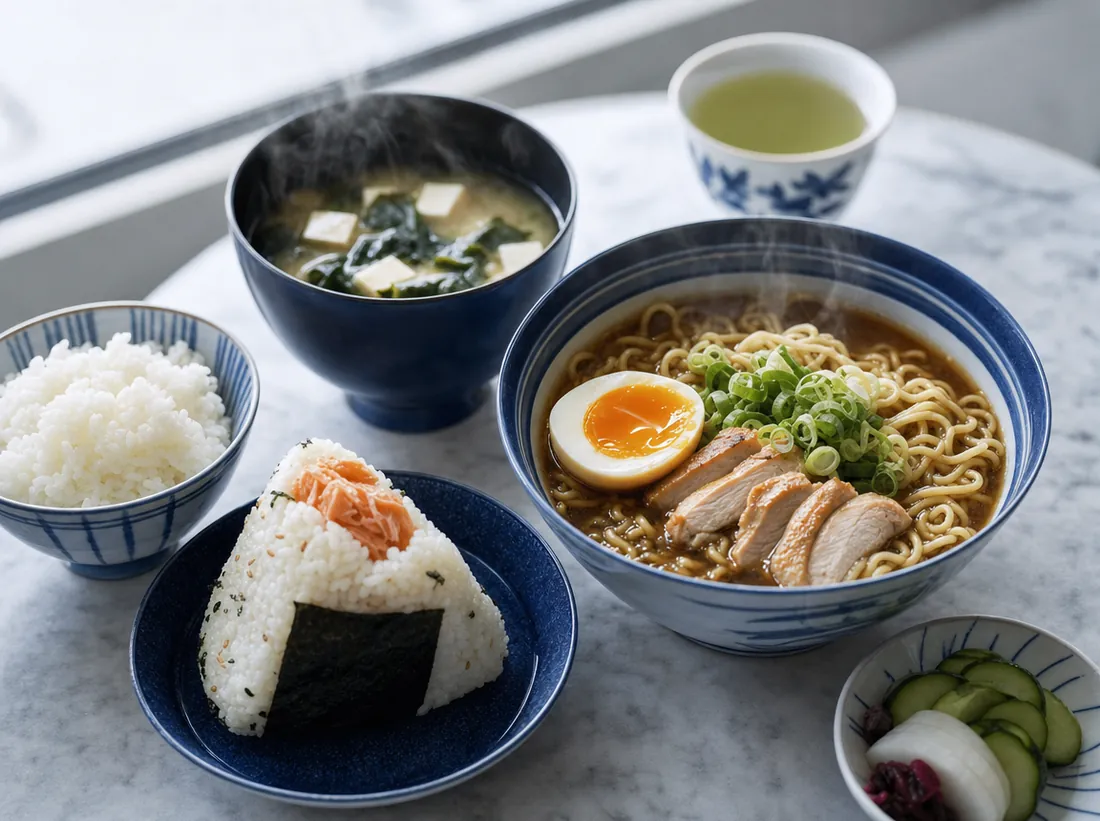 Illustration
The dishes of Japanese cuisine (washoku)
By when they are eaten: Shabbat, holidays, everyday and the street.
Japanese cuisine (washoku), for holidays
6 dishes
- Soba: Buckwheat noodles; on Japanese New Year's Eve, 'toshikoshi soba'
- Osechi-ryori: The New Year menu, the background to washoku's UNESCO listing
- Ozoni: New Year rice-cake soup
- Mochi: Sticky rice cake
- Wagashi: Traditional sweets for the tea ceremony
- Kaiseki: A multi-course Kyoto banquet
Japanese cuisine (washoku), everyday
12 dishes
- Sushi: Rice seasoned with vinegar with fish or fillings; in Japan an occasion food, not an everyday one
- Sashimi: Slices of raw fish, without rice; the purest form according to chef Parti
- Udon: Thick wheat noodles
- Tempura: Fried in a light batter
- Tonkatsu: Pork schnitzel coated in panko
- Donburi: A bowl of rice with a topping
- Japanese curry rice: Came from Britain at the end of the 19th century
- Miso soup: Dashi and miso; part of the 'one soup, three sides' meal
- Tamagoyaki: Rolled sweet-and-savoury omelette, in a rectangular pan
- Chawanmushi: Egg custard steamed in dashi
- Oden: A winter stew of fish products, eggs and daikon radish in dashi
- Sukiyaki / Shabu-shabu: A hot pot shared at the table
Japanese cuisine (washoku), street food
7 dishes
- Onigiri: Filled rice ball wrapped in nori
- Ramen: Noodles in broth; of Chinese origin
- Karaage: Japanese fried chicken
- Yakitori: Chicken skewers over charcoal
- Okonomiyaki: Savoury cabbage pancake
- Takoyaki: Dough balls with octopus
- Gyoza: Filled dumplings
Japanese cuisine in one minute
What it is
Japanese cuisine, or washoku, is cooking built around rice, a light stock called dashi, the season's vegetables and fish, soy and fermented flavours, and a careful eye for how a tray looks. A home meal is rice, a soup and a few small dishes. Restaurants in Japan are usually specialists: one shop for sushi, another for tempura, another for noodles.
The three families of dishes
Washoku is the traditional kitchen: sushi, sashimi, simmered dishes, grilled fish, miso soup and pickles. Yoshoku is Western food made Japanese since the late 19th century: curry rice, omurice, hambagu and croquettes. Chuka is food of Chinese origin made Japanese: ramen, gyoza and fried rice. All three are everyday food in Japan.
The rule of five
A balanced tray follows three fives: five colours (white, black, red, yellow, green), five methods (raw, simmered, grilled, steamed, fried) and five tastes (sweet, sour, salty, bitter, umami). Nobody counts at dinner, but you can see it on any well-made plate.
The season on the plate
Shun is the moment an ingredient is at its best: bamboo shoots in spring, cold noodles and edamame in summer, chestnuts and mushrooms in autumn, hot pots and yellowtail in winter. Menus, and even the plates and bowls, change with it.
Japanese cuisine in numbers
colours on a balanced tray
White, black, red, yellow and green.
cooking methods
Raw, simmered, grilled, steamed and fried.
tastes
Sweet, sour, salty, bitter and umami, the savoury taste first described in Japan.
prefectures, each with its own dishes
Every prefecture has its kyodo ryori, regional home cooking.
dishes in the food list below
With what is in each one, how it is eaten and what to change in a kosher kitchen.
Japanese food list: 38 dishes and how to eat them
The dish, its family, what is in it, when and how it is eaten, and what a kosher kitchen changes.
| Dish | Kind | What is in it | When and how it is eaten | In a kosher kitchen |
|---|---|---|---|---|
| Nigiri sushi | Sushi | Hand-pressed vinegared rice topped with a slice of fish | At the counter or for an occasion; one bite, fish side dipped lightly in soy sauce | Salmon, tuna, yellowtail and sea bream are kosher fish; eel, octopus, squid and shellfish are not |
| Maki | Sushi | Rice and fillings rolled in nori and cut into rounds | Takeaway and parties; on Setsubun in February a whole uncut roll is eaten | Cucumber, avocado, egg, salmon and tuna, with nori that carries a kosher mark |
| Temaki | Sushi | A cone of nori filled by hand with rice and fillings | Home parties where everyone rolls their own | As for maki |
| Chirashi | Sushi | A bowl of sushi rice scattered with fish, egg and vegetables | Hinamatsuri on 3 March and family celebrations | Kosher fish, egg ribbons, cucumber |
| Inari sushi | Sushi | Sweet simmered fried-tofu pouches filled with sushi rice | Bento boxes and picnics | Parve as it is |
| Sashimi | Raw | Slices of raw fish without rice | The opening of a formal meal, with daikon and wasabi | Kosher fish only, very fresh |
| Onigiri | Rice | A salted rice ball filled with salmon, pickled plum, kombu or tuna, wrapped in nori | Lunchboxes, picnics and corner shops; eaten by hand | Parve or fish fillings, very easy |
| Tamagoyaki | Egg | A rolled omelette built in thin layers, sweet or with dashi | Breakfast, bento and as a sushi topping | Parve, with kombu or kosher bonito dashi |
| Miso soup | Soup | Dashi with miso, tofu, wakame and spring onion | At almost every meal; sipped straight from the bowl | Parve, with kosher bonito flakes or with kombu and shiitake |
| Tempura | Fried | Fish and vegetables in a cold, light batter | With a dipping broth and grated daikon, or on noodles and rice | Vegetables and kosher fish, without the classic shrimp |
| Karaage | Fried | Chicken marinated in soy, ginger and garlic, starch-coated and fried | Bars, bento and home dinners | Kosher chicken as it is |
| Tonkatsu and chicken katsu | Fried | A panko-crusted cutlet with shredded cabbage and a thick sauce | Set meals with rice and miso soup | Tonkatsu is pork; chicken or veal katsu is the kosher version |
| Yakitori | Grill | Chicken skewers, salted or brushed with a sweet soy glaze | Bars and festivals | Kosher chicken, without the pork skewers |
| Teriyaki | Grill | Fish or chicken glazed with soy, mirin and sugar until it shines | Home dinners and bento | Salmon or chicken |
| Saba shioyaki | Grill | Salt-grilled mackerel | Breakfast and set meals, with grated daikon | Mackerel is a kosher fish |
| Gyoza | Dumpling | Pan-fried dumplings, in Japan usually filled with pork and cabbage | Beside ramen or rice, dipped in soy and vinegar | Chicken, beef or vegetable fillings |
| Ramen | Noodles | Wheat noodles in a soy, miso, salt or pork-bone broth | Ramen shops; slurping is expected | Chicken or beef broth and toppings, without the pork chashu |
| Udon | Noodles | Thick wheat noodles in a dashi broth | Hot in winter, chilled in summer | Parve with kombu or kosher bonito; with meat toppings use kombu dashi |
| Soba | Noodles | Buckwheat noodles, hot in broth or cold with a dipping sauce | All year, and on New Year's Eve for luck in the year ahead | Parve |
| Somen | Noodles | Very thin wheat noodles served ice-cold | Summer | Parve |
| Yakisoba | Noodles | Stir-fried noodles with cabbage and a sweet-savoury sauce | Festivals and street stalls | Chicken or vegetables instead of pork |
| Oyakodon | Rice bowl | Chicken and egg simmered in dashi and soy over rice | Quick lunches | Kombu dashi rather than bonito, because kosher kitchens keep fish and meat apart |
| Gyudon | Rice bowl | Thin beef and onion simmered in sweet soy over rice | Fast, cheap lunches | Kosher beef and kombu dashi |
| Katsudon | Rice bowl | A cutlet simmered with egg and onion over rice | Before exams, because katsu sounds like the word for winning | Chicken katsu |
| Curry rice | Yoshoku | A thick, mild curry with potato, carrot and onion over rice | Home dinners and school lunches | Many roux blocks contain milk or animal fat; choose a parve roux for meat |
| Omurice | Yoshoku | An omelette over ketchup fried rice | Cafés, and a children's favourite | Chicken fried rice without butter |
| Korokke | Yoshoku | A breaded potato croquette, sometimes with minced meat | Butcher shops and bento | Parve potato, or kosher meat |
| Nikujaga | Simmered | Beef, potato and onion simmered in soy and mirin | Home comfort food | Kosher beef and kombu dashi |
| Oden | Hot pot | Daikon, eggs, fish cakes and konnyaku in dashi | Winter, from shop counters and stalls | Fish cakes from kosher fish only, and no beef tendon in the pot |
| Sukiyaki | Hot pot | Beef slices, tofu and leek in sweet soy, often dipped in raw egg | Celebrations | Kosher beef; the egg dip is optional |
| Shabu-shabu | Hot pot | Thin beef swished in a kombu broth at the table | Social dinners | Kosher beef |
| Okonomiyaki | Griddle | A cabbage batter pancake with sauce, mayonnaise, seaweed flakes and bonito flakes | Osaka and Hiroshima, cooked at the table | Without pork belly and squid; chicken or vegetables |
| Takoyaki | Street | Batter balls with octopus inside | Street stalls in Osaka | Octopus is not kosher; the same pan works with kosher fish or vegetables |
| Natto | Fermented | Sticky fermented soybeans | Breakfast, over rice | Parve; check the sauce sachet |
| Tsukemono | Pickles | Pickled daikon, cucumber, aubergine and plum | At every meal | Parve |
| Edamame | Snack | Young soybeans boiled in salted water, in the pod | Bars and summer evenings | Parve |
| Mochi | Sweet | Pounded sticky rice, plain or filled with sweet bean paste | New Year and festivals; eaten in small bites | Parve |
| Dango | Sweet | Rice-flour dumplings on a skewer | Cherry-blossom viewing and the autumn moon | Parve |
Kosher notes describe the usual version. Any packaged sauce, curry roux or seaweed needs a kosher mark.
A day of Japanese meals, from breakfast to the late ramen
- Breakfast
A traditional Japanese breakfast is a small set: rice, miso soup, a piece of grilled fish such as salmon, a rolled omelette, natto, pickles and a sheet of nori. Many homes now eat toast and coffee on weekdays and keep the full set for weekends and inns.
- Lunch
Fast and complete: a bento box, a bowl of noodles, a rice bowl, or a teishoku set meal of a main dish with rice, soup and pickles.
- Afternoon
Green tea with a small sweet, or a snack from the corner shop: onigiri, a steamed bun, a sweet bean pastry.
- Dinner at home
Ichiju-sansai: rice, one soup and three dishes, usually a grilled or simmered main, a vegetable side and a salad or tofu, with pickles.
- Dinner out
An izakaya, the Japanese pub, with many small plates shared at the table: yakitori, karaage, edamame, sashimi and grilled fish.
- Late night
A bowl of ramen on the way home is a ritual in many cities.
Japanese food by region: 13 places and what to eat there
From Hokkaido in the north to Okinawa in the south.
| Region | What to eat there | What to know |
|---|---|---|
| Hokkaido | Miso ramen, jingisukan lamb barbecue, seafood rice bowls, soup curry | Cold-climate food, dairy and the best salmon roe; the lamb is grilled on a domed pan |
| Akita | Kiritanpo: pounded rice on cedar sticks, grilled and cooked in a chicken hot pot | The rice country of the north |
| Sendai (Miyagi) | Gyutan: grilled beef tongue with barley rice and oxtail soup | A post-war dish that became the city's signature |
| Tokyo | Edomae sushi, soba, monjayaki, tempura | Edomae is the style of old Edo, where nigiri was born as fast street food |
| Yamanashi | Hoto: flat wheat noodles in a miso stew with pumpkin | Mountain comfort food |
| Shizuoka | Green tea, Shizuoka oden in a dark broth | One of Japan's great tea regions |
| Nagoya (Aichi) | Miso katsu, tebasaki chicken wings, kishimen flat noodles | Dark red miso goes into everything |
| Kyoto | Kaiseki, yudofu (simmered tofu), obanzai home dishes, Uji matcha | The old capital of refined, vegetable-led and temple cooking |
| Osaka | Okonomiyaki, takoyaki, kushikatsu | Called the nation's kitchen; kuidaore means eat until you drop |
| Hiroshima | Layered okonomiyaki with noodles | Built in layers on the griddle instead of mixed |
| Kagawa | Sanuki udon | Firm, chewy udon; it is called the udon prefecture |
| Fukuoka | Hakata ramen with thin noodles, mentaiko (spicy pollock roe), yatai street stalls | Food stalls by the river at night |
| Okinawa | Goya champuru (bitter melon stir-fry), Okinawa soba, taco rice | A separate island cuisine with Chinese, Southeast Asian and American traces |
Pork, eel and shellfish dishes have kosher swaps in the food list above.
The Japanese pantry, beyond soy sauce
The English name, the Japanese name, the Hebrew name and what it does.
| English | Japanese | Hebrew | What it does |
|---|---|---|---|
| Dried shiitake | 干し椎茸 hoshi shiitake | פטריות שיטאקה מיובשות | Soaked for a deep dashi without fish or meat, and for simmered dishes |
| Panko | パン粉 | פנקו | Coarse, airy breadcrumbs for katsu and croquettes |
| Potato starch | 片栗粉 katakuriko | עמילן תפוחי אדמה | Coats karaage and thickens sauces to a clear gloss |
| Toasted sesame and sesame oil | ごま goma | שומשום קלוי ושמן שומשום | Ground into dressings; a few drops of oil finish a dish |
| Shichimi togarashi | 七味唐辛子 | שיצ׳ימי טוגראשי | Chilli with sesame, orange peel and seaweed, sprinkled on noodles |
| Sansho pepper | 山椒 | פלפל סאנשו | A citrusy berry that tingles on the tongue, for grilled dishes |
| Furikake | ふりかけ | פוריקקה | A seasoning of seaweed, sesame and salt shaken over rice |
| Matcha | 抹茶 | מאצ׳ה | Shade-grown green tea ground on stone, whisked for the tea ceremony |
| Ponzu | ポン酢 | פונזו | A citrus and soy dipping sauce for hot pots and salads |
| Mentsuyu | めんつゆ | מנצויו | A ready base of dashi, soy and mirin for noodle broths and dips |
| Daikon | 大根 | צנון לבן (דייקון) | Grated raw beside fried and grilled food, or simmered in oden |
| Shiso | 紫蘇 | שיסו | A fragrant leaf served with sashimi and inside rolls |
| Pickled ginger | ガリ gari, 紅生姜 beni shoga | ג׳ינג׳ר כבוש | Pale gari cleans the palate between pieces of sushi; red beni shoga tops noodles and rice bowls |
| Konnyaku | こんにゃく | קונייקו | A firm jelly from konjac root that soaks up broth in oden |
The fifteen basics, from dashi to umeboshi, are in the glossary above.
How to eat in Japan: 9 rules that matter
Itadakimasu, gochisosama
Say itadakimasu before eating and gochisosama deshita when you finish. It thanks everyone who brought the meal to the table.
Never upright in rice
Chopsticks standing in a bowl of rice, and food passed from chopsticks to chopsticks, both belong to funeral rites. Rest them on the holder.
Lift them
Pick up rice and soup bowls and bring them close to your mouth. Soup is sipped straight from the bowl.
Slurping is fine
Slurping ramen and soba is normal, and it cools the noodles on the way.
One bite, fish side down
Hands or chopsticks are both correct. Dip the fish side, not the rice, and eat nigiri in one bite.
Not on the rice
Pour a little into the small dish. Plain white rice is eaten as it is.
The oshibori is for hands
Wipe your hands with the hot or cold towel before eating; in a formal place, not your face.
No tipping
Service is part of the price. Pay at the counter, and in many places put the money on the small tray.
Pour for others
At a shared table you fill your neighbour's glass, and they fill yours.
Kosher Japanese food: what to check
What to know to cook or order Japanese food in a kosher kitchen.
| Item | The issue | The kosher way |
|---|---|---|
| Fish | Only fish with fins and scales are kosher | Salmon, tuna, yellowtail, sea bream, mackerel and sardine are kosher; eel, octopus, squid, shrimp, crab, scallops and sea urchin are not |
| Fish roe | Roe follows its fish | Salmon roe and pollock roe come from kosher fish and need a kosher mark |
| Dashi | Bonito flakes are fish | Kosher bonito dashi is parve; for meat dishes use kombu and shiitake dashi, since fish and meat are not cooked together |
| Soy sauce, mirin and sake | Processed products | Choose bottles with a kosher mark |
| Nori | Sheets can carry tiny sea creatures | Buy nori with a kosher mark |
| Curry roux | Many blocks contain milk or animal fat | For a meat curry, choose a parve roux |
| Pork dishes | Tonkatsu, chashu, pork gyoza, pork-bone ramen | Chicken or veal katsu, chicken or beef ramen broth, chicken and cabbage gyoza |
| Meat and dairy | Japanese cooking uses little dairy | Most meat dishes have no milk to begin with; watch for butter in Western-style yoshoku dishes |
| Surimi | Imitation crab sticks | Kosher-certified surimi made from kosher fish works in rolls and salads |
Japanese food: myths and facts
What people say, and what is true.
| You may have heard | The fact |
|---|---|
| Sushi means raw fish | Sushi is the seasoned rice. Raw fish on its own is sashimi. |
| Japanese food is mostly raw | Most of it is cooked: simmered, grilled, steamed and fried. |
| Wasabi is the green paste | Most green paste is horseradish with mustard and colouring. Real wasabi is a rhizome grated fresh. |
| Ramen is an ancient Japanese dish | It came from China and spread in Japan in the 20th century; instant noodles followed in 1958. |
| The California roll is Japanese | It was created in North America and only later reached Japan. |
| Teriyaki is a sauce | Teriyaki is a method: teri is shine and yaki is grilling, so it means a glossy grill. |
| Matcha is any green tea | Matcha is shade-grown leaf ground to powder in stone mills. |
| In Japan people pour soy sauce on rice | Plain rice is eaten plain; soy sauce goes in a small dish for dipping. |
Start here: 10 Japanese dishes to cook at home, easiest first
- 1. Rice in a pot
Rinse short-grain rice until the water runs clear, soak it for 30 minutes, cook it covered and let it rest for 10 minutes.
- 2. Miso soup
Kombu soaked in cold water and warmed, miso whisked in once the pot is off the boil, then tofu and wakame.
- 3. Onigiri
Wet, salted hands, warm rice, a spoon of salmon in the middle and a strip of nori.
- 4. Tamagoyaki
Beaten eggs with a little sugar and dashi, rolled layer by layer in a pan.
- 5. Teriyaki salmon
Pan-fry, then glaze with soy, mirin and sugar until it shines.
- 6. Oyakodon
Chicken and onion simmered in sweet soy and kombu dashi, egg poured over, then onto rice.
- 7. Gyoza
A chicken and cabbage filling, pleat, fry, add water, cover to steam, then uncover to crisp.
- 8. Chicken katsu
Flour, egg and panko, fried until golden, sliced and served with cabbage.
- 9. Vegetable tempura
Ice-cold batter barely mixed, sweet potato and aubergine fried in small batches.
- 10. Hosomaki
Nori on a bamboo mat, a thin layer of sushi rice, one filling, roll tight and cut with a wet knife.
The holiday calendar of Japanese cuisine (washoku)
What goes on the table on each date.
| Date | Dishes | Note |
|---|---|---|
| Oshogatsu (Japanese New Year) | Osechi-ryori, Ozoni, Mochi | The UNESCO listing is called 'Washoku, traditional dietary cultures of the Japanese, notably for the celebration of New Year' |
| New Year's Eve | Toshikoshi soba | |
| Hinamatsuri (3 March) | Chirashi sushi | |
| Tsukimi | Tsukimi dango |
Spice and ingredient glossary
The name in Hebrew, in the local language and in English, and what it is for.
| English | Local name | Hebrew | What it is |
|---|---|---|---|
| Dashi | 出汁 | Dashi | Kombu and katsuobushi stock |
| Kombu | 昆布 | Kombu | |
| Katsuobushi | 鰹節 | Katsuobushi | |
| Miso | 味噌 | Miso | Fermented soybeans and koji |
| Shoyu | 醤油 | Shoyu | |
| Mirin | みりん | Mirin | |
| Sake | 酒 | Sake | |
| Wasabi | わさび | Wasabi | |
| Yuzu | 柚子 | Yuzu | |
| Koji | 麹 | Koji | |
| Koshihikari rice | コシヒカリ | Koshihikari rice | |
| Nori | 海苔 | Nori | |
| Tofu | 豆腐 | Tofu | |
| Rice vinegar | 米酢 | Rice vinegar | |
| Umeboshi | 梅干し | Umeboshi |
Techniques and vessels
How it is cooked, and in what.
Ichiju-sansai
Rice, soup, three side dishes and pickles
Rice cooking
Washing, soaking, steaming; in a pot (kama) or a donabe
Donabe clay pot
Clay pot for communal cooking at the table
Dashi extraction
Kombu in cold water and katsuobushi briefly simmered
Knife work
Cutting sashimi with a long knife
Tempura frying
A cold, light batter, oil at medium-high heat
Charcoal grilling
Yakitori
Fermentation
Koji, miso, shoyu in wooden barrels
Regions and variants
The same dish, another city, another taste.
| Region | What is special |
|---|---|
| Kanto (Tokyo) | Edomae sushi; darker sauce |
| Kansai (Osaka) | Okonomiyaki and takoyaki |
| Kyoto | Kaiseki and shojin ryori |
| Hokkaido and Kyushu | Miso ramen versus tonkotsu |
| Okinawa | A distinct cuisine |
Japanese cuisine (washoku) in Israel
How they came
There is no Jewish-Japanese community; the cuisine arrived through restaurants and sushi. sushi began to conquer Israel in the 1990s. A new direction: Jewish-Japanese fusion such as matzo-ball ramen
Where they settled
Restaurants in the big cities; on kashrut, fermentation ingredients (mirin, sake) and dashi require checking
Markets and places
Yapani (Tel Aviv): Onigiri; appears in the Google Maps pack. Okinawa Sushi (Levontin St): Google Maps pack. Oben Koben: Google Maps pack. Sakura (Jerusalem): One of the old-established sushi places, according to JPost; opening year not found. : Background on the growth in demand in Israel; not read in full.
Japanese cuisine (washoku) in numbers
Japanese restaurants outside Japan (Japanese agriculture ministry survey, 2023)
Japanese restaurants in China / the United States / South Korea
Traditional meal structure
Curry arrived in Japan
Neighbouring cuisines
The same pots, other spices.
Iraqi (Iraqi-Jewish) cuisine
19 dishes, a spice glossary, a holiday calendar and the story in Israel.
To the pageMoroccan (Moroccan-Jewish) cuisine
22 dishes, a spice glossary, a holiday calendar and the story in Israel.
To the pageYemenite cuisine
21 dishes, a spice glossary, a holiday calendar and the story in Israel.
To the pageKurdish (Kurdish-Jewish) cuisine
21 dishes, a spice glossary, a holiday calendar and the story in Israel.
To the pagePersian (Iranian-Jewish) cuisine
21 dishes, a spice glossary, a holiday calendar and the story in Israel.
To the pageSyrian (Aleppo and Damascus Jewish) and Lebanese cuisine
25 dishes, a spice glossary, a holiday calendar and the story in Israel.
To the pageFrequently asked questions
What is washoku?
The collective name for traditional Japanese cuisine. It was listed on 4 December 2013 on UNESCO's Intangible Cultural Heritage list, with an emphasis on New Year and respect for nature.
What is the difference between sushi and sashimi?
Sushi is rice seasoned with vinegar with fish or another filling. Sashimi is slices of raw fish without rice.
What is dashi?
The foundation stock of the cuisine: kombu and katsuobushi. It gives the umami to miso soup, udon and oden.
What is umami?
The fifth taste. It comes mainly from glutamate (kombu) and from ingredients such as inosinate (katsuobushi), and combining the two strengthens it.
Is sushi an everyday food in Japan?
No: the everyday meal is rice, soup and three side dishes. Sushi is considered an occasion dish.
What is the difference between ramen, udon and soba?
Ramen is wheat noodles in broth, with Chinese influence. Udon are thick wheat noodles, and soba are buckwheat noodles.
What do people eat in Japan at New Year?
Osechi ryori, ozoni and mochi.
Is Japanese food kosher?
It depends: fish without fins and scales is forbidden, and additions such as mirin, sake and dashi need kashrut checking. Kosher restaurants exist in Israel.
What is the difference between koshihikari rice and ordinary sushi rice?
Koshihikari is a short-grain Japanese rice variety, regarded as the quality standard. Details on our ingredient page.
What is yuzu?
An aromatic Japanese citrus fruit used for sauces, tea and sweets. Our page: yuzu.
A meal from this cuisine, for a team or an event
How many people, when and what they like. We come back with a proposal.