Potato latkes

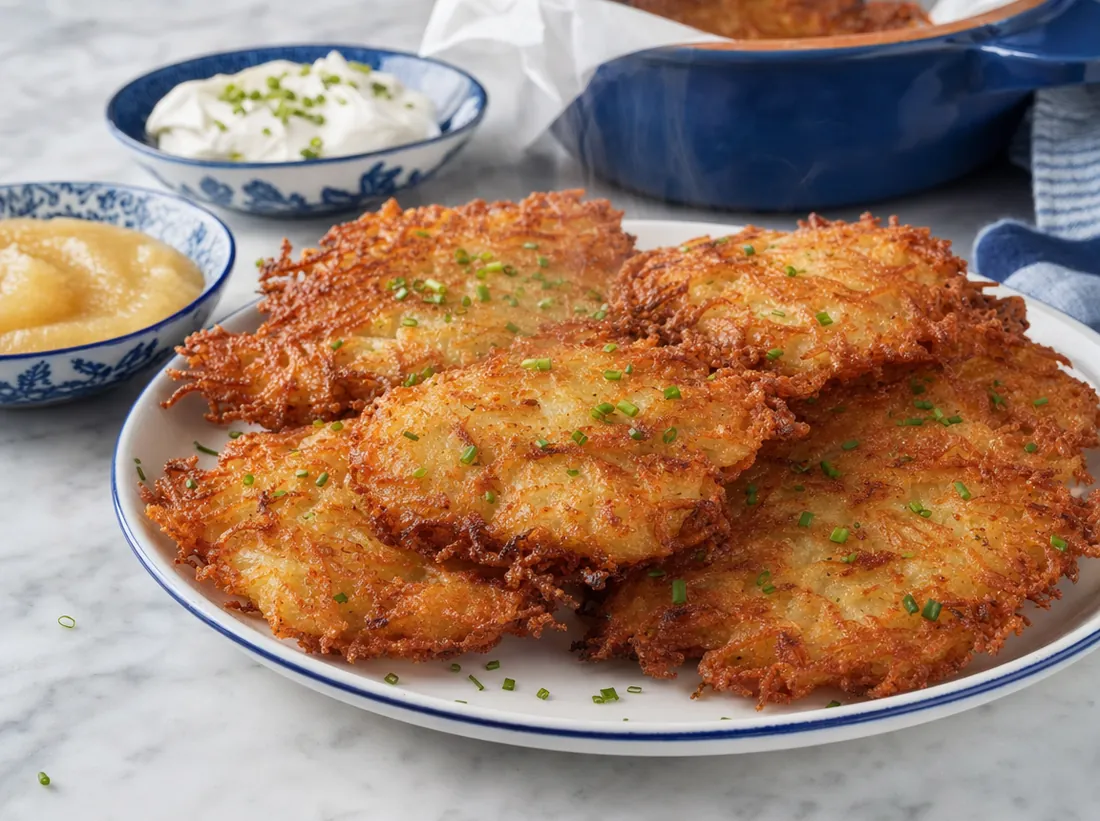
Potato latkes are fried cakes of grated potato, onion, egg and a little flour, with golden, lacy, crisp edges and a soft centre. They are the home food of Hanukkah in Israel, next to the doughnuts from the bakery, because frying in oil recalls the miracle of the cruse of oil.

Quantity calculatorOrder Potato latkes

VegetarianDairy freeParveAllergens:GlutenEggs

Updated

Potato latkesIllustration
Time1 hCook 35 min
Amount6 portions0.9 kg
Per portion238 kcal6.6 g protein · a 150 g portion
Cost of the pot₪14for the pot, about ₪2.4 a bowl

The story of Potato latkes

The Hebrew word levivah already appears in the book of Samuel, in the story of Amnon and Tamar, where it was probably a dough cake. The first Hanukkah latkes were made of cheese: Italian Jews were already frying soft cheese pancakes in the Middle Ages and linked them to the story of Judith, who fed the enemy of her people salty cheese. In Eastern Europe frying was done in chicken fat, which cannot be used with cheese, so latkes there were made from buckwheat and rye flour.

Potatoes became a staple in Eastern Europe in the 19th century, after years of failed harvests, and they were cheap, available and filling. The latke, as it is called in Yiddish, became a potato pancake, and immigrants carried it to America, where it is served with applesauce and sour cream. In Israel the Hebrew name levivah came back, and next to the Ashkenazi version other communities brought their own to Hanukkah, such as Moroccan maakouda of mashed, spiced potato.

What makes Potato latkes itself

A good potato latke is a contrast: thin, crisp edges and a soft centre that tastes like baked potato. The secret is controlling water. Grated potato is full of liquid, and whatever is not squeezed out turns to steam in the pan, cools the oil and breaks the latke apart. Squeeze hard, return the starch that settles out of the liquid, and fry in oil that is hot enough, and the latke comes out crisp instead of greasy.
Potato latkes for any number of people

Change the number of people and the portion size, and every ingredient updates in grams, with the cost, calories and protein per portion.

Portion size
Units
0.9kg of food
3Pot to use, litres
₪14Cost of the pot
₪2.4per portion
238kcal per portion
6.6g protein per portion
IngredientAmountCost
The batter
Potatoes, peeled1 kg · 5 pcs₪5.9
Medium onion150 g · 1 pcs₪0.9
Eggs110 g · 2 pcs₪2.7
Plain flour, or matzo meal40 g₪0.2
Salt10 g₪0.0
Black pepper1 g₪0.1
For frying
Canola oil for shallow frying, 0.5 to 1 cm deep300 g₪4.5
Send on WhatsApp

Shelf prices at a large Israeli chain and specialty shops, October 2026. Nutrition from the ingredients in grams, before cooking.

How many calories in Potato latkes? Nutrition facts and calorie calculator

Change the amount of any ingredient, drop one, or pick a lighter version, and the numbers per serving update at once: calories, fat, carbs, protein, sodium and fibre.

Potato latkes has 159 calories per 100 g. A 150 g serving made with our recipe has 238 calories: 6.6 g protein, 7.5 g fat and 36.2 g carbohydrates.

Lighter

Ingredients, for the whole recipe

  • 5 pcs128 kcal per serving
  • 1 pcs10 kcal per serving
  • 2 pcs26 kcal per serving
  • 40 g24 kcal per serving
  • 10 g0 kcal per serving
  • 1 g0 kcal per serving
  • 300 ml49 kcal per serving

What each add-on adds to Potato latkes

Values for the amount in the row, from the national food database.

Add-onCaloriesProtein, gFat, g
One large egg837.35.5
A tablespoon of oil122013.8

How to make Potato latkes

In cook mode the screen stays on, tap a step when it is done, and the timers run next to each step.
  1. Grate the onion on the coarse side of the grater into a large bowl.
  2. Grate the potatoes coarsely straight into the onion, mixing every few potatoes so they do not darken.
  3. Tip into a clean tea towel, gather it up and squeeze hard over a bowl. You will get about 200 to 250 ml of liquid.
  4. Let the liquid stand for 5 minutes, gently pour off the water and return the white starch that settled at the bottom to the potatoes.
  5. Add the eggs, flour, salt and pepper and mix. The batter should be moist but not runny.
  6. Heat the oil in a wide, heavy pan, 0.5 to 1 cm deep, to 175 to 180°C. Without a thermometer: a little batter should sizzle at once and bubble hard.
  7. Drop in mounds of 2 tablespoons, flatten to 1 cm, 4 to 5 per batch with space between them, and fry for 3 to 4 minutes a side until deep golden with crisp edges. Turn once.
  8. Move to a rack over a tray, not a pile on paper, and keep warm on the rack in a 100°C oven. Between batches, stir the batter, top up the oil and wait for it to come back to heat.
  9. Serve at once, with applesauce, or with sour cream at a dairy meal.

The science of Potato latkes

Kitchen science

The right oil temperature for potato latkes

Between 170 and 185°C. At that heat the water in the outer layer boils at once, the steam rushes out and pushes the oil away, and meanwhile the surface dries and browns through the Maillard reaction. Below 160°C the crust forms slowly and the latke soaks up oil. Above 190°C it burns outside before the centre cooks.

Kitchen science

When a latke soaks up oil

Most of the oil goes in after the latke leaves the pan. As it cools, the steam inside condenses, creating a slight vacuum, and the oil on its surface is drawn in. So let it drip for a moment over the pan and move it to a rack. A pile on paper keeps the oil pressed against the latkes and softens them.

Kitchen science

The starch that holds a latke together

The liquid squeezed from the potatoes carries starch, which settles at the bottom of the bowl as a white powder. Returned to the batter, it absorbs water, sets in the heat and glues the strands together without extra flour. Too much flour makes a doughy, soft latke.

Kitchen science

Why the batter darkens

Grated potato exposes the enzyme polyphenol oxidase to oxygen, and it produces grey and brown pigments. Grated onion slows the reaction, and so do working fast and frying at once. The taste barely changes, but latkes from darkened batter come out darker.

Kitchen science

Coarse or fine grating

Coarse grating leaves long strands whose thin tips dry and brown in the oil until they are as crisp as chips. Fine grating gives an even batter that behaves like a cake, softer and paler. Many cooks grate half coarse and half fine.

Potato latkes in every kitchen

Classic Ashkenazi

Grated potato, onion, egg and matzo meal or flour. In Eastern European homes of the past they were fried in chicken or goose fat and served with applesauce.

Moroccan maakouda

Boiled, mashed potatoes with egg, garlic, parsley, cumin and turmeric, fried as thick patties. They are yellow and soft inside, and some serve them in pita with hot sauce.

Mashed potato latkes

Made from ready mash or leftovers, with egg, fried onion and flour. They almost never fall apart, but have no crisp edges, which is why children love them.

Cheese latkes, the first latke

In Israel they are made of soft white cheese, eggs and flour or semolina, and served with sugar or date syrup. This version is dairy, so it belongs to a dairy meal only.

Germany, Poland, Belarus and Ukraine

German Reibekuchen come with applesauce, Polish potato pancakes with cream, and Belarusian draniki and Ukrainian deruny with sour cream. All are made from the same grated batter and fried in a pan.

Swiss rösti

One large cake the size of the pan, from coarsely grated potato, sometimes parboiled, with no egg and no flour. The starch alone holds it together, and it is cut into wedges.

Common Potato latkes problems and how to fix them

My latkes fall apart in the oil

There is too much liquid, the oil is not hot enough, or they were turned too early. Squeeze hard in a towel, return the starch, and add a spoonful of flour if needed. Wait until the first side is golden and set before turning.

My latkes come out greasy

The oil is too cool, there are too many latkes in the pan at once, or they were piled on paper. Fry at 175°C, 4 to 5 per batch, and drain on a rack. After each batch wait for the oil to come back to heat.

Latkes burnt outside and raw inside

The oil is too hot or the latkes are too thick. Flatten to 1 cm and fry over medium high heat, not the highest. Thick latkes can be finished for 8 minutes in a 200°C oven.

The latke batter turned black

The grated potatoes sat in the air. Grate the onion first, mix every few potatoes and start frying straight away. If you must wait, press cling film directly onto the batter.

My latkes are soft, not crispy

The grating was too fine, there is too much flour, or they were covered while waiting. Grate coarsely, keep to about 40 g of flour per kilo of potatoes, and reheat soft latkes on a rack in a 220°C oven for 5 minutes.

The oil smokes and turns dark

Burnt crumbs have built up at the bottom. Every three batches lift them out with a slotted spoon, and if the oil is dark and smells burnt, change it. Canola or sunflower oil handles this heat better than olive oil.

Storing, freezing and reheating

2 days

In the fridge

2 months, fried and cooled, in a single layer

In the freezer

2+4

To cool

Bring it from 60 to 21 °C within two hours and down to 5 °C within four more. Split a big pot into shallow boxes.

75 °C

Reheating

On a rack in a 220°C oven for 8 to 10 minutes, or 12 minutes from frozen. Not in the microwave, where they turn soft.

Nutrition of Potato latkes

From our recipe, per bowl and per 100 g, next to the national food database.

ServingkcalProtein, gFat, gCarbs, gFibre, g
Our recipe, a 150 g portion2386.67.536.24.3
Our recipe, 100 g1594.45.024.12.9
Typical Potato latkes, 100 g2163.613.221.42.4

What the ingredients of Potato latkes cost

What each ingredient costs in one pot, and where to buy it.

IngredientPriceIn this potWhere to buy
Potatoes, peeled₪5.9 per kg₪5.9Greengrocer
Canola oil for shallow frying, 0.5 to 1 cm deep₪15 per litre₪4.5Supermarket
Eggs₪1.4 each₪2.7Supermarket
Medium onion₪5.9 per kg₪0.9Greengrocer
Plain flour, or matzo meal₪5.9 per kg₪0.2Supermarket
Black pepper₪139 per kg₪0.1Supermarket
Salt₪2.1 per kg₪0Supermarket

Shelf prices at a large Israeli chain and specialty shops, October 2026, VAT included. Vegetable prices change with the season.

Potato latkes and its culture

In Israel Hanukkah is split between the bakery and the kitchen: doughnuts are bought, while latkes are fried at home in a big pan, with the smell filling the stairwell. Kindergartens and schools hold a Hanukkah party with latkes, and offices order trays for a candle lighting evening. The eight nights of the holiday bring the family together, and latkes are the dish children remember helping to make.

In the diaspora the latke is perhaps the strongest symbol of Hanukkah. American families hold latke parties with applesauce and sour cream, and at the University of Chicago a humorous debate between latke lovers and hamantash lovers has run for decades. Communities abroad order latkes in quantity for a communal candle lighting, because frying hundreds of latkes in a synagogue kitchen is a full day's work.

Make Potato latkes a meal

Shabbat

Ready Shabbat food

Soup, hamin, mains and sides, with a quantity calculator and prices.

Plan Shabbat
Hosting

Hosting trays

9 trays to go with the soup, with a planner by number of guests.

Tray planner
Events

Catering

A whole menu in grams per guest, with a reheating table.

Menus

What to serve with Potato latkes

Serve hot, straight away, with applesauce, and at a dairy meal with sour cream or yoghurt too. At a Hanukkah dinner they are a side next to soup or a roast, and at a party they are a dish on their own.

Potato latkes in large quantities: events, offices and communities

How much of everything by number of guests, at a 150 g portion. For trays, catering and community kitchens.

Guestskg of food3 kg traysCost of ingredients
253.82₪60
507.53₪119
100155₪238
2003010₪477
5007525₪1,192

Every ingredient for any number of guests is in the calculator above: type the number of people.

Order Potato latkes

A ready pot for Shabbat, an event or the office, ordered ahead.

  • Cooked to order, for Shabbat, an event or the office.
  • Tell us how many people and when, and we send a quote.
  • Delivery in Tel Aviv from ₪35, free over ₪750.

Order Potato latkes for a large event

Large orders in Israel and abroad: events, offices, synagogues, communities and institutions.

  • In Israel: cooked in Tel Aviv and delivered to events in the area, and to large events anywhere in the country on a quote.
  • Abroad: for communities, events and restaurants. Tell us where, how many and when, and we come back with a quote and options.
  • Institutional quantities and a shopping list for any number of guests, in the calculator above.

Frequently asked questions

Why do we eat latkes on Hanukkah?

Because of the oil. Frying recalls the miracle of the cruse of oil that burned for eight days. Before potatoes arrived, cheese pancakes were eaten on Hanukkah, linked to the story of Judith.

How do I make potato latkes in the oven?

Heat the oven to 220°C with a well oiled tray inside, place flattened mounds on the hot tray, brush oil on top and bake for 12 to 15 minutes a side. The edges are less crisp, but they use very little oil.

Flour or matzo meal in latkes?

Both work. Matzo meal soaks up liquid quickly and gives a lighter latke; plain flour gives a soft, even texture. For Passover use matzo meal or potato starch.

Which oil is best for frying latkes?

A neutral oil that handles heat, such as canola or sunflower. Olive oil adds flavour but smokes sooner, so mix a little of it with another oil. In the old days latkes were fried in chicken fat.

What is the difference between a levivah and a latke?

There is none. Latke is the Yiddish word and levivah the Hebrew one, from the book of Samuel. Both mean the same fried potato pancake.

Can I make latkes ahead for a party?

Yes. Fry until golden, cool on a rack and chill or freeze in a single layer. Before serving, reheat on a rack in a 220°C oven and they crisp up again.

How many latkes do I need for an event?

3 to 4 latkes per guest as a side, and 2 at a Hanukkah party with many dishes. A kilo of potatoes makes about 24 latkes, so about 6 kg of potatoes for 50 guests.

How many calories are in Potato latkes?

A 150 g portion of Potato latkes made with our recipe has about 238 calories and 6.6 g of protein. Per 100 g: 159 calories.

How much does it cost to make Potato latkes at home?

A tray or pot of 6 portions costs about ₪14 at Israeli shelf prices in October 2026, about ₪2.4 a portion. The calculator above works it out for any number of people.

Every dish

Home dishes of every community, each with a calculator, a price list and the science.

All the dishes