Masabacha

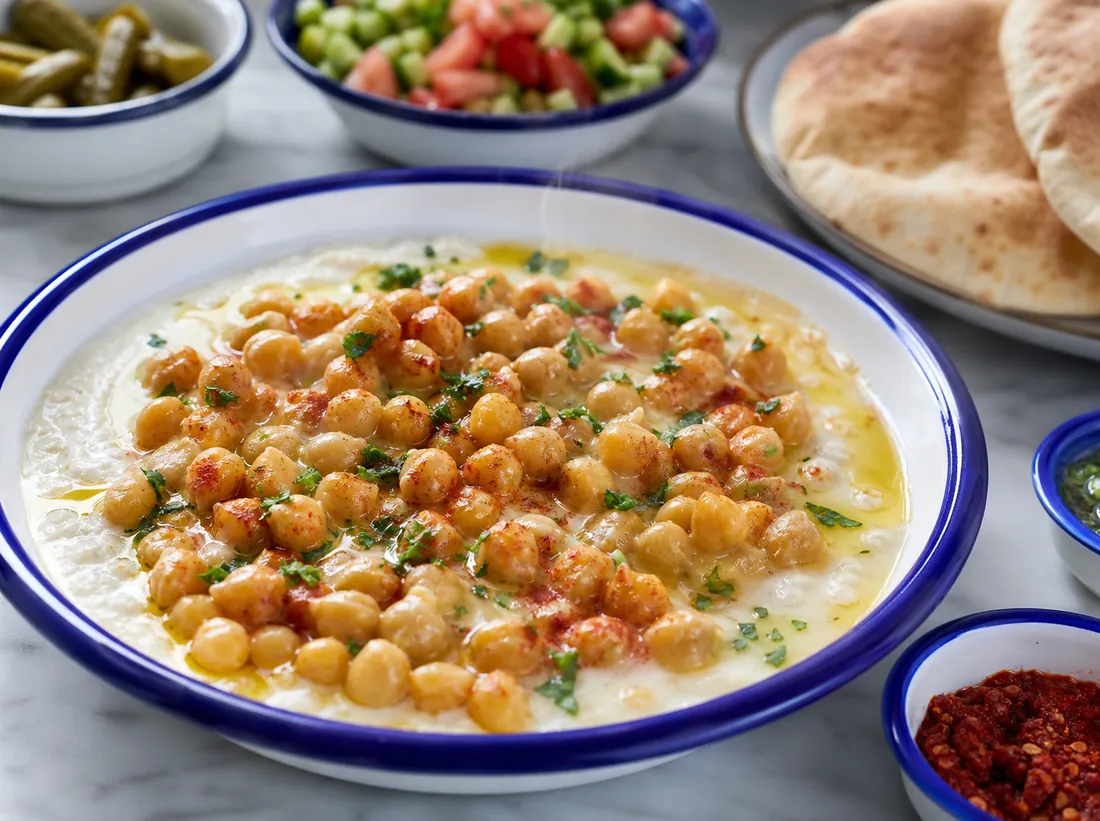
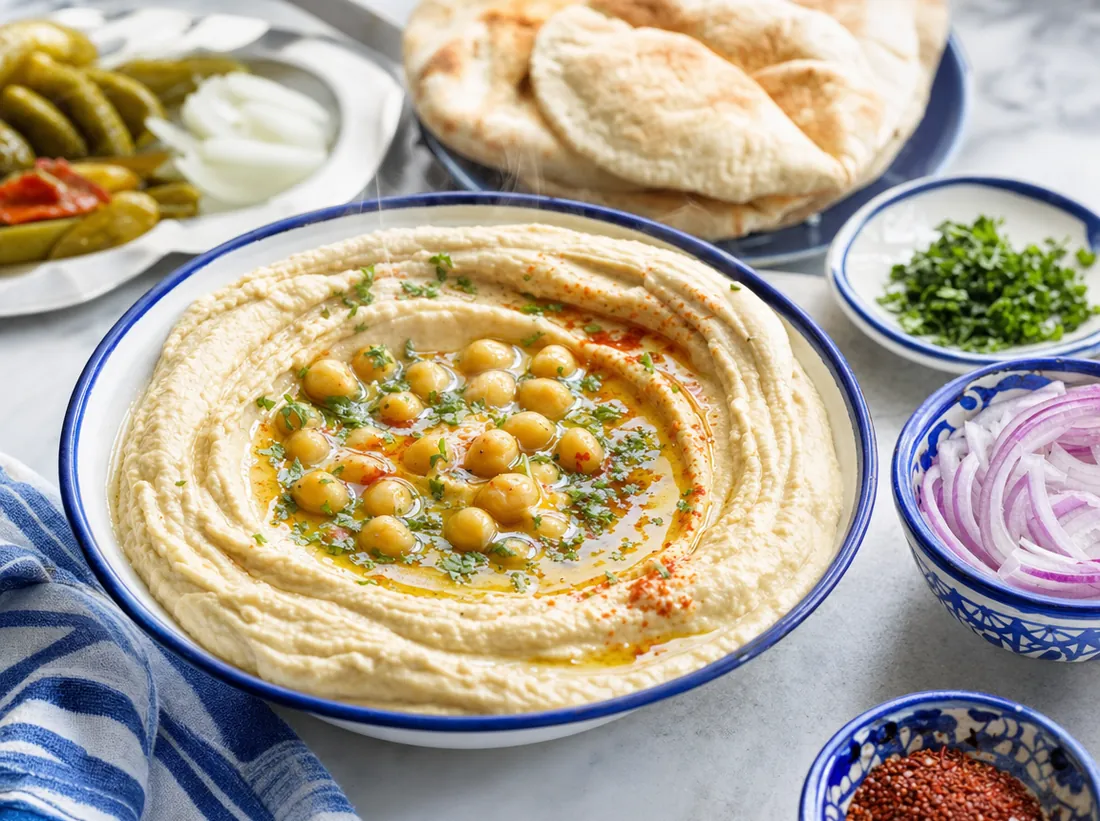
Masabacha is whole chickpeas, soft and warm, served in a tahini sauce with lemon and garlic, finished with olive oil and a hot lemon sauce. It is a breakfast dish of the Levant, and in the Israeli hummusiya it is both a plate of its own and the favourite topping for hummus.

Quantity calculatorOrder Masabacha

VeganVegetarianGluten freeDairy freeParve

Updated

MasabachaIllustration
Time1 h 35 minCook 1 h 20 min · + Soak 12 h
Amount6 portions1.5 kg
Per portion487 kcal19.3 g protein · a 250 g portion
Cost of the pot₪17for the pot, about ₪2.9 a bowl

The story of Masabacha

The name masabacha comes from the Arabic root meaning to swim: the chickpeas swim in tahini and olive oil. In Arabic the dish is often called hummus msabbaha, and in Lebanon, Syria and the Palestinian towns it is a common breakfast, sometimes coarser and warmer than hummus, with the chickpeas only partly crushed.

In Israel masabacha entered the hummusiya both as a dish in its own right and as a topping: a plate of smooth hummus crowned with a heap of warm chickpeas soaked in tahini, known simply as hummus masabacha. At home it is also the easiest way to enjoy good chickpeas, because you need no food processor: only a pot, a bowl and a fork.

What makes Masabacha itself

In masabacha the chickpea itself is the star, so it has to be soft enough to melt in the mouth but still whole. The tahini is poured over while the chickpeas are hot, and the heat and starch on their surface turn it into a creamy sauce that clings to every one. The difference from hummus is texture: in hummus everything is blended to a spread, while every spoonful of masabacha is full of whole chickpeas.
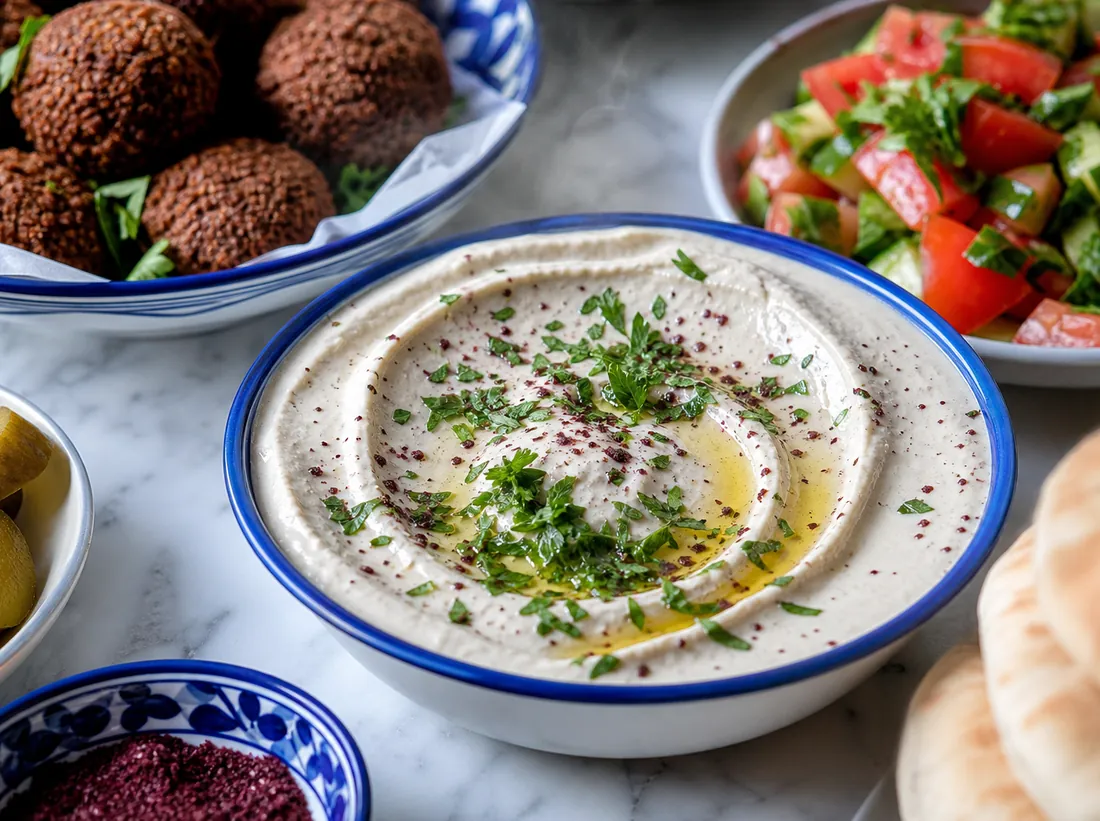
Masabacha for any number of people

Change the number of people and the portion size, and every ingredient updates in grams, with the cost, calories and protein per portion.

Portion size
Units
1.5kg of food
3Pot to use, litres
₪17Cost of the pot
₪2.9per portion
487kcal per portion
19.2g protein per portion
IngredientAmountCost
The chickpeas
Dried chickpeas, of even size400 g₪6.6
Baking soda, for soaking and cooking8 g₪0.2
Salt for the cooking water8 g₪0.0
Hot cooking liquid, kept from the pot150 g
The tahini
Raw tahini150 g₪4.5
Fresh lemon juice60 g₪1.2
Garlic cloves, crushed6 g · 2 pcs₪0.2
Salt4 g₪0.0
Cold water120 g
The hot lemon sauce
Fresh lemon juice40 g₪0.8
Hot green chilli, finely chopped15 g · 1 pcs₪0.2
Garlic cloves, crushed6 g · 2 pcs₪0.2
Salt2 g
To serve
Olive oil50 g₪2.7
Ground cumin2 g₪0.2
Sweet paprika2 g₪0.2
Chopped parsley10 g₪0.5
Send on WhatsApp

Shelf prices at a large Israeli chain and specialty shops, October 2026. Nutrition from the ingredients in grams, before cooking.

How many calories in Masabacha? Nutrition facts and calorie calculator

Change the amount of any ingredient, drop one, or pick a lighter version, and the numbers per serving update at once: calories, fat, carbs, protein, sodium and fibre.

Masabacha has 195 calories per 100 g. A 250 g serving made with our recipe has 487 calories: 19.2 g protein, 26.8 g fat and 31.5 g carbohydrates.

Lighter

Ingredients, for the whole recipe

  • 400 g243 kcal per serving
  • 8 g0 kcal per serving
  • 8 g0 kcal per serving
  • 150 g166 kcal per serving
  • 60 ml2 kcal per serving
  • 2 pcs1 kcal per serving
  • 4 g0 kcal per serving
  • 40 ml2 kcal per serving
  • 1 pcs1 kcal per serving
  • 2 pcs1 kcal per serving
  • 2 g0 kcal per serving
  • 50 ml68 kcal per serving
  • 2 g1 kcal per serving
  • 2 g1 kcal per serving
  • 10 g1 kcal per serving

What each add-on adds to Masabacha

Values for the amount in the row, from the national food database.

Add-onCaloriesProtein, gFat, g
A tablespoon of oil122013.8
A tablespoon of raw tahini1003.69

How to make Masabacha

In cook mode the screen stays on, tap a step when it is done, and the timers run next to each step.
  1. Soaking: cover the chickpeas with three times their volume of cold water and 5 g of baking soda, and soak for 12 to 24 hours in the fridge.
  2. Rinse well, cover with 2.5 litres of fresh water, add the remaining 3 g of baking soda and bring to a boil. Skim off the foam and any skins that float.
  3. Lower to a very gentle simmer, add the salt after 30 minutes, and cook for 60 to 80 minutes in total, until a chickpea melts in the mouth but stays whole. Start checking at 50 minutes.
  4. While they cook, make the tahini: stir the tahini with the lemon juice, crushed garlic and salt. It will thicken a lot, and that is fine.
  5. Add the cold water gradually, whisking, until you have a smooth sauce as thick as cream.
  6. Hot lemon sauce: crush the chilli, garlic and salt in a mortar, or chop very finely, and mix with the lemon juice.
  7. Lift the chickpeas out with a slotted spoon and keep 150 ml of the hot cooking liquid. In a bowl, mix the hot chickpeas with two thirds of the tahini and 3 to 4 spoonfuls of the liquid until coated in a soft, creamy sauce.
  8. Spoon into shallow bowls, pour the rest of the tahini on top, drizzle with olive oil and hot lemon sauce, and sprinkle with cumin, paprika and parsley. Serve at once, hot.

The science of Masabacha

Kitchen science

How masabacha chickpeas end up soft and whole

Baking soda raises the pH and speeds up the breakdown of the pectin that holds the cell walls together, so the chickpea softens faster. But a soft chickpea is also fragile: at a rolling boil the chickpeas knock against each other and the pot, and their skins tear. A gentle simmer, close to 95 degrees, softens them completely without breaking them.

Kitchen science

Why tahini turns creamy on hot chickpeas

The surface of a cooked chickpea is coated with a thin film of starch and protein released during cooking. When the tahini meets it hot, the starch binds the water in the tahini and thickens it, and the oil droplets are trapped in that network. As the masabacha cools the starch sets, which is why it thickens and turns sticky on the plate. Serve at once, and loosen with hot liquid.

Kitchen science

The chickpea cooking liquid

The liquid the chickpeas cooked in, also called aquafaba, holds starch, proteins and saponins that have passed into it from the chickpea. These behave like an emulsifier: they surround oil droplets and keep them suspended in water. That is why a spoonful of hot cooking liquid makes tahini sauce glossier and smoother than plain water does.

Kitchen science

Masabacha at an event: heat and safety

Masabacha is a hot, moist, low acid food. Between 5 and 60 degrees Celsius bacteria multiply in it quickly, so at an event keep the chickpeas in their liquid above 60 degrees, in a pot on a low flame or in a warmer, and keep the tahini separately in the fridge. Assemble each bowl only as it is served.

Masabacha in every kitchen

Israeli, hummus masabacha

A plate of smooth hummus with warm masabacha in the centre, olive oil, cumin and parsley. That is how many hummusiyot serve it, sometimes with a hard boiled egg on the side.

Lebanese

The chickpeas are partly crushed into tahini with plenty of lemon and garlic, so the texture sits between coarse hummus and masabacha. Served warm for breakfast with pita, fresh vegetables and mint.

Mashawsha

The spicy cousin: warm chickpeas partly crushed with lemon, garlic and hot green chilli, usually with a little tahini too. Common in the Galilee and parts of Lebanon.

Balila

Warm whole chickpeas with no tahini at all, dressed with cumin, lemon, garlic and olive oil. A simple, quick breakfast in Lebanon and Syria.

With green tahini

An Israeli home version: the tahini is blended with parsley and coriander before it is poured over the chickpeas, giving a greener, fresher masabacha.

Common Masabacha problems and how to fix them

The masabacha chickpeas stayed hard

The chickpeas were old, the soak was too short, or cooking stopped too early. Keep cooking with another pinch of soda, and next time soak for 24 hours. A ready chickpea melts in the mouth; edible is not enough.

The chickpeas turned to mush

They cooked at a rolling boil, too much soda went in, or they cooked too long. Simmer gently, check from 50 minutes, and blend any broken chickpeas into hummus.

The tahini turned lumpy and thick on the chickpeas

There was not enough liquid, or the masabacha cooled down. Add hot cooking liquid a spoonful at a time and stir gently until the sauce is soft and flowing again.

My masabacha tastes bland

The chickpeas were cooked without salt, so at serving time the salt sits only on the surface. Salt the cooking water halfway through so it gets inside the chickpea, and correct the tahini with lemon.

Leftover masabacha went cold and sticky

The starch set in the cold. Warm the chickpeas in a little cooking liquid over low heat, and only then add fresh tahini. Do not cook the tahini itself; with long heat it dries out and turns grainy.

Storing, freezing and reheating

3 days for chickpeas in their liquid, 4 days for the tahini

In the fridge

3 months for cooked chickpeas in their liquid, without tahini

In the freezer

2+4

To cool

Bring it from 60 to 21 °C within two hours and down to 5 °C within four more. Split a big pot into shallow boxes.

75 °C

Reheating

Warm the chickpeas in their cooking liquid over low heat until hot right through, and reassemble with fresh tahini. Do not reheat masabacha that is already mixed with tahini.

Nutrition of Masabacha

From our recipe, per bowl and per 100 g, next to the national food database.

ServingkcalProtein, gFat, gCarbs, gFibre, g
Our recipe, a 250 g portion48719.326.831.514.7
Our recipe, 100 g1957.710.712.65.9

What the ingredients of Masabacha cost

What each ingredient costs in one pot, and where to buy it.

IngredientPriceIn this potWhere to buy
Dried chickpeas, of even size₪16 per kg₪6.6Supermarket
Raw tahini₪30 per kg₪4.5Supermarket
Olive oil₪53 per litre₪2.7Supermarket
Fresh lemon juice₪20 per litre₪2Supermarket
Chopped parsley₪4.9 each₪0.5Greengrocer
Garlic cloves, crushed₪34 per kg₪0.4Greengrocer
Hot green chilli, finely chopped₪13 per kg₪0.2Greengrocer
Baking soda, for soaking and cooking₪24 per kg₪0.2Supermarket
Ground cumin₪86 per kg₪0.2Supermarket
Sweet paprika₪86 per kg₪0.2Supermarket
Salt for the cooking water₪2.1 per kg₪0Supermarket

Shelf prices at a large Israeli chain and specialty shops, October 2026, VAT included. Vegetable prices change with the season.

Masabacha and its culture

Masabacha is a weekend breakfast. In the Arab towns and villages of the Galilee, in Jaffa and in Akko, people come early, before the pot runs out, and in Lebanese and Syrian homes it sits on the table next to fresh vegetables, olives and mint. In an Israeli hummusiya, ordering hummus masabacha announces that you have come to eat seriously.

Abroad, in Lebanese and Israeli restaurants in Paris, London and New York, it appears on menus as msabbaha. At events it is the star of a hummus bar: a hot pot of chickpeas in their liquid, a bowl of tahini and olive oil alongside, and each guest builds their own. For a kiddush, an office breakfast or a community evening it is a hot dish that is parve and vegan and suits everyone.

Make Masabacha a meal

Shabbat

Ready Shabbat food

Soup, hamin, mains and sides, with a quantity calculator and prices.

Plan Shabbat
Hosting

Hosting trays

9 trays to go with the soup, with a planner by number of guests.

Tray planner
Events

Catering

A whole menu in grams per guest, with a reheating table.

Menus

What to serve with Masabacha

Serve hot in a shallow bowl with fresh pita, onion quarters, pickles and olives, or on top of a plate of smooth hummus. A hard boiled egg and ful medames alongside make it a full meal.

The cuisine behind Masabacha

Lebanese

Lebanese cuisine

The name masabacha comes from the Arabic root meaning to swim: the chickpeas swim in tahini and olive oil. In Arabic the dish is often…

Lebanese cuisine

Masabacha in large quantities: events, offices and communities

How much of everything by number of guests, at a 250 g portion. For trays, catering and community kitchens.

Guestskg of food3 kg traysCost of ingredients
256.23₪72
50125₪145
100259₪290
2005017₪579
50012542₪1,448

Every ingredient for any number of guests is in the calculator above: type the number of people.

Order Masabacha

A ready pot for Shabbat, an event or the office, ordered ahead.

  • Cooked to order, for Shabbat, an event or the office.
  • Tell us how many people and when, and we send a quote.
  • Delivery in Tel Aviv from ₪35, free over ₪750.

Order Masabacha for a large event

Large orders in Israel and abroad: events, offices, synagogues, communities and institutions.

  • In Israel: cooked in Tel Aviv and delivered to events in the area, and to large events anywhere in the country on a quote.
  • Abroad: for communities, events and restaurants. Tell us where, how many and when, and we come back with a quote and options.
  • Institutional quantities and a shopping list for any number of guests, in the calculator above.

Frequently asked questions

What is masabacha?

Whole chickpeas, soft and warm, in a tahini sauce with lemon and garlic. The name comes from the Arabic root meaning to swim, because the chickpeas swim in tahini and olive oil.

What is hummus masabacha?

A plate of smooth hummus with warm masabacha in the centre: whole chickpeas in tahini, with olive oil and cumin. It is one of the most common orders in Israeli hummusiyot.

What is the difference between masabacha and mashawsha?

In masabacha the chickpeas stay whole and swim in tahini. In mashawsha they are partly crushed and seasoned mainly with lemon, garlic and hot chilli, with a little tahini or none.

Can I make masabacha with canned chickpeas?

Yes. Drain them, simmer for 10 to 15 minutes in fresh water with a pinch of baking soda until very soft, and serve hot with the tahini. The flavour is less deep than with dried chickpeas.

Is masabacha served hot or cold?

Hot, or at least warm. Cold masabacha thickens and turns sticky, because the starch in the chickpeas firms up as it cools.

How much masabacha do I need for an event?

As a plate, 200 to 250 g per guest. As a topping for hummus or part of a buffet, 80 to 100 g. Keep the chickpeas hot in their liquid and the tahini separate, and assemble as you serve.

How many calories are in Masabacha?

A 250 g portion of Masabacha made with our recipe has about 487 calories and 19.3 g of protein. Per 100 g: 195 calories.

How much does it cost to make Masabacha at home?

A tray or pot of 6 portions costs about ₪17 at Israeli shelf prices in October 2026, about ₪2.9 a portion. The calculator above works it out for any number of people.

Every dish

Home dishes of every community, each with a calculator, a price list and the science.

All the dishes