Miso soup

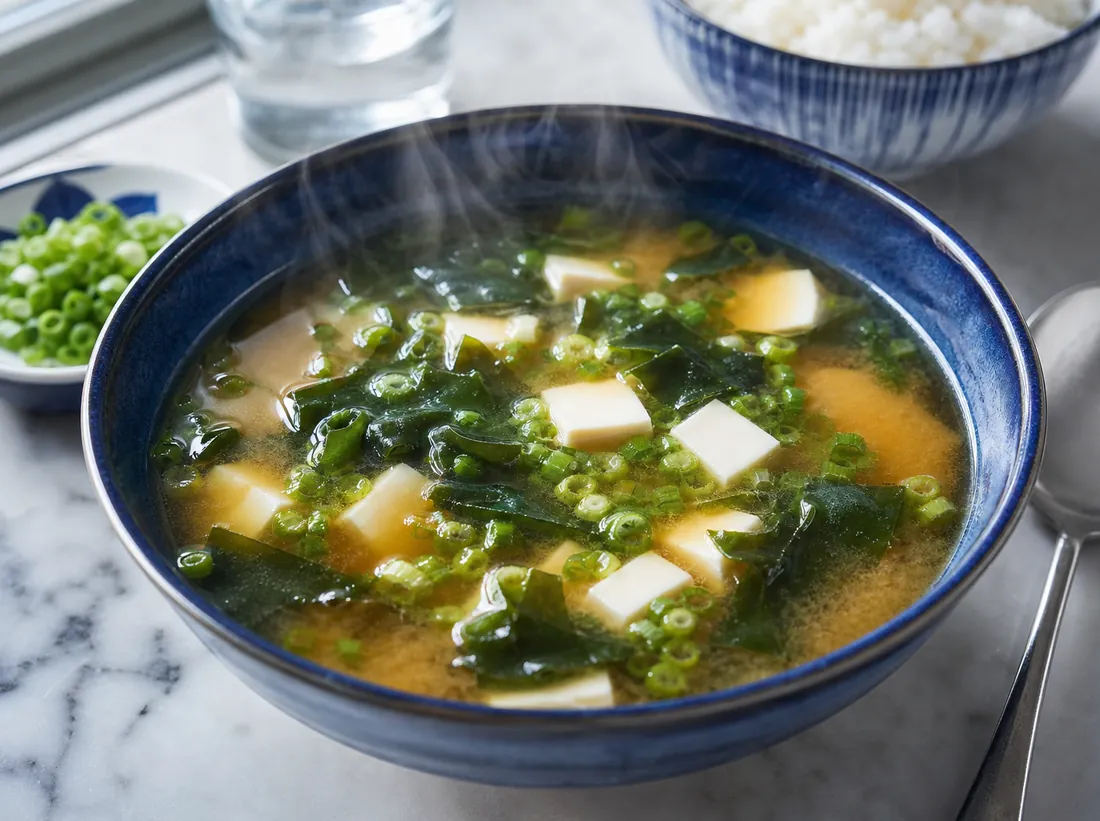
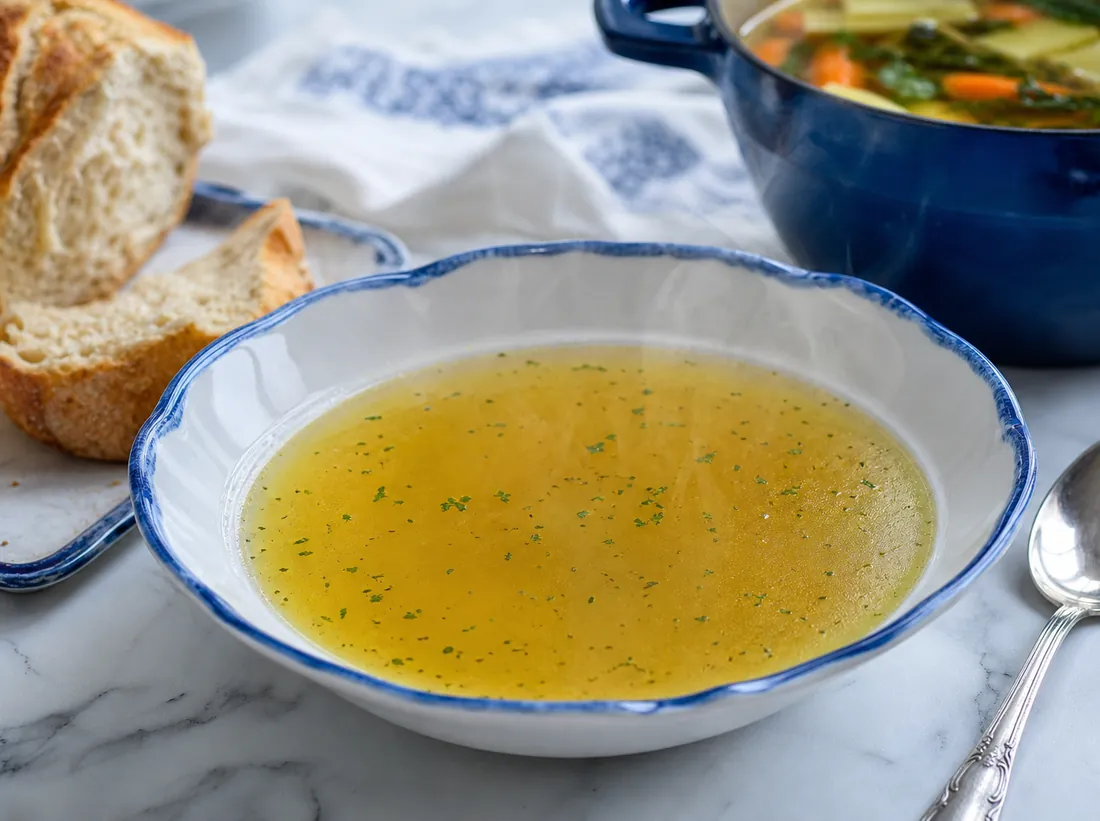
Miso soup is the everyday soup of Japan: a clear dashi of kombu and dried bonito flakes, with miso stirred in, cubes of soft tofu, wakame and spring onion. It takes 20 minutes, and the secret is never to boil the miso.

Pot calculatorOrder Miso soup

Dairy freeParveAllergens:FishSoy

Updated

Miso soupIllustration
Time30 minCook 20 min · + Soak 30 min
Pot4 bowls1 litres
Per bowl105 kcal9.7 g protein · a 250 ml bowl
Cost of the pot₪36for the pot, about ₪9.1 a bowl

The story of Miso soup

A Japanese home meal is a bowl of rice, a bowl of soup and a few small dishes alongside, and the soup is almost always miso soup. It is eaten at breakfast, lunch and dinner, sipped straight from the bowl, with the tofu and seaweed picked up with chopsticks. Each region has its miso: sweet white miso is linked with Kyoto, and a very dark miso made from soybeans alone, hatcho miso, with the area around Nagoya.

Miso itself is a fermented paste of soybeans, salt and koji, steamed rice or barley on which the mould Aspergillus oryzae has grown. Japan has made miso for centuries, and it also goes into sauces, marinades and stews. In Israel miso soup is known mostly from Japanese restaurants, but every ingredient is now on supermarket shelves, and homemade is better, because the miso does not sit on the heat for hours.

What makes Miso soup itself

Miso soup is built on a pair: dashi and miso. Dashi brings a clear, sea-like umami, from the glutamate in the kombu and the inosinate in the bonito, while miso brings saltiness, a gentle sweetness and a pleasant cloudy body. They do not just add up, they amplify each other, which is why a spoonful of miso in dashi tastes far better than in water. The miso goes in last and off the boil, so its fermented aroma stays in the bowl.
Miso soup for any number of people

Change the number of people and the bowl size, and every ingredient updates in grams, with the cost, calories and protein per bowl.

Bowl size
Units
1litres in the pot
3Pot to use, litres
₪36Cost of the pot
₪9.1per bowl
105kcal per bowl
9.7g protein per bowl
IngredientAmountCost
The dashi
Cold water, filtered if you can1 l
Kombu10 g₪2.1
Katsuobushi (dried bonito flakes)20 g₪24
The soup
White miso (shiro), or half white and half red70 g₪2.1
Silken or soft tofu, in 1.5 cm cubes200 g₪6.5
Dried wakame4 g₪0.9
Spring onion, thinly sliced20 g₪0.9
Send on WhatsApp

Shelf prices at a large Israeli chain and specialty shops, October 2026. Nutrition from the ingredients in grams, before cooking.

How many calories in Miso soup? Nutrition facts and calorie calculator

Change the amount of any ingredient, drop one, or pick a lighter version, and the numbers per serving update at once: calories, fat, carbs, protein, sodium and fibre.

Miso soup has 42 calories per 100 ml. A 250 ml bowl made with our recipe has 105 calories: 9.7 g protein, 4.8 g fat and 5.4 g carbohydrates. A 250 ml cup has 105 calories.

Ingredients, for the whole recipe

  • 10 g1 kcal per serving
  • 20 g0 kcal per serving
  • 70 g35 kcal per serving
  • 200 g65 kcal per serving
  • 4 g3 kcal per serving
  • 20 g2 kcal per serving

What each add-on adds to Miso soup

Values for the amount in the row, from the national food database.

Add-onCaloriesProtein, gFat, g
A tablespoon of oil122013.8
A slice of white bread792.50.5
A slice of challah12641.1

How to make Miso soup

In cook mode the screen stays on, tap a step when it is done, and the timers run next to each step.
  1. Wipe the kombu with a damp cloth without rinsing, and soak it in 1 litre of cold water in a pot for at least 30 minutes.
  2. Heat over medium-low heat for about 10 minutes, until small bubbles appear at the sides, around 60 to 70 °C. Lift out the kombu before the water boils.
  3. Bring the water just to the boil, turn off the heat, scatter in the bonito flakes and wait 2 minutes until they sink.
  4. Strain through a sieve lined with paper towel or a cloth, without pressing the flakes. You will have about 850 ml of dashi.
  5. Soak the wakame in cold water for 5 minutes, squeeze lightly and cut into small pieces if needed.
  6. Return the dashi to the pot, heat to a gentle simmer, add the tofu and warm for 2 minutes.
  7. Turn off the heat. Put the miso in a ladle or a small sieve, dip it into the dashi and dissolve it with a spoon or chopsticks until no lumps remain.
  8. Add the wakame, taste and add a little more miso if needed. Do not bring it back to the boil.
  9. Serve at once in bowls, with sliced spring onion on top.

The science of Miso soup

Kitchen science

Koji, the engine of miso

Koji is steamed rice, or barley, on which the mould Aspergillus oryzae has grown. The mould releases proteases, which cut soy proteins into peptides and amino acids, glutamate among them, and amylases, which break starch into glucose and simple sugars. Over months of fermentation, under salt that keeps spoilage away, yeasts and lactic acid bacteria add aroma and a gentle tang, and sugars and amino acids meet in Maillard reactions that darken the miso.

Kitchen science

Why dashi and miso taste better together

The umami receptor on the tongue responds to glutamate, and nucleotides such as inosinate bind next to it and hold it in its active shape. Kombu and miso are rich in glutamate, dried bonito is rich in inosinate, so together the umami is several times stronger than the sum of the parts.

Kitchen science

The temperature of kombu

Glutamate and mannitol leave the kombu at 60 to 70 °C. At a boil the seaweed also releases slimy alginates and harsh sea flavours, and the dashi turns cloudy and slightly bitter. That is why it comes out before the boil.

Kitchen science

Why miso soup must never boil

Miso's aroma is made of volatile compounds from fermentation, and boiling drives them off within minutes, leaving a soup that is salty and flat. Its proteins and particles also clump in strong heat and turn grainy. Unpasteurised miso holds live yeasts and bacteria, and they do not survive boiling. Add miso when the dashi is below the boil, around 80 °C, and serve.

Kitchen science

The clouds in the bowl

Miso never fully dissolves. Tiny particles of soy and koji float in the dashi, and as the surface cools, cooler liquid sinks and warmer liquid rises, drawing currents that look like clouds. As the soup stands the particles settle, which is why you stir before sipping.

Miso soup in every kitchen

Shiro miso, white

Lots of rice koji and a short fermentation. Pale, sweetish and gentle, good with tofu and vegetables.

Aka miso, red

A longer fermentation, a reddish brown colour and a salty, deep taste. Use less of it.

Awase, blended

A mix of white and red, the most common miso at home, balancing sweetness and depth.

Hatcho miso

A very dark miso made from soybeans alone and aged a long time. Strong and slightly bitter, used sparingly.

Vegan miso soup

Dashi from kombu and dried shiitake instead of bonito. The guanylate in the mushrooms boosts the glutamate in the kombu in the same way.

Common Miso soup problems and how to fix them

My miso soup is too salty

Too much miso, or red miso instead of white. Add hot dashi or water, and next time start with 15 g of miso per bowl and taste.

I boiled the miso and the flavour is gone

Boiling drives off the aroma. Stir in a fresh spoonful of miso off the heat, and next time add the miso only at the end.

My dashi came out bitter or slimy

The kombu boiled, or the bonito was squeezed while straining. Lift out the kombu before the boil and strain without pressing.

There are lumps of miso in the soup

The miso went straight into the pot. Dissolve it in a ladle with a little dashi or in a small sieve, then stir it in.

The wakame swelled and took over the soup

Dried wakame grows many times over in water. One gram dry per bowl is enough, soaked separately before it goes in.

The tofu fell apart in the soup

Silken tofu breaks when stirred. Cut it on your palm or a board, slide it gently into the pot without stirring hard, or choose soft tofu, which is a little firmer.

Storing, freezing and reheating

2 days; plain dashi without miso up to 3 days

In the fridge

Dashi only, 1 month

In the freezer

2+4

To cool

Bring it from 60 to 21 °C within two hours and down to 5 °C within four more. Split a big pot into shallow boxes.

75 °C

Reheating

Warm over low heat until it steams, without boiling. Better still, keep dashi separate and dissolve fresh miso in it each time.

Nutrition of Miso soup

From our recipe, per bowl and per 100 g, next to the national food database.

ServingkcalProtein, gFat, gCarbs, gFibre, g
Our recipe, a 250 ml bowl1059.74.85.41.4
Our recipe, 100 ml423.91.92.10.6

What the ingredients of Miso soup cost

What each ingredient costs in one pot, and where to buy it.

IngredientPriceIn this potWhere to buy
Katsuobushi (dried bonito flakes)₪1,200 per kg₪24Asian grocer (hard to find)
Silken or soft tofu, in 1.5 cm cubes₪32 per kg₪6.5Supermarket
Kombu₪210 per kg₪2.1Asian grocer (hard to find)
White miso (shiro), or half white and half red₪30 per kg₪2.1Asian grocer (hard to find)
Spring onion, thinly sliced₪6.9 each₪0.9Greengrocer
Dried wakame₪219 per kg₪0.9Supermarket

Shelf prices at a large Israeli chain and specialty shops, October 2026, VAT included. Vegetable prices change with the season.

From the pantry: what Miso soup needs

Pantry

Kombu

Pantry

Katsuobushi (dried bonito flakes)

Pantry

White miso (shiro), or half white and half red

Price and where to buy

Make Miso soup a meal

Shabbat

Ready Shabbat food

Soup, hamin, mains and sides, with a quantity calculator and prices.

Plan Shabbat
Hosting

Hosting trays

9 trays to go with the soup, with a planner by number of guests.

Tray planner
Events

Catering

A whole menu in grams per guest, with a reheating table.

Menus

What to serve with Miso soup

Serve in small bowls with steamed white rice, pickles and grilled fish or an egg, as in a Japanese home meal. Sip from the bowl and eat the pieces with chopsticks.

The cuisine behind Miso soup

Japanese

Japanese cuisine

A Japanese home meal is a bowl of rice, a bowl of soup and a few small dishes alongside, and the soup is almost always miso soup. It is…

Japanese cuisine

Miso soup in large quantities: events, offices and communities

How much of everything by number of guests, at a 250 ml bowl. For institutional pots, catering and community kitchens.

GuestsLitres30 l potsCost of ingredients
256.21₪228
50121₪456
100251₪912
200502₪1,823
5001255₪4,558

Every ingredient for any number of guests is in the calculator above: type the number of people.

Order Miso soup

A ready pot for Shabbat, an event or the office, ordered ahead.

  • Cooked to order, for Shabbat, an event or the office.
  • Tell us how many people and when, and we send a quote.
  • Delivery in Tel Aviv from ₪35, free over ₪750.

Order Miso soup for a large event

Large orders in Israel and abroad: events, offices, synagogues, communities and institutions.

  • In Israel: cooked in Tel Aviv and delivered to events in the area, and to large events anywhere in the country on a quote.
  • Abroad: for communities, events and restaurants. Tell us where, how many and when, and we come back with a quote and options.
  • Institutional quantities and a shopping list for any number of guests, in the calculator above.

Frequently asked questions

What is miso?

A fermented paste of soybeans, salt and koji, which is rice or barley on which the mould Aspergillus oryzae has grown. It is salty, slightly sweet and rich in umami.

What is the difference between white and red miso?

White miso ferments briefly with plenty of rice koji, so it is pale and sweetish. Red miso ferments longer, so it is darker and saltier, and you need less of it.

Can I make miso soup without dashi?

You can, but it tastes flatter. For quick dashi use dashi powder, or soak kombu and dried shiitake in cold water overnight in the fridge.

Why should miso not be boiled?

Boiling drives off its fermented aroma, leaves the soup salty and flat, and makes the texture grainy. Add miso off the heat.

How much miso per bowl?

About 15 to 18 g, a heaped tablespoon, for 200 ml of dashi. Red miso is saltier, so start with less.

Is miso soup kosher?

The ingredients are kosher by nature: seaweed, soy, tofu and bonito, a fish with fins and scales. Look for certification on the miso, the bonito flakes and dashi powder. The soup is parve, and because of the fish it is not mixed with meat.

What is the connection between koji and miso?

Koji is the fermentation starter of miso. Its enzymes break soybeans and rice into amino acids and sugars, which is where the flavour comes from. The same koji is used for sake, soy sauce and mirin.

How many calories are in Miso soup?

A 250 ml bowl of Miso soup made with our recipe has about 105 calories and 9.7 g of protein. Per 100 ml: 42 calories.

How much does it cost to make Miso soup at home?

A pot of 4 bowls costs about ₪36 at Israeli shelf prices in October 2026, about ₪9.1 a bowl. The calculator above works it out for any number of people.

Every soup in Israel

75 soups, each with a pot calculator, a price list and the science. Search by community, time, calories or cost.

All the soups