Dizi (abgoosht)

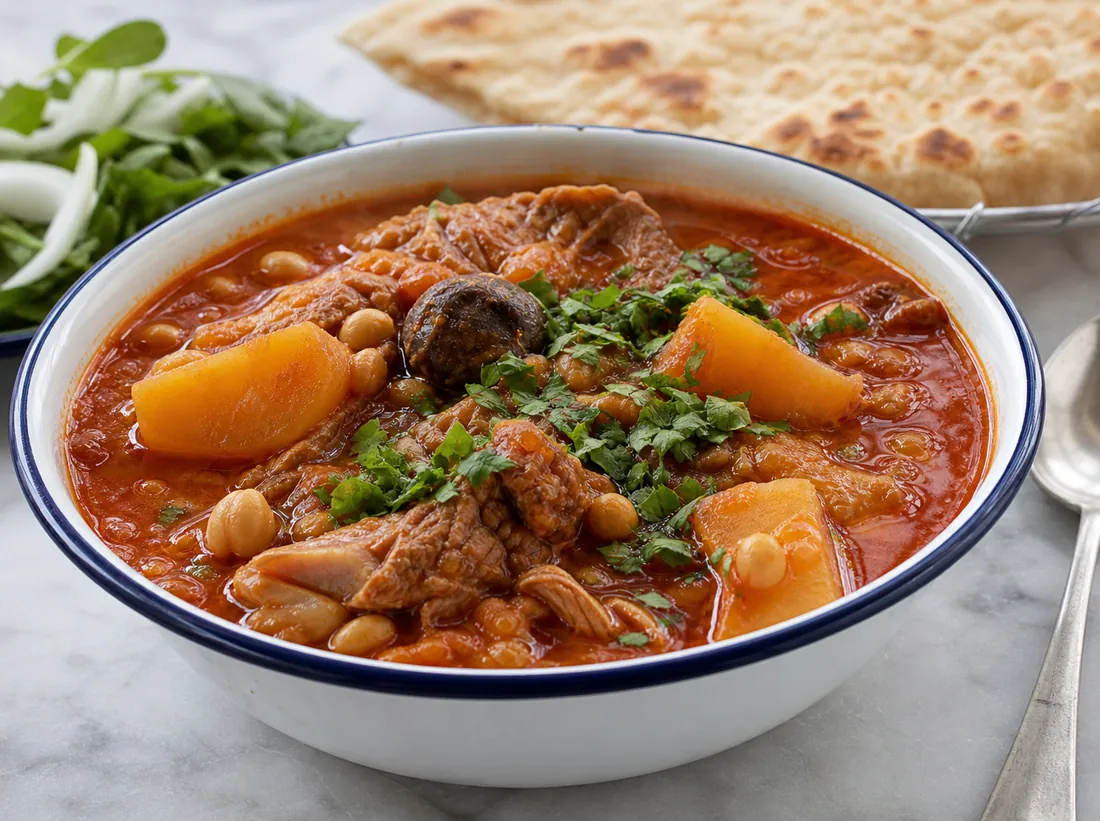
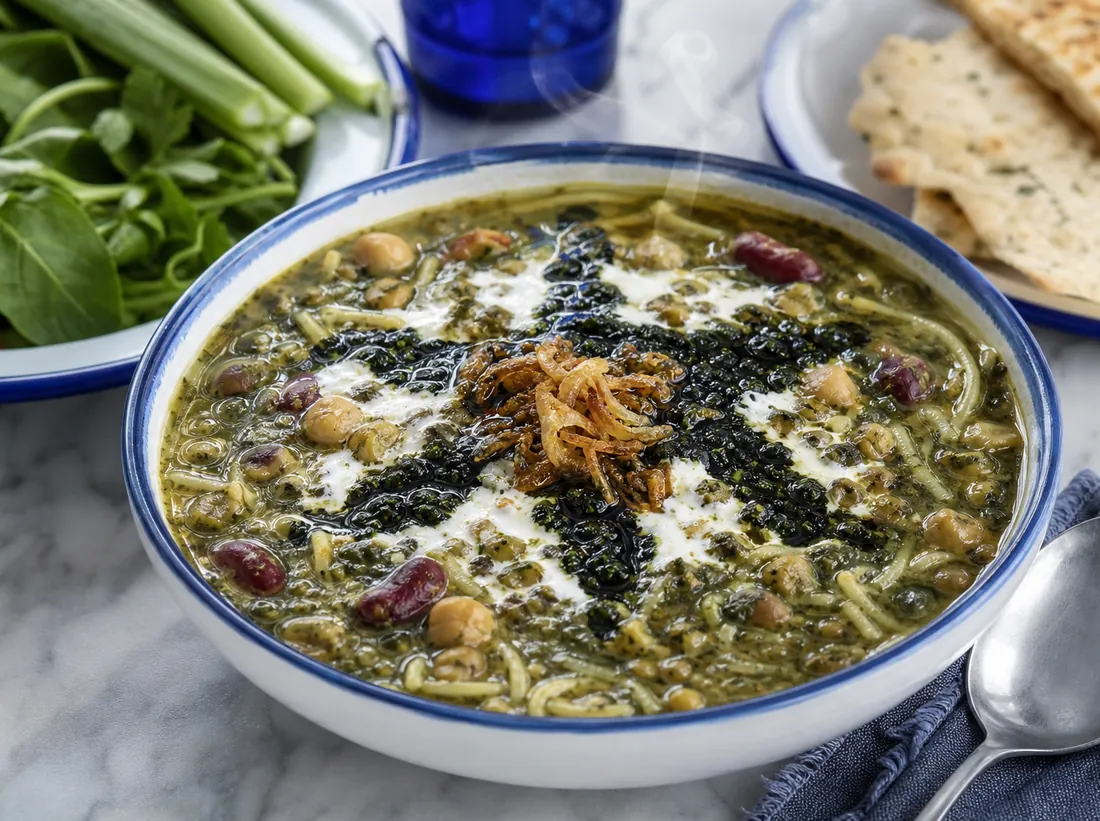
Abgoosht is the hearty lamb soup of Iran, with chickpeas, white beans, potatoes, tomatoes and dried Persian lime. It is eaten in two acts: first the broth with torn bread, then the meat and legumes pounded into a coarse mash.

Pot calculatorOrder Dizi

Dairy freeMeatAllergens:Gluten

Updated

DiziIllustration
Time3 h 55 minCook 3 h 30 min · + Soak 8 h
Pot6 bowls1.8 litres
Per bowl728 kcal46.5 g protein · a 300 ml bowl
Cost of the pot₪177for the pot, about ₪30 a bowl

The story of Dizi

Abgoosht means meat water in Persian, and dizi is the name of the small stone or clay pot it is cooked and served in, one portion per pot. It is everyday food of markets and simple eateries, and in Tehran there are places that serve little else. It has relatives across the region: piti from Azerbaijan, and Assyrian and Armenian versions cooked with beef.

The ritual is half the dish. The broth is poured into a bowl, flatbread is torn into it and left to soak, and this is called tilit. Then the meat, chickpeas, beans and potatoes are pounded into a coarse mash called gusht kubideh, pounded meat, and eaten with raw onion, fresh herbs, pickles and more bread. The Jews of Iran cooked abgoosht too, with lamb or kosher beef.

What makes Dizi itself

Abgoosht is two dishes from one pot. The broth is fairly clear, yellow from turmeric and tangy from dried lime, and it is meant for bread. The mash is thick, rich and deep, and it is meant for the raw onion and herbs that cut through it. The dried lime is the signature: a smoky, slightly bitter sourness that no fresh lemon gives. And pounding by hand, not in a blender, is what gives the mash the texture of meat rather than glue.
Dizi for any number of people

Change the number of people and the bowl size, and every ingredient updates in grams, with the cost, calories and protein per bowl.

Bowl size
Units
1.8litres in the pot
3Pot to use, litres
₪177Cost of the pot
₪30per bowl
728kcal per bowl
46.5g protein per bowl
IngredientAmountCost
The pot
Lamb shoulder or neck on the bone, in chunks1.2 kg₪143
Dry chickpeas, soaked overnight150 g₪2.5
Dry white beans, soaked overnight100 g₪2.0
Onion, quartered300 g₪1.8
Turmeric5 g₪0.4
Black pepper2 g₪0.3
Cold water2.5 l
For the last hour and a half
Potatoes, peeled and halved600 g₪3.5
Tomatoes, peeled and halved400 g₪3.2
Tomato paste30 g₪1.1
Dried Persian limes, pierced20 g · 4 pcs₪2.2
Cinnamon, a pinch1 g₪0.1
Salt14 g₪0.0
To serve
Flatbread, lavash or sangak300 g₪10
Red onion, quartered150 g₪1.2
Fresh mint30 g₪2.5
Fresh basil30 g₪4.0
Send on WhatsApp

Shelf prices at a large Israeli chain and specialty shops, October 2026. Nutrition from the ingredients in grams, before cooking.

How many calories in Dizi? Nutrition facts and calorie calculator

Change the amount of any ingredient, drop one, or pick a lighter version, and the numbers per serving update at once: calories, fat, carbs, protein, sodium and fibre.

Dizi has 243 calories per 100 ml. A 300 ml bowl made with our recipe has 728 calories: 46.5 g protein, 22.5 g fat and 76.3 g carbohydrates. A 250 ml cup has 607 calories.

Ingredients, for the whole recipe

  • 1,200 g320 kcal per serving
  • 150 g91 kcal per serving
  • 100 g56 kcal per serving
  • 300 g20 kcal per serving
  • 5 g3 kcal per serving
  • 2 g1 kcal per serving
  • 600 g77 kcal per serving
  • 400 g12 kcal per serving
  • 30 g7 kcal per serving
  • 4 pcs0 kcal per serving
  • 1 g0 kcal per serving
  • 14 g0 kcal per serving
  • 300 g127 kcal per serving
  • 150 g10 kcal per serving
  • 30 g4 kcal per serving
  • 30 g1 kcal per serving

What each add-on adds to Dizi

Values for the amount in the row, from the national food database.

Add-onCaloriesProtein, gFat, g
A tablespoon of oil122013.8
A slice of white bread792.50.5
A slice of challah12641.1
A side cup of cooked rice, about1823.50.3

How to make Dizi

In cook mode the screen stays on, tap a step when it is done, and the timers run next to each step.
  1. The night before, soak the chickpeas and beans in cold water for 8 to 12 hours, then drain.
  2. Put the lamb, onion, chickpeas, beans, turmeric and pepper in a pot, add 2.5 litres of cold water and bring to a boil over high heat.
  3. Skim off the foam that rises in the first few minutes, lower the heat and simmer for two hours with the lid ajar, until the legumes are soft and the meat starts to tenderise.
  4. Pierce each dried lime twice with the tip of a knife. Add the potatoes, tomatoes, tomato paste, limes, cinnamon and salt to the pot.
  5. Cook for another hour and a half over low heat, until the meat falls off the bone and the potatoes are completely soft. If the liquid drops below the ingredients, add a little boiling water.
  6. Lift out the limes and the bones. Strain the broth into another pot and keep it hot.
  7. Tear some of the bread into bowls, pour hot broth over it and let it soak for 2 minutes. That is the first act.
  8. Pound the meat, legumes, potatoes and tomatoes with a masher or pestle, with a spoonful or two of broth, into a coarse mash. Do not use a blender.
  9. Serve the mash on a plate with quartered red onion, fresh mint and basil, pickles and the rest of the bread.

The science of Dizi

Kitchen science

Why cuts on the bone

Neck and shoulder are full of connective tissue, and the bones hold marrow. In long cooking above 70 °C, collagen unwinds and turns into gelatin, which gives the broth body and the mash a pleasant stickiness, while the marrow releases fat and flavour. Lean, boneless meat gives a thin broth and a dry mash.

Kitchen science

Dried lime, the deep sourness

A Persian dried lime is a whole lime dried until hard and dark. The long drying creates browning compounds that give it a smoky, musky taste, while its citric acid stays concentrated. It is pierced so the broth can get inside, and never crushed, because the seeds and white pith are bitter.

Kitchen science

Why the tomatoes go in late

Acid stabilises the pectin in legume cell walls and slows their softening. That is why the tomatoes and lime go in only after two hours, once the chickpeas and beans are already soft. This way they finish tender and still hold their shape.

Kitchen science

The smell of lamb

Lamb's typical aroma comes mainly from branched-chain fatty acids in its fat, such as 4-methyloctanoic acid. They dissolve in fat, so skimming some fat off the broth softens the smell. Turmeric, onion and the sourness of the lime balance what remains.

Kitchen science

Pounding abgoosht, by hand not by blender

In cooked potatoes, starch swells inside the cells. A masher breaks the cells gently, but fast blades tear them open and release free starch that turns the mash into glue. Pound while everything is hot, because as it cools the gelatin and lamb fat firm up and the mash turns lumpy.

Dizi in every kitchen

Dizi in single clay pots

Each portion in its own small pot, in a low oven for 3 to 4 hours. The pot comes to the table and the pounding happens inside it.

Abgoosht in one pot

The home version: a large pot on the stove, broth served in bowls and the mash on a shared plate.

With beef

Assyrian and Armenian versions are cooked with beef. Beef shank or oxtail on the bone replaces the lamb well.

With other beans

Some homes swap the white beans for red kidney beans or black-eyed peas, and the mash comes out darker.

Piti

The relative from Azerbaijan, lamb and chickpeas cooked in individual clay pots, served in the same two stages.

Common Dizi problems and how to fix them

The chickpeas in my abgoosht stayed hard

The tomatoes and lime went in too early, or the legumes were not soaked. Soak overnight and add acid only after the chickpeas are fully soft.

My abgoosht tastes bitter

The limes were crushed, too many, or left in too long. Pierce without crushing, take them out when the sourness is right, and never pound them into the mash.

The meat will not come off the bone

The cut is too lean, the time too short, or the pot boiled hard and the fibres tightened. Choose neck or shoulder, keep a gentle simmer and add half an hour.

The mash is sticky like glue

It went through a blender or food processor. Pound with a masher or pestle, with a little hot broth, and keep it coarse.

The broth is too fatty

Lamb carries a lot of fat. Spoon off the yellow layer on top, or chill the broth overnight and lift off the set fat.

Storing, freezing and reheating

3 days

In the fridge

3 months

In the freezer

2+4

To cool

Bring it from 60 to 21 °C within two hours and down to 5 °C within four more. Split a big pot into shallow boxes.

75 °C

Reheating

Reheat the broth and the mash separately. Bring the broth to a boil, and warm the mash in a pan over low heat with a spoonful of broth.

Nutrition of Dizi

From our recipe, per bowl and per 100 g, next to the national food database.

ServingkcalProtein, gFat, gCarbs, gFibre, g
Our recipe, a 300 ml bowl72846.522.576.313.2
Our recipe, 100 ml24315.57.525.44.4

What the ingredients of Dizi cost

What each ingredient costs in one pot, and where to buy it.

IngredientPriceIn this potWhere to buy
Lamb shoulder or neck on the bone, in chunks₪119 per kg₪143Butcher
Flatbread, lavash or sangak₪4 each₪10Supermarket
Fresh basil₪7.9 each₪4Greengrocer
Potatoes, peeled and halved₪5.9 per kg₪3.5Greengrocer
Tomatoes, peeled and halved₪7.9 per kg₪3.2Greengrocer
Dry chickpeas, soaked overnight₪16 per kg₪2.5Supermarket
Fresh mint₪4.9 each₪2.5Greengrocer
Dried Persian limes, pierced₪110 per kg₪2.2Spice shop
Dry white beans, soaked overnight₪20 per kg₪2Supermarket
Onion, quartered₪5.9 per kg₪1.8Greengrocer
Red onion, quartered₪7.9 per kg₪1.2Greengrocer
Tomato paste₪35 per kg₪1.1Supermarket
Turmeric₪86 per kg₪0.4Supermarket
Black pepper₪139 per kg₪0.3Supermarket
Cinnamon, a pinch₪140 per kg₪0.1Supermarket
Salt₪2.1 per kg₪0Supermarket

Shelf prices at a large Israeli chain and specialty shops, October 2026, VAT included. Vegetable prices change with the season.

From the pantry: what Dizi needs

Pantry

Dried Persian limes, pierced

Price and where to buy

Make Dizi a meal

Shabbat

Ready Shabbat food

Soup, hamin, mains and sides, with a quantity calculator and prices.

Plan Shabbat
Hosting

Hosting trays

9 trays to go with the soup, with a planner by number of guests.

Tray planner
Events

Catering

A whole menu in grams per guest, with a reheating table.

Menus

What to serve with Dizi

The first act is hot broth with torn bread. The second is the mash, with raw red onion, fresh mint and basil, radishes, pickles and flatbread.

The cuisine behind Dizi

Persian

Persian cuisine

Abgoosht means meat water in Persian, and dizi is the name of the small stone or clay pot it is cooked and served in, one portion per pot.…

Persian cuisine

Dizi in large quantities: events, offices and communities

How much of everything by number of guests, at a 300 ml bowl. For institutional pots, catering and community kitchens.

GuestsLitres30 l potsCost of ingredients
257.51₪739
50151₪1,479
100302₪2,957
200603₪5,915
5001506₪14,787

Every ingredient for any number of guests is in the calculator above: type the number of people.

Order Dizi

A ready pot for Shabbat, an event or the office, ordered ahead.

  • Cooked to order, for Shabbat, an event or the office.
  • Tell us how many people and when, and we send a quote.
  • Delivery in Tel Aviv from ₪35, free over ₪750.

Order Dizi for a large event

Large orders in Israel and abroad: events, offices, synagogues, communities and institutions.

  • In Israel: cooked in Tel Aviv and delivered to events in the area, and to large events anywhere in the country on a quote.
  • Abroad: for communities, events and restaurants. Tell us where, how many and when, and we come back with a quote and options.
  • Institutional quantities and a shopping list for any number of guests, in the calculator above.

Frequently asked questions

What is the difference between abgoosht and dizi?

They are the same dish. Abgoosht is the name of the soup, meat water, and dizi is the name of the stone or clay pot it is cooked and served in.

How do you eat abgoosht?

In two stages. First the broth with torn bread that soaks it up, then the meat, legumes and potatoes pounded into a mash, with raw onion and herbs.

What is a dried Persian lime and where do I buy it?

A whole lime dried until hard and dark, with a smoky sourness. Spice shops sell it. If you have none, add a little lemon zest and lemon juice at the end.

Can I make abgoosht in a regular pot?

Yes, and most homes do. A heavy pot with a lid over low heat gives the same result as clay pots.

Can I make abgoosht with beef?

Yes. Beef shank or oxtail on the bone works, with similar timing. That is how the Assyrian and Armenian versions are made.

Can I make abgoosht in a pressure cooker?

Yes. After soaking, cook the meat and legumes for 45 minutes at pressure, release, add the potatoes, tomatoes and limes, and cook for 10 more minutes at pressure.

How many calories are in Dizi?

A 300 ml bowl of Dizi made with our recipe has about 728 calories and 46.5 g of protein. Per 100 ml: 243 calories.

How much does it cost to make Dizi at home?

A pot of 6 bowls costs about ₪177 at Israeli shelf prices in October 2026, about ₪30 a bowl. The calculator above works it out for any number of people.

Every soup in Israel

75 soups, each with a pot calculator, a price list and the science. Search by community, time, calories or cost.

All the soups