Georgian cuisine: 34 dishes, khachapuri, khinkali, the supra
Georgian cuisine: 26 dishes, from Khachapuri to Khinkali, 16 ingredients and spices, 5 dates in the holiday calendar, and the community’s story in Israel. Every dish that has a page here is linked, with every ingredient in grams.
 Illustration
The dishes of Georgian cuisine
By when they are eaten: Shabbat, holidays, everyday and the street.
Georgian cuisine, for shabbat
2 dishes
- Khalia: Georgian-Jewish beef stew with onions, cooked slowly with coriander and khmeli suneli
- Sateni: Fried carp in a walnut and tomato sauce with coriander, a Georgian-Jewish dish for Shabbat and holidays
Georgian cuisine, for holidays
5 dishes
- Korkoti: Plain wheat porridge for Shabbat Beshalach, the Shabbat of the manna
- Satsivi: Poached chicken or turkey in a cold walnut, garlic and spice sauce, a winter holiday dish
- Chakapuli: Spring stew of lamb or veal with tarragon, green plums and white wine
- Churchkhela: Strings of walnuts dipped again and again in thickened grape juice and dried, made at the harvest
- Gozinaki: Walnuts set in honey caramel and cut into diamonds, the New Year sweet
Georgian cuisine, everyday
15 dishes
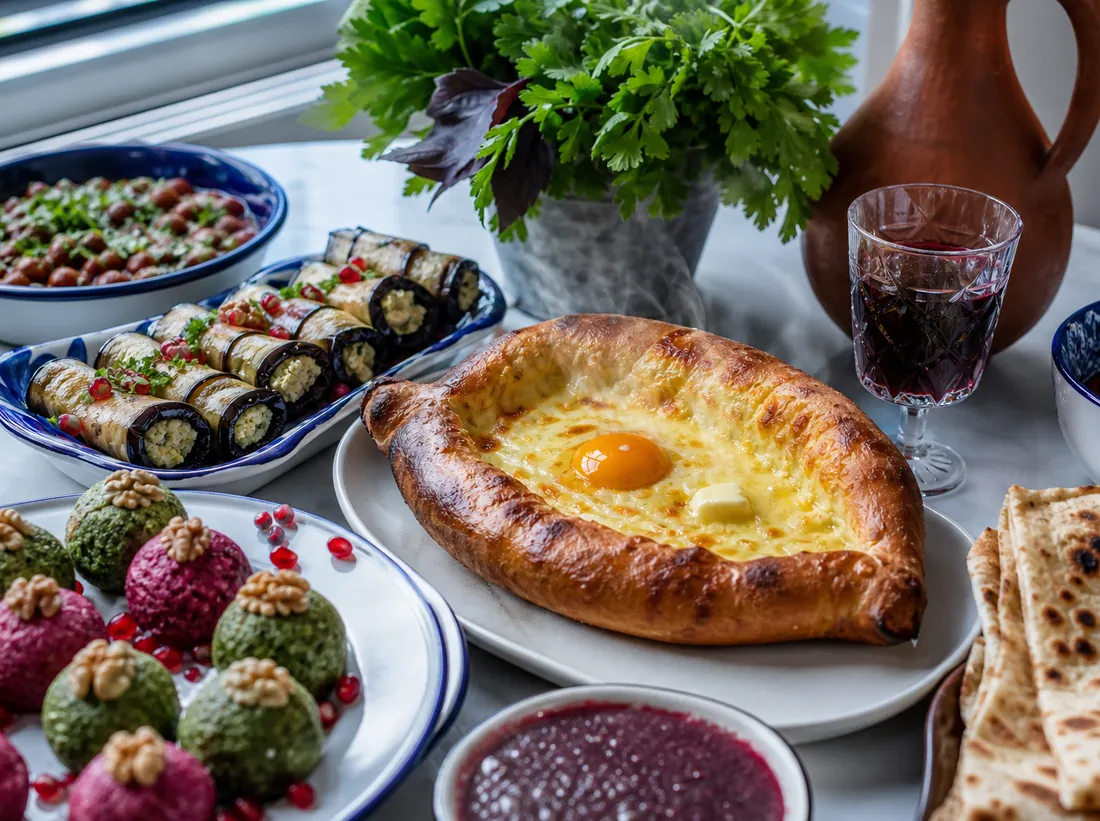
- Khachapuri: Cheese-filled bread, the best-known dish of Georgia: a boat with egg and butter in Adjara, a round closed bread in Imereti
- Pkhali: Spinach, beetroot or leek chopped with walnut paste, garlic and herbs, topped with pomegranate seeds
- Kharcho: Thick beef soup with rice, ground walnuts, garlic, coriander and sour plum
- Chikhirtma: Chicken soup thickened with egg yolks and a little vinegar, with coriander
- Chakhokhbili: Chicken stewed with tomatoes, onions and plenty of fresh herbs
- Chanakhi: Lamb, aubergine, potato and tomato baked in a clay pot
- Lobio: Red beans stewed with onion, coriander and khmeli suneli, often in a clay pot
- Badrijani nigvzit: Fried aubergine slices rolled around walnut and garlic paste
- Ajapsandali: Summer stew of aubergine, peppers, tomatoes and herbs
- Elarji: Cornmeal porridge cooked with sulguni cheese until it stretches
- Mchadi: Small cornbread cakes, baked on a clay pan or fried
- Lobiani: Bread filled with seasoned mashed beans; parve when made with oil
- Kubdari: Svan bread filled with chopped meat, onion and Svan salt
- Achma: Layers of boiled dough with cheese and butter, baked like a lasagne
- Kartopiliani: Parve pastry filled with potato and onion, from the Jews of Kutaisi, made to go with meat meals
Georgian cuisine, street food
4 dishes
- Khinkali: Pleated dumplings of spiced minced meat with broth inside, eaten by hand; beef or beef and lamb in a kosher kitchen
- Mtsvadi: Chunks of meat grilled on skewers over vine cuttings, with raw onion, pomegranate seeds and tkemali
- Shotis puri: Canoe-shaped white bread baked on the wall of a round clay tone oven
- Penovani: Flaky square of puff pastry filled with cheese, the bakery snack
Georgian cuisine in one minute
What it is
Georgian cuisine is the cooking of Georgia, the country in the Caucasus between the Black Sea and the Caspian, not the US state. It is built on walnuts, garlic and fresh herbs, sour plums and pomegranates, brined cheeses, and breads baked in clay ovens. Wine has been made here for about 8,000 years, and a meal with guests becomes a supra, a long feast led by a toastmaster.
The flavours
Ground walnuts thicken sauces instead of cream or flour. Coriander, dill, tarragon and purple basil go in by the handful. Sourness comes from tkemali plums, pomegranate and vinegar, and the warm, nutty smell of most dishes comes from blue fenugreek and dried marigold, the heart of khmeli suneli. East and west differ: the east grills meat and makes wine, the west cooks with corn, cheese and more heat.
Khachapuri and khinkali
Two dishes carry this cuisine around the world. Khachapuri is cheese bread, round in Imereti, a boat with an egg in Adjara, and every region has its own. Khinkali are pleated dumplings from the mountains, filled with spiced meat and their own broth, and eaten by hand.
The Georgian-Jewish kitchen
By the community's own tradition, Jews have lived in Georgia since the Babylonian exile. They cooked the same food as their neighbours, by the rules of kashrut: beef, lamb and chicken instead of pork, cheese kept off the meat table, and wine made at home. They also kept dishes of their own, like khalia, a Shabbat meat stew, and sateni, fried carp in walnut sauce, and brought them to Israel.
Georgian cuisine in numbers
years of winemaking
Clay qvevri jars buried in the ground are still in use, and the method has been on the UNESCO heritage list since 2013.
native grape varieties
Saperavi for red and rkatsiteli for white are the best known.
pleats on a good khinkali
That is the folk rule. Skilled hands fold more, and the knot on top is left on the plate.
khachapuri types in the table below
From the Adjarian boat to the Gurian crescent with eggs.
dishes in the food list below
With the region, what is in each one, how it is eaten and whether it is meat, dairy or parve.
Georgian food list: 34 dishes and how they are eaten
The dish, the region, what is in it, how it is eaten and where it stands in kashrut.
| Dish | Where | What is in it | How it is eaten | Kosher |
|---|---|---|---|---|
| Khachapuri adjaruli (acharuli) | Adjara | A boat of dough filled with sulguni and imeruli cheese; an egg yolk and a knob of butter go in straight from the oven | Stir the yolk and butter into the hot cheese, tear off the crust and dip | Dairy |
| Khachapuri imeruli | Imereti | A round, closed bread with fresh imeruli cheese inside | Cut into wedges; the everyday bread, with tea and at every feast | Dairy |
| Khachapuri megruli | Samegrelo | Like the Imeretian one, with a second layer of cheese melted on top | Hot, in wedges | Dairy |
| Penovani | Across Georgia | Puff pastry folded around cheese into a square | A bakery snack, eaten on the go | Dairy |
| Achma | Adjara | Sheets of boiled dough layered with cheese and butter and baked in a tray | In squares, like a cheese lasagne | Dairy |
| Khinkali | The mountains: Pshavi, Mtiuleti, Khevsureti | Pleated dumplings of minced meat with onion, pepper and herbs, with broth inside | By hand: hold the knot, bite, sip the broth and leave the knot; black pepper on top | Meat, beef or beef and lamb |
| Mtsvadi | Kakheti and everywhere | Chunks of meat grilled on skewers over the embers of vine cuttings | With raw onion rings, pomegranate seeds, tkemali and bread | Meat, lamb, beef or chicken |
| Kubdari | Svaneti | Bread filled with chopped meat, onion and Svan salt | Hot, in wedges | Meat |
| Lobiani | Racha and Imereti | Bread filled with mashed beans and onion | With pickles and herbs | Parve, without butter |
| Shotis puri | Across Georgia | White wheat bread shaped like a canoe and baked on the wall of a round clay tone oven | Warm from the bakery, torn by hand, with cheese or beside any meal | Parve |
| Mchadi | Western Georgia | Small cakes of cornmeal and water, baked on a clay pan or fried | With lobio, cheese and pickles | Parve |
| Ghomi | Samegrelo | A thick porridge of coarse cornmeal | In place of bread, with sulguni pressed in or beside stews | Parve, dairy with cheese |
| Elarji | Samegrelo | Ghomi cooked with plenty of sulguni until it stretches into long strings | Hot, with a spoon, beside a sauce | Dairy |
| Pkhali | Across Georgia | Spinach, beetroot, beet greens, leek or cabbage chopped with walnut paste, garlic and herbs | Shaped into balls with pomegranate seeds on top, as a starter | Parve |
| Badrijani nigvzit | Across Georgia | Fried aubergine slices rolled around walnut and garlic paste | Cold, as a starter, with pomegranate seeds | Parve |
| Lobio | Imereti, Racha and everywhere | Red beans with onion, coriander and khmeli suneli, often in a clay pot | Hot, with mchadi and pickles | Parve |
| Ajapsandali | Across Georgia | Aubergine, peppers, tomatoes, onion and herbs stewed until soft | Warm or cold, with bread | Parve |
| Georgian salad | Across Georgia | Tomato, cucumber, onion and purple basil, sometimes with a walnut dressing | At every table, beside grilled meat | Parve |
| Kharcho | Samegrelo and across Georgia | A thick beef soup with rice, ground walnuts, garlic, coriander and sour plum | Hot, with bread | Meat |
| Chikhirtma | Across Georgia | Chicken broth thickened with egg yolks and a little vinegar, with coriander | Hot, as a first course | Meat |
| Satsivi | Across Georgia | Poached chicken or turkey in a cold sauce of walnuts, garlic, coriander and marigold | Cold, at the winter holidays and the New Year | Meat; the walnut sauce is parve |
| Chakhokhbili | Across Georgia | Chicken stewed with tomatoes, onion and a lot of fresh herbs | With bread to mop up the sauce | Meat |
| Shkmeruli | Racha | Fried chicken baked in a clay pan in a garlic sauce with milk or cream | Bubbling, straight from the pan | Not kosher as it is; with broth instead of milk it is meat |
| Chakapuli | Eastern Georgia | Lamb or veal stewed with tarragon, green plums or tkemali and white wine | In spring, the season of tarragon and green plums | Meat, with kosher wine |
| Chanakhi | Across Georgia | Lamb, aubergine, potato and tomato with garlic and herbs, baked in a clay pot | From the pot, one pot per person | Meat |
| Chashushuli | Across Georgia | Beef or veal stewed with tomatoes, peppers, garlic and chilli | Hot, with bread or ghomi | Meat |
| Khalia | Georgian-Jewish homes | Beef cooked slowly with onions, coriander and khmeli suneli | On Shabbat | Meat |
| Sateni | Georgian-Jewish homes | Fried carp in a sauce of walnuts, tomato and coriander | On Shabbat and holidays | Parve, fish |
| Kartopiliani | The Jews of Kutaisi | Pastry filled with potato and onion | Beside a meat meal, since it is parve | Parve |
| Korkoti | Georgian-Jewish homes | Plain wheat porridge | On Shabbat Beshalach, the Shabbat of the manna | Parve |
| Churchkhela | Kakheti and across Georgia | Walnuts on a string, dipped again and again in thickened grape juice and dried | Sliced, with tea or wine, from the harvest through the winter | Parve |
| Gozinaki | Across Georgia | Walnuts cooked in honey until it sets, cut into diamonds | At the New Year | Parve |
| Pelamushi | Kakheti and across Georgia | Grape juice thickened with flour or cornmeal, set and sliced | After the grape harvest, with walnuts | Parve |
| Tkemali | Across Georgia | Sour plum sauce with garlic, coriander, dill and ombalo, a wild mint | Beside mtsvadi, potatoes and almost anything | Parve |
The names are as you will hear them in Georgian. In Israel many people also say Gruzini, from the Russian name for Georgia.
Georgian food by region: 10 regions and what to eat there
One small country, ten kitchens.
| Region | Towns | What to eat there | What marks it |
|---|---|---|---|
| Kartli and Tbilisi | Tbilisi, Gori, Mtskheta | Shoti from the tone oven, khinkali houses, mtsvadi, Georgian salad | The capital's table mixes every region. Mtskheta, the old capital, was home to the early Jewish community |
| Kakheti | Telavi, Sighnaghi | Qvevri wine, mtsvadi over vine cuttings, churchkhela, pelamushi, chakapuli | The wine country of the east: grapes, walnuts and grilled meat |
| Imereti | Kutaisi | Imeretian khachapuri, imeruli cheese, pkhali, lobio, mchadi | The bridge between east and west. Kutaisi had one of the largest Jewish communities in Georgia |
| Samegrelo (Megrelia) | Zugdidi | Megrelian khachapuri, elarji, ghomi, kharcho, ajika, sulguni | The hottest food in Georgia, with chilli, corn and stretched cheese |
| Adjara | Batumi | Adjarian khachapuri, achma, borano (cheese melted in butter) | The Black Sea coast, butter and cheese, and touches from the Ottoman era |
| Guria | Ozurgeti | Gurian khachapuri, a crescent with cheese and hard-boiled eggs | This khachapuri is baked in Guria for Christmas |
| Racha | Ambrolauri, Oni | Shkmeruli, lobiani, Khvanchkara wine | Mountain valleys. Rachuli lobiani is made with ham, so a kosher kitchen bakes the plain bean bread. Oni has one of the old synagogues of Georgia |
| Svaneti | Mestia | Kubdari, Svan salt, tashmijabi (mashed potato with cheese), chvishtari (cornbread with cheese) | High mountains, stone towers and food that lasts a whole winter |
| The eastern mountains: Pshavi, Mtiuleti, Khevsureti, Tusheti | Pasanauri, Omalo | Khinkali, guda cheese, kotori (Tushetian cheese pie) | Shepherds' food: meat, sheep cheese and dough |
| Samtskhe-Javakheti (Meskheti) | Akhaltsikhe | Tenili cheese pulled into threads, tatarberaki (pasta with onion and matsoni) | Highland dairy and pastry |
Every region has differences between town and village, valley and mountain.
The supra and the tamada: how a Georgian feast works
Supra
Supra means tablecloth, and it is the name for any feast with guests. The dishes are set out all at once, sometimes stacked on top of each other, more food comes as plates empty, and a supra can last for hours. A joyful feast is a keipi; a mourning meal is a kelekhi.
Tamada
The tamada leads the toasts and is chosen for wit, memory and a strong head. He opens every toast, sets its subject and its pace, and by tradition wine is drunk only during a toast.
Toast after toast
The toasts follow a familiar order that changes from table to table: to peace, to the reason for the gathering, to the hosts, to those who have passed away, to parents, to children, to friends and to Georgia. Each one is a short speech.
Alaverdi
After the tamada speaks, he can pass the toast to a guest with the word alaverdi. The guest adds a few words of his own on the same subject before drinking.
Gaumarjos
The Georgian cheers, meaning to your victory. At the important toasts the glass is emptied, sometimes from a horn or a large bowl.
Songs and the merikipe
The merikipe keeps the glasses full and helps the tamada. Between the toasts come songs in three voices, and Georgian polyphonic singing is on the UNESCO heritage list.
A kosher supra
An ordinary supra puts cheese breads and grilled meat on the same cloth. A kosher supra chooses: meat, with mtsvadi, khinkali, satsivi and walnut salads, or dairy, with khachapuri, achma and elarji. The wine is kosher wine.
The Georgian pantry: 14 things every kitchen keeps
The English name, the name you will hear in the kitchen, and what it is for.
| English | Name you will hear | Hebrew | What it does |
|---|---|---|---|
| Khmeli suneli | khmeli suneli | חמלי סונלי | A dried blend of blue fenugreek, coriander seed, marigold, dill, savory, basil, mint and bay. The warm, nutty base of kharcho, satsivi and lobio |
| Blue fenugreek | utskho suneli | חילבה כחולה | Milder and nuttier than fenugreek seed, and the smell of Georgian cooking. The pods and seeds are ground together |
| Imeretian saffron | imeruli zaprana | זעפרן אימרתי | Dried marigold petals, for a golden colour and a light floral scent in walnut sauces and satsivi |
| Ajika | ajika | אג׳יקה | A paste of hot red pepper, garlic, coriander and blue fenugreek. Red ajika is hot; green ajika is made with green chilli and herbs |
| Tkemali | tkemali | טקמאלי | Sour plum sauce: green from unripe plums in spring, red from ripe ones in summer. With mtsvadi and potatoes |
| Svan salt | svanuri marili | מלח סוואני | Salt ground with garlic, blue fenugreek, coriander, chilli and other seeds. For meat, eggs and salads |
| Walnuts | nigozi | אגוזי מלך | Ground with garlic and herbs for the bazhe and satsivi sauces, pkhali and badrijani. The cream of the Georgian kitchen |
| Pomegranate | brotseuli | רימון | Seeds on pkhali and salads, sour juice in sauces and with grilled meat |
| Fresh herbs | mtsvanili | עשבי תיבול טריים | Coriander, dill, parsley, tarragon, purple basil and mint, served whole on a plate at every meal |
| Sulguni | sulguni | סולוגוני | A salty, elastic brined cheese with stretched curd, from Samegrelo. It melts in khachapuri and elarji, and also comes smoked |
| Imeruli cheese | imeruli kveli | גבינה אימרתית | A fresh, mild brined cheese, the classic khachapuri filling |
| Matsoni | matsoni | מצוני | Thick fermented milk, like yogurt. Eaten plain, with honey and in cold soups |
| Tklapi | tklapi | טקלאפי | Thin dried sheets of sour plum purée, melted into kharcho and stews for sourness |
| Jonjoli | jonjoli | ג׳ונג׳ולי | Pickled flower buds of the bladdernut shrub, served with oil and onion as a starter |
Khmeli suneli, blue fenugreek, ajika and tkemali are sold in Israel at spice shops and at Georgian and Russian delis, and sulguni is in many supermarkets. Check every pack for a kashrut mark.
Khachapuri types: 8 cheese breads and 2 cousins
The shape, the region and the filling, and how each one is eaten.
| Kind | Where | Shape | Filling | How it is eaten |
|---|---|---|---|---|
| Adjaruli (acharuli) | Adjara | An open boat | Sulguni and imeruli cheese, with an egg yolk and butter added while hot | Stir, tear off the crust and dip |
| Imeruli | Imereti | Round and closed | Imeruli cheese | In wedges, every day |
| Megruli | Samegrelo | Round, with cheese on top too | Imeruli cheese and sulguni | In wedges, hot |
| Penovani | Across Georgia | A square of puff pastry | Cheese | As a street snack |
| Achma | Adjara | Layers in a tray | Boiled sheets of dough, cheese and butter | In squares, like a lasagne |
| Guruli | Guria | A crescent | Cheese and halved hard-boiled eggs | Baked in Guria for Christmas |
| Osuri (khabizgina) | From the Ossetian kitchen | Round and closed | Cheese and mashed potato | In wedges |
| Shampuri | Across Georgia | Wrapped around a skewer | Cheese, grilled over coals | Hot, straight off the skewer |
| Kubdari, the meat cousin | Svaneti | Round and closed | Chopped meat with onion and Svan salt | Not a cheese bread, so it suits a meat meal |
| Lobiani, the bean cousin | Racha and Imereti | Round and closed | Seasoned mashed beans | With pickles; parve when made with oil |
Every khachapuri is dairy. Kubdari is meat, and lobiani baked with oil is parve.
Kosher Georgian food: what to check
What to know to cook or order Georgian food in a kosher kitchen.
| Item | The issue | The kosher way |
|---|---|---|
| Pork | In Georgia mtsvadi, khinkali and kupati sausages are often made with pork | Mtsvadi of lamb, beef or chicken; khinkali of beef, or beef and lamb |
| Meat and milk | Shkmeruli is baked in a sauce with milk or cream, and some dishes are fried in butter | A garlic sauce made with chicken broth, and oil instead of butter in meat dishes |
| Cheese breads | Khachapuri, achma and elarji are dairy | Serve them at a dairy meal, not beside khinkali or mtsvadi |
| Walnut sauces | Satsivi, bazhe, pkhali and badrijani contain no dairy | Parve: they go with meat or with dairy |
| Wine | Wine is at the centre of the supra and goes into chakapuli | Kosher wine for drinking and for cooking |
| Caul fat | Abkhazura meatballs are wrapped in caul fat, a fat that kashrut forbids | The same spiced meatballs, without the wrapping |
| Fish | Trout is common and kosher; sturgeon, also eaten in Georgia, is not | Trout or carp, as in Georgian-Jewish sateni |
| Cheese | Sulguni and imeruli cheese are made with rennet, and they and matsoni need supervision | Buy them with a kashrut mark |
| Liver and giblets | Kuchmachi is made of giblets cooked with walnuts and pomegranate | Liver is first broiled over a flame, as in every kosher kitchen; hearts and gizzards from a kosher butcher |
A year in the Georgian kitchen
What is cooked in each season, and why.
| When | What is cooked | Why |
|---|---|---|
| Spring | Green tkemali from unripe plums, chakapuli with tarragon, jonjoli, greens for pkhali | The first sour plums and the new herbs arrive together |
| Summer | Ajapsandali, tomato and cucumber salads, red tkemali, matsoni | Vegetables at their best, and the ripe plums go into the red sauce |
| Rtveli, the harvest, September and October | Grapes are pressed, new wine goes into the qvevri, and churchkhela and pelamushi are made from the fresh juice | The harvest makes the sweets for the whole winter |
| Winter | Lobio, kharcho, chashushuli, khinkali | Hot pots for the cold months in the mountains |
| The New Year, 1 January | Satsivi, gozinaki, churchkhela | The festive table of every Georgian home |
| The Jewish calendar | Khalia and sateni on Shabbat, cheese breads at Shavuot, korkoti on Shabbat Beshalach | The dates are in the holiday calendar above |
Start here: 10 Georgian dishes, easiest first
- 1. Georgian salad
Cut tomatoes, cucumber and red onion, add purple basil and coriander, salt and a little oil. For the walnut version, blend a handful of walnuts with garlic, water and a drop of vinegar.
- 2. Pkhali
Cook 500 g of spinach, squeeze it dry and chop. Grind 100 g of walnuts with 2 garlic cloves, coriander, a teaspoon of khmeli suneli, salt and a tablespoon of vinegar, mix, shape into balls and scatter pomegranate seeds on top.
- 3. Badrijani nigvzit
Fry thin lengthwise slices of aubergine, let them cool, spread with walnut and garlic paste and roll up.
- 4. Lobio
Simmer soaked red beans until soft, add fried onion, coriander, khmeli suneli and a little chilli, and mash some of the beans.
- 5. Ajapsandali
Stew aubergine, peppers, onion and tomatoes in oil until soft, and finish with garlic, basil and coriander.
- 6. Mchadi
Knead cornmeal, salt and warm water into a dough, shape small flat cakes and cook them slowly in a dry or lightly oiled pan.
- 7. Chakhokhbili
Brown chicken pieces, add onions and plenty of chopped tomatoes, simmer, and at the end stir in garlic and a big bunch of herbs.
- 8. Mtsvadi
Marinate chunks of lamb or beef with onion and salt, thread them on skewers and grill over hot coals; serve with raw onion and pomegranate.
- 9. Khachapuri imeruli
Wrap a soft yeast dough around grated cheese, flatten it into a round and bake in a hot oven until golden. A dairy meal.
- 10. Khinkali
Roll out thin rounds, fill with beef, onion, herbs and a little water, pleat into a knot and boil. It takes practice to keep the broth inside.
The holiday calendar of Georgian cuisine
What goes on the table on each date.
| Date | Dishes | Note |
|---|---|---|
| Shabbat | Khalia, Sateni | A meat stew and fried carp in walnut sauce; cheese stays off the meat table |
| Shabbat Beshalach (Shabbat Shira) | Korkoti | Plain wheat porridge that recalls the manna |
| Shavuot | Khachapuri, Achma, Elarji | The dairy holiday, and the cheese breads fit it as they are |
| Passover | Mtsvadi, Pkhali, Badrijani nigvzit | Grilled meat and walnut dishes need no flour; the breads and khinkali wait until after the holiday |
| Family celebrations | A supra | In a kosher home the supra is either meat, with mtsvadi, khinkali and satsivi, or dairy, with khachapuri, achma and elarji |
Spice and ingredient glossary
The name in Hebrew, in the local language and in English, and what it is for.
| English | Local name | Hebrew | What it is |
|---|---|---|---|
| Walnuts | ნიგოზი | Walnuts | The base of satsivi, bazhe, pkhali and badrijani |
| Khmeli suneli | ხმელი სუნელი | Khmeli suneli | Dried herb and spice blend: blue fenugreek, coriander seed, marigold and herbs |
| Blue fenugreek | უცხო სუნელი | Blue fenugreek | Utskho suneli, milder and nuttier than fenugreek seed |
| Imeretian saffron | იმერული ზაფრანა | Imeretian saffron | Dried marigold petals that colour and scent walnut sauces |
| Ajika | აჯიკა | Ajika | Hot paste of red pepper, garlic, coriander and blue fenugreek |
| Tkemali | ტყემალი | Tkemali | Sour plum sauce, green in spring and red in summer |
| Svan salt | სვანური მარილი | Svan salt | Salt ground with garlic, blue fenugreek, coriander and chilli |
| Coriander | ქინძი | Coriander | Fresh leaves by the handful and ground seed |
| Tarragon | ტარხუნა | Tarragon | Chakapuli and herb plates |
| Purple basil | რეჰანი | Purple basil | Salads and the plate of fresh herbs |
| Pomegranate | ბროწეული | Pomegranate | Seeds on pkhali and badrijani, juice in sauces |
| Sulguni | სულგუნი | Sulguni | Brined, stretched-curd cheese from Samegrelo |
| Imeruli cheese | იმერული ყველი | Imeruli cheese | Fresh brined cheese, the filling of khachapuri |
| Matsoni | მაწონი | Matsoni | Thick fermented milk, like yogurt |
| Cornmeal | სიმინდის ფქვილი | Cornmeal | Mchadi, ghomi and elarji |
| Red kidney beans | ლობიო | Red kidney beans | Lobio and lobiani |
Techniques and vessels
How it is cooked, and in what.
Tone oven
A round clay oven sunk into the floor; the shoti dough is slapped onto its hot wall
Ketsi
A clay pan for mchadi, shkmeruli and small breads
Grilling over vine cuttings
Mtsvadi over the embers of dried vine prunings
Pleating khinkali
The dough is folded into many pleats and twisted into a knot that holds the broth
Walnut paste
Walnuts ground with garlic, herbs and spices; it thickens sauces instead of cream or flour
Qvevri
A clay jar buried in the ground for making and keeping wine
Churchkhela dipping
Strings of walnuts dipped many times in tatara, thickened grape juice, and dried in the sun
Clay pot cooking
Lobio and chanakhi in a kotani, a clay pot
Regions and variants
The same dish, another city, another taste.
| Region | What is special |
|---|---|
| Imereti | Round khachapuri with imeruli cheese, pkhali, lobio and mchadi |
| Samegrelo (Megrelia) | The hottest food in Georgia: ajika, elarji, ghomi, kharcho and Megrelian khachapuri with cheese on top |
| Adjara | The boat-shaped khachapuri with egg and butter, and achma |
| Kakheti | The wine country: qvevri wine, mtsvadi over vine cuttings, churchkhela |
| Kartli and Tbilisi | Shoti from the tone oven and khinkali houses |
| The eastern mountains | Pshavi, Mtiuleti and Khevsureti, the home of khinkali, and Tusheti with its sheep cheese |
| Svaneti | Kubdari and Svan salt |
| Racha | Shkmeruli and lobiani |
Georgian cuisine in Israel
How they came
About 30,000 Jews left Georgia in the 1970s, most of them for Israel, often whole families and neighbourhoods together. A second large wave came in the 1990s, after the fall of the Soviet Union.
Where they settled
Ashdod has the largest Georgian-Jewish community in the world. Large communities also live in Lod, Bat Yam, Holon, Ashkelon, Haifa and Jerusalem.
Markets and places
Ashdod: The biggest community, with Georgian synagogues, bakeries and grocers. Georgian bakeries: In towns with large communities, bakeries with a tone oven sell shoti bread, khachapuri and lobiani. Georgian restaurants: Across the country, many of them kosher; a kosher restaurant is meat or dairy, so its menu leans to khinkali and mtsvadi or to the cheese breads.
Georgian cuisine in numbers
Israelis of Georgian-Jewish origin, depending on how the Israeli-born are counted
Jews in Georgia in 1970 and in 1979
Qvevri winemaking on the UNESCO heritage list
Neighbouring cuisines
The same pots, other spices.
Iraqi (Iraqi-Jewish) cuisine
19 dishes, a spice glossary, a holiday calendar and the story in Israel.
To the pageMoroccan (Moroccan-Jewish) cuisine
22 dishes, a spice glossary, a holiday calendar and the story in Israel.
To the pageYemenite cuisine
21 dishes, a spice glossary, a holiday calendar and the story in Israel.
To the pageKurdish (Kurdish-Jewish) cuisine
21 dishes, a spice glossary, a holiday calendar and the story in Israel.
To the pagePersian (Iranian-Jewish) cuisine
21 dishes, a spice glossary, a holiday calendar and the story in Israel.
To the pageSyrian (Aleppo and Damascus Jewish) and Lebanese cuisine
25 dishes, a spice glossary, a holiday calendar and the story in Israel.
To the pageFrequently asked questions
What is Georgian cuisine?
The cooking of Georgia, the country in the Caucasus, not the US state. It is built on walnuts, garlic and fresh herbs, sour plums and pomegranate, brined cheeses and breads from clay ovens, and it is served at the supra, a long feast with toasts.
What is the national dish of Georgia?
Khachapuri, the cheese bread, and khinkali, the meat dumplings, share the title. Every region bakes its own khachapuri, and khinkali come from the eastern mountains.
What is khachapuri?
A bread filled with cheese. The Adjarian kind is an open boat with an egg yolk and butter stirred into the hot cheese; the Imeretian kind is round and closed. All of them are dairy.
How do you eat khinkali?
By hand. Hold the knot on top, bite a small hole, sip the broth, eat the rest and leave the knot on the plate. Black pepper goes on top.
What is a supra and who is the tamada?
A supra is a Georgian feast with guests. The tamada is the toastmaster who leads it, sets the subject of each toast and passes the word to guests.
What is khmeli suneli?
A dried Georgian blend of herbs and spices, built on blue fenugreek, coriander seed and marigold, with dill, savory, mint and bay. It goes into kharcho, lobio and satsivi.
Is Georgian food spicy?
Mostly not. The flavour comes from herbs, garlic, walnuts and sour plums. The heat lives in the west, in Samegrelo, and in ajika, the hot pepper paste.
Can Georgian food be kosher?
Yes, Georgian Jews cooked it that way for centuries: beef, lamb and chicken instead of pork, cheese breads at dairy meals only, walnut sauces that are parve, and kosher wine.
Where do Georgian Jews live in Israel?
Ashdod has the largest community. There are also large communities in Lod, Bat Yam, Holon, Ashkelon, Haifa and Jerusalem.
Why do Israelis call Georgian food Gruzini?
Gruzia is the Russian name for Georgia, and many Israelis learned the word from Russian. Gruzini and Georgian food are the same thing.
A meal from this cuisine, for a team or an event
How many people, when and what they like. We come back with a proposal.