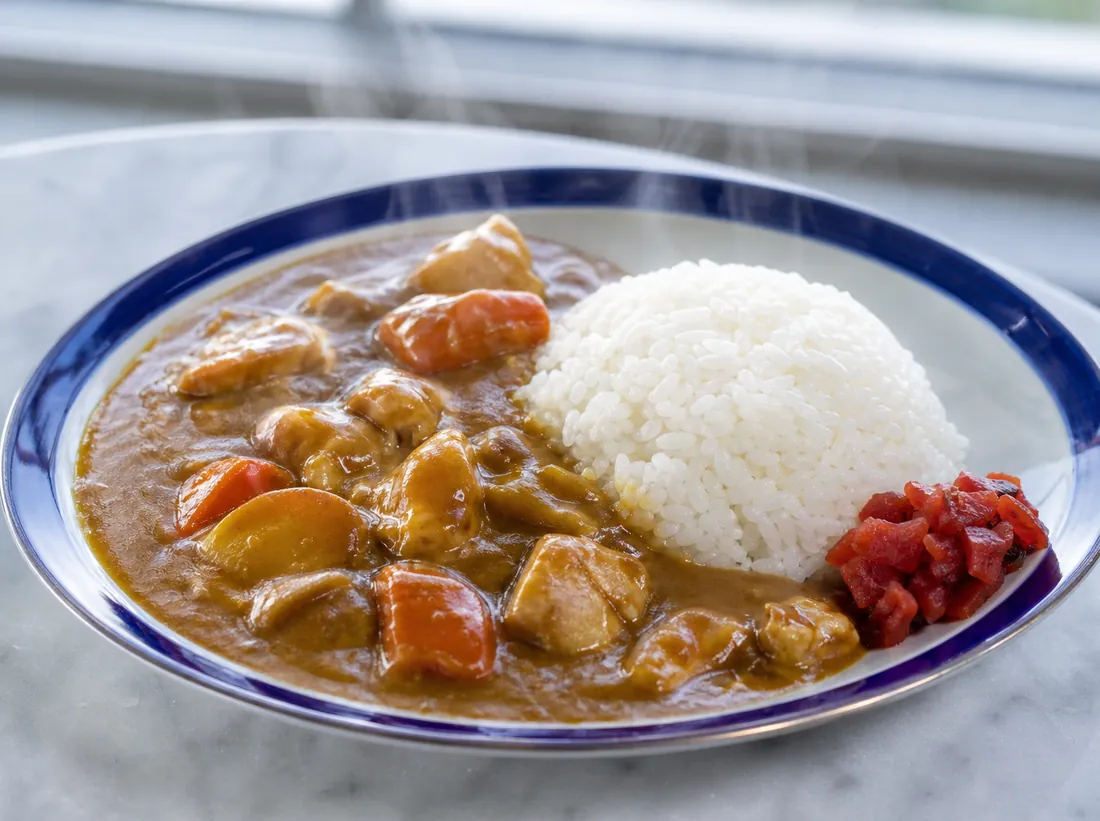
The story of Japanese curry
Curry reached Japan in the Meiji era, at the end of the 19th century, through the British, who had brought curry powder from India. That is why Japanese curry is closer to the British curry stew thickened with flour than to Indian curry. The Japanese navy took it up from the Royal Navy because it was easy to cook in large batches on a ship, and to this day the Japan Maritime Self-Defense Force eats curry on Fridays, with every ship proud of its own recipe.
In the middle of the 20th century ready-made roux blocks appeared and turned curry into a meal anyone could cook at home in half an hour. Since then it has been one of the most common dinners in Japan, a dish children ask for, a regular at school lunches, and something every family makes a little differently, with apple, honey, coffee or dark chocolate as the secret touch.
What makes Japanese curry itself
Japanese curry is thick, glossy and gently sweet, not as hot as most Indian or Thai curries. Its fixed trio is onion, carrot and potato in big pieces, and the meat changes with the region. The thickness comes from a roux, flour cooked in fat with curry powder, stirred in near the end. The rice is never mixed into the sauce: it goes on one side of a wide plate and the curry is poured beside it. A kosher kitchen meets two traps here, and both are easy to avoid. Most store-bought roux blocks contain milk powder, butter or cheese, and sometimes animal fat, and many recipes add Worcestershire sauce, which contains anchovies. Here the roux is parve margarine and flour, and the depth comes from apple, honey, soy sauce and ketchup.