Stuffed vine leaves

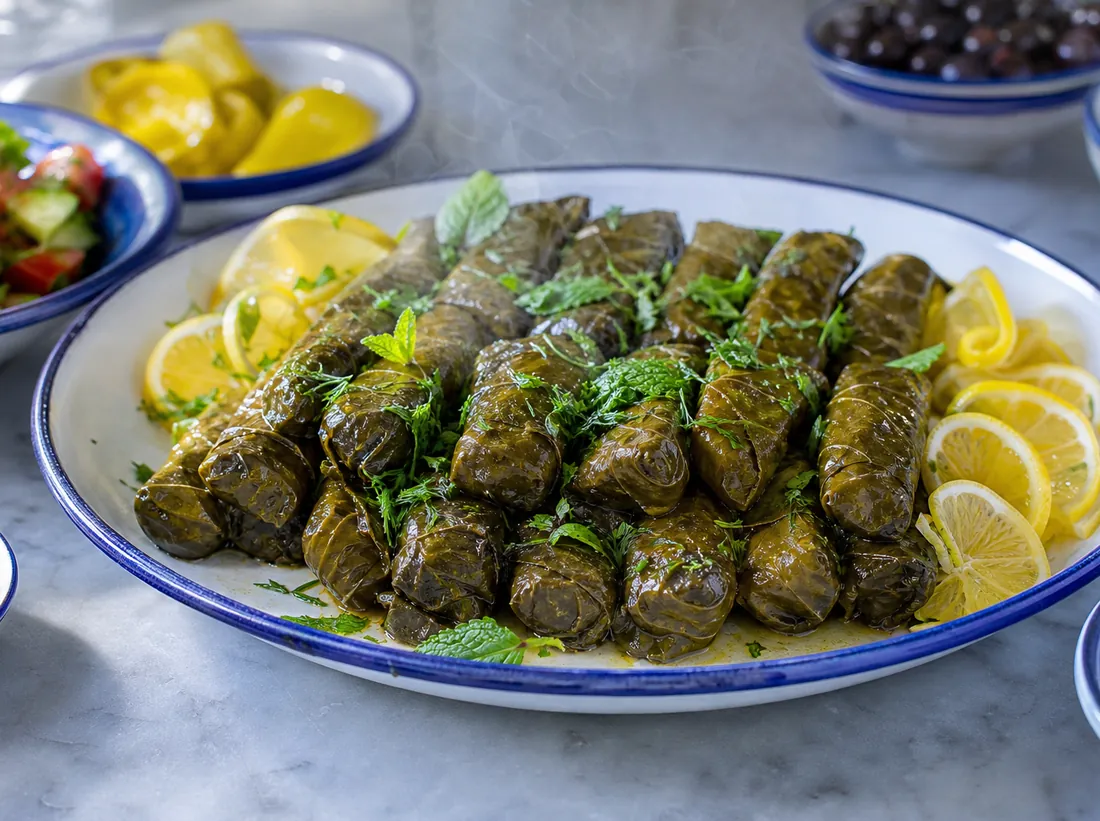
Stuffed vine leaves are slim rolls of grape leaves filled with rice, tomato, parsley and mint, cooked slowly in olive oil and lemon until the rice is soft and the leaf melts in the mouth. The dish belongs to the whole Middle East and the Balkans, is vegan by nature, and is served hot, at room temperature or cold from the fridge.

Quantity calculatorOrder Stuffed vine leaves

VeganGluten freeDairy freeParve

Updated

Stuffed vine leavesIllustration
Time2 h 30 minCook 1 h · + Soak 15 min
Amount6 portions2.1 kg
Per portion470 kcal9 g protein · a 350 g portion
Cost of the pot₪39for the pot, about ₪6.4 a bowl

The story of Stuffed vine leaves

Stuffed vine leaves are probably the oldest and most famous of all stuffed dishes. In Ottoman cooking they were called sarma, a roll, and dolma, a stuffed thing, and from there they spread to Greece, the Balkans, Armenia, Syria, Lebanon and Iraq. Wherever vines grew, cooks used the young spring leaves, and when the season ended they preserved them in brine so they could roll all year.

In Israel vine leaves belong to everyone: the slender rolls of the Druze villages in the Galilee and on the Carmel, the meat and fruit rolls of Syrian Jews, the sweet and sour dolma of Iraqi Jews, and the cold olive oil leaves of families from Turkey and Greece. The differences lie in the size of the roll, the sourness, and whether there is meat in the pot.

What makes Stuffed vine leaves itself

The vine leaf gives the roll a gentle sourness and a green, slightly bitter taste that no other leaf has. All the work is in the balance: a roll tight enough not to open, yet loose enough for the rice to swell inside. In the vegan version olive oil and lemon are the whole sauce, which is why it is especially good after a night in the fridge, when the flavours have soaked into the rice.
Stuffed vine leaves for any number of people

Change the number of people and the portion size, and every ingredient updates in grams, with the cost, calories and protein per portion.

Portion size
Units
2.1kg of food
3Pot to use, litres
₪39Cost of the pot
₪6.4per portion
470kcal per portion
9.0g protein per portion
IngredientAmountCost
The bottom of the pot
Potatoes, in 1 cm slices300 g · 2 pcs₪1.8
Whole garlic cloves, peeled18 g · 6 pcs₪0.6
The cooking liquid
Water750 g
Fresh lemon juice120 g₪2.4
Olive oil60 g₪3.2
Salt4 g₪0.0
The dough
Brined vine leaves, rinsed (60 for rolling and 10 more for lining)300 g · 70 pcs₪14
The filling
Short grain rice, rinsed and drained300 g₪3.9
Onion, very finely chopped200 g · 1 pcs₪1.2
Tomatoes, finely diced, juice drained250 g · 2 pcs₪2.0
Parsley, chopped60 g₪2.9
Fresh mint, chopped20 g₪1.6
Dill, chopped20 g₪1.2
Olive oil60 g₪3.2
Lemon juice30 g₪0.6
Salt7 g₪0.0
Black pepper2 g₪0.3
Ground allspice2 g₪0.3
Send on WhatsApp

Shelf prices at a large Israeli chain and specialty shops, October 2026. Nutrition from the ingredients in grams, before cooking.

How many calories in Stuffed vine leaves? Nutrition facts and calorie calculator

Change the amount of any ingredient, drop one, or pick a lighter version, and the numbers per serving update at once: calories, fat, carbs, protein, sodium and fibre.

Stuffed vine leaves has 134 calories per 100 g. A 350 g serving made with our recipe has 470 calories: 9 g protein, 20.2 g fat and 58.6 g carbohydrates.

Lighter

Ingredients, for the whole recipe

  • 2 pcs39 kcal per serving
  • 6 pcs4 kcal per serving
  • 120 ml5 kcal per serving
  • 60 ml81 kcal per serving
  • 4 g0 kcal per serving
  • 70 pcs47 kcal per serving
  • 300 g183 kcal per serving
  • 1 pcs13 kcal per serving
  • 2 pcs8 kcal per serving
  • 60 g4 kcal per serving
  • 20 g2 kcal per serving
  • 20 g1 kcal per serving
  • 60 ml81 kcal per serving
  • 30 ml1 kcal per serving
  • 7 g0 kcal per serving
  • 2 g1 kcal per serving
  • 2 g1 kcal per serving

How to make Stuffed vine leaves

In cook mode the screen stays on, tap a step when it is done, and the timers run next to each step.
  1. Prepare the leaves: rinse brined leaves and soak them for 15 minutes in hot water, changing the water once to draw out the salt. Blanch fresh leaves for 30 to 60 seconds in boiling water until they turn olive green and pliable, then cool them in cold water. Trim off the stems.
  2. Filling: soak the rinsed rice in water for 10 minutes and drain well. Mix with the onion, the drained tomatoes, herbs, olive oil, lemon juice and spices. The filling should be moist, not runny.
  3. Line the bottom of a wide 4 litre pot with the potato slices, and lay the 10 torn or oversized leaves on top.
  4. Roll: lay a leaf on the counter shiny side down, veins up and the base towards you. Put about 16 g of filling, a heaped teaspoon, in a strip near the base, fold the base over it, fold in both sides and roll firmly but gently into a 7 to 8 cm cylinder.
  5. Pack the rolls tightly into the pot seam side down, in circles, layer upon layer, tucking the garlic cloves in between.
  6. Mix the water, lemon juice, olive oil and salt, and pour it over until the rolls are barely covered. Set an upturned plate on top to hold them in place.
  7. Bring to a boil, lower the heat to very low, cover and cook for 50 to 60 minutes, until almost all the liquid is absorbed and the rice is completely soft. Taste a roll from the top layer, where cooking finishes last.
  8. Turn off the heat and let the pot rest for at least 30 minutes with the plate on. Lift the rolls out with a spoon or carefully turn the pot out onto a platter, and serve hot, at room temperature or cold, with lemon wedges.

The science of Stuffed vine leaves

Kitchen science

Why stuffed vine leaves open, and what holds them

The rice in the filling absorbs liquid as it cooks and nearly triples in volume. A roll that is too tight tears as the rice swells, and a loose roll opens because nothing holds it. That is why the rolls are packed tightly with a plate on top: the plate and the neighbouring rolls keep the shape until the starch sets and glues the leaf to the filling from the inside.

Kitchen science

Why the leaves turn olive green

The leaf's green comes from chlorophyll, which has a magnesium ion at its centre. With heat and the acidity of lemon, hydrogen ions take its place and chlorophyll becomes pheophytin, which is olive coloured. With vine leaves this is wanted, not a fault: the colour shows that the leaf has softened and the sourness has gone in.

Kitchen science

What the brine does, and why you soak

Vine leaves are preserved in salt water, sometimes with citric acid, which stops spoilage and softens the leaf. The salt gets into the tissue, so rinsing alone is not enough. In hot water the salt moves out by osmosis, and changing the water draws out more. A leaf that was not soaked will over salt the whole pot.

Kitchen science

Why olive oil vine leaves are eaten cold

Olive oil thickens in the fridge but turns liquid and glossy again within minutes at room temperature, so the vegan version is delicious cold. Lamb or beef fat hardens already at room temperature into a waxy film on the tongue, which is why the meat version is served hot. In Turkish cooking this is almost a rule: olive oil dishes cold, meat dishes hot.

Stuffed vine leaves in every kitchen

Turkish, zeytinyağlı yaprak sarma

Rice with onion fried in olive oil, pine nuts, currants, dill, mint, allspice and cinnamon. Cooked and served cold, with a wedge of lemon.

Greek, dolmades

Rice with dill, mint, spring onion and lemon. The meat version is served hot with avgolemono, an egg and lemon sauce thickened from the cooking liquid, with no dairy.

Lebanese and Syrian, warak enab

Rice with tomato, parsley, mint and plenty of lemon, sometimes with pomegranate molasses. For the festive version, browned lamb chops line the bottom of the pot and the rolls cook on top of them.

Druze

Especially slim rolls, the width of a finger, filled with rice, tomato, parsley and mint, with lots of lemon and garlic between the layers. Some homes cook them vegetarian and some lay lamb bones or chops at the bottom.

Syrian Jewish, yebra

Vine leaves stuffed with meat and rice in a sweet and sour sauce of dried apricots and tamarind, served hot on Shabbat and holidays. Some families use prunes instead of tamarind.

Iraqi, dolma

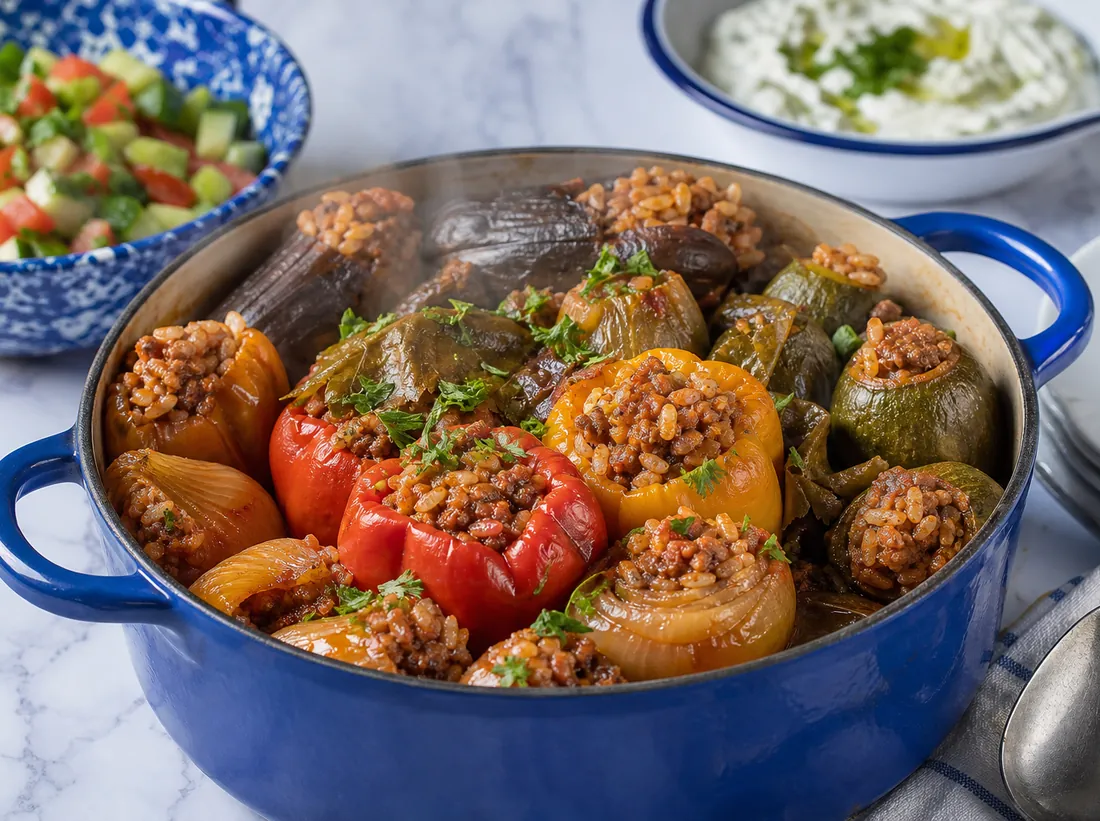
Vine leaves cooked in one pot with stuffed onions, peppers, courgettes and aubergines, in a sauce of lemon, sugar and a little tomato paste. The filling is rice and meat seasoned with baharat.

Common Stuffed vine leaves problems and how to fix them

My stuffed vine leaves open while cooking

The rolls were loose, not packed tightly, or the boil was too strong. Roll with the sides fully folded in, pack them close together seam side down, put an upturned plate on top and cook on the lowest heat.

The vine leaves came out too salty

The brined leaves were not soaked. Soak for 15 minutes in hot water and change the water once. If the pot is already salty, serve with plenty of lemon, and next time reduce the salt in the filling.

The rice in the vine leaves stayed hard

There was too little liquid, the heat was high and it evaporated, or the rolls were so tight the liquid could not get in. Add 150 ml boiling water with a squeeze of lemon, cover and cook for 15 more minutes on low heat.

The leaves are tough and chewy

The leaves were too mature or the veins too thick. Choose young, thin leaves, blanch fresh ones for a full minute, and trim the thick end of the central vein before rolling.

The vine leaves burned on the bottom of the pot

The liquid ran out too early. Slices of potato or tomato at the bottom protect the first layer, and a heavy pot spreads the heat. Check the liquid after 40 minutes and add a little boiling water if needed.

Storing, freezing and reheating

5 days

In the fridge

3 months, cooked, in a closed box

In the freezer

2+4

To cool

Bring it from 60 to 21 °C within two hours and down to 5 °C within four more. Split a big pot into shallow boxes.

75 °C

Reheating

The vegan version needs no reheating: take it out of the fridge half an hour before serving and drizzle with lemon and olive oil. Reheat the meat version in a covered pot with a little water over low heat.

Nutrition of Stuffed vine leaves

From our recipe, per bowl and per 100 g, next to the national food database.

ServingkcalProtein, gFat, gCarbs, gFibre, g
Our recipe, a 350 g portion4709.020.258.69.3
Our recipe, 100 g1342.65.816.72.7
Typical Stuffed vine leaves, 100 g1353.04.117.33.7
Typical Stuffed vine leaves, 100 g (2)1172.73.514.93.5
Typical Stuffed vine leaves, 100 g (3)1427.07.28.73.6

What the ingredients of Stuffed vine leaves cost

What each ingredient costs in one pot, and where to buy it.

IngredientPriceIn this potWhere to buy
Brined vine leaves, rinsed (60 for rolling and 10 more for lining)₪45 per kg₪14Supermarket
Olive oil₪53 per litre₪6.4Supermarket
Short grain rice, rinsed and drained₪13 per kg₪3.9Supermarket
Fresh lemon juice₪20 per litre₪3Supermarket
Parsley, chopped₪4.9 each₪2.9Greengrocer
Tomatoes, finely diced, juice drained₪7.9 per kg₪2Greengrocer
Potatoes, in 1 cm slices₪5.9 per kg₪1.8Greengrocer
Fresh mint, chopped₪4.9 each₪1.6Greengrocer
Dill, chopped₪4.9 each₪1.2Greengrocer
Onion, very finely chopped₪5.9 per kg₪1.2Greengrocer
Whole garlic cloves, peeled₪34 per kg₪0.6Greengrocer
Ground allspice₪160 per kg₪0.3Spice shop
Black pepper₪139 per kg₪0.3Supermarket
Salt₪2.1 per kg₪0Supermarket

Shelf prices at a large Israeli chain and specialty shops, October 2026, VAT included. Vegetable prices change with the season.

Stuffed vine leaves and its culture

Rolling vine leaves is work done together. In Druze villages, Syrian homes and Iraqi kitchens, women sit around the table with a stack of leaves and a bowl of filling and roll hundreds of pieces for a wedding, a holiday or Shabbat while they talk. A slim roll is a point of pride: everyone can spot her mother's rolls, and the neighbour's, in a shared pot.

Today vine leaves are a fixture of the Israeli meze table, from fish restaurants by the harbour to the Rosh Hashanah table. In the diaspora, among Syrian Jews in New York and Turkish and Greek communities across Europe, they carry the memory of home, and for events and offices they are ordered in large trays because they keep well, are eaten by hand and suit vegan guests too.

From the pantry: what Stuffed vine leaves needs

Pantry

Short grain rice, rinsed and drained

Make Stuffed vine leaves a meal

Shabbat

Ready Shabbat food

Soup, hamin, mains and sides, with a quantity calculator and prices.

Plan Shabbat
Hosting

Hosting trays

9 trays to go with the soup, with a planner by number of guests.

Tray planner
Events

Catering

A whole menu in grams per guest, with a reheating table.

Menus

What to serve with Stuffed vine leaves

Serve as a starter or as part of a meze table, with lemon wedges, hummus, a vegetable salad and pita. Serve the meat version hot as a main course, with white rice or majadra on the side.

The cuisine behind Stuffed vine leaves

Lebanese

Lebanese cuisine

Stuffed vine leaves are probably the oldest and most famous of all stuffed dishes. In Ottoman cooking they were called sarma, a roll, and…

Lebanese cuisine
Iraqi

Iraqi cuisine

Iraqi cuisine

Stuffed vine leaves in large quantities: events, offices and communities

How much of everything by number of guests, at a 350 g portion. For trays, catering and community kitchens.

Guestskg of food3 kg traysCost of ingredients
258.83₪161
50186₪322
1003512₪645
2007024₪1,290
50017559₪3,224

Every ingredient for any number of guests is in the calculator above: type the number of people.

Order Stuffed vine leaves

A ready pot for Shabbat, an event or the office, ordered ahead.

  • Cooked to order, for Shabbat, an event or the office.
  • Tell us how many people and when, and we send a quote.
  • Delivery in Tel Aviv from ₪35, free over ₪750.

Order Stuffed vine leaves for a large event

Large orders in Israel and abroad: events, offices, synagogues, communities and institutions.

  • In Israel: cooked in Tel Aviv and delivered to events in the area, and to large events anywhere in the country on a quote.
  • Abroad: for communities, events and restaurants. Tell us where, how many and when, and we come back with a quote and options.
  • Institutional quantities and a shopping list for any number of guests, in the calculator above.

Frequently asked questions

How do you roll vine leaves?

Shiny side down, veins up. A heaped teaspoon of filling near the base of the leaf, fold the base over, fold in both sides, and roll firmly but gently into a 7 to 8 cm cylinder.

How long do you cook stuffed vine leaves?

50 to 60 minutes on very low heat, covered and weighed down with a plate, then half an hour of rest. A version with meat and chops at the bottom needs 70 to 80 minutes.

Fresh or brined vine leaves?

Both work. Blanch fresh leaves for 30 to 60 seconds and soak brined ones for 15 minutes in hot water. Fresh leaves are more delicate and greener, brined ones slightly more sour and salty.

Which rice is best for stuffed vine leaves?

Short or medium grain rice, which absorbs liquid and turns soft and slightly sticky, holding the roll together. Long grain basmati stays separate and gives a roll that falls apart easily.

How do you make stuffed vine leaves with meat?

Replace part of the rice with ground beef or lamb, and line the bottom of the pot with browned lamb chops or bones. Cook for 70 to 80 minutes and serve hot as a main course.

Are stuffed vine leaves vegan?

The classic version of rice, vegetables, herbs, olive oil and lemon is completely vegan, parve and gluten free. Only the version with meat is a meat dish.

Can you freeze stuffed vine leaves?

Yes, cooked, for up to 3 months. Thaw overnight in the fridge, and serve the vegan version as it is, without reheating.

How many calories are in Stuffed vine leaves?

A 350 g portion of Stuffed vine leaves made with our recipe has about 470 calories and 9 g of protein. Per 100 g: 134 calories.

How much does it cost to make Stuffed vine leaves at home?

A tray or pot of 6 portions costs about ₪39 at Israeli shelf prices in October 2026, about ₪6.4 a portion. The calculator above works it out for any number of people.

Every dish

Home dishes of every community, each with a calculator, a price list and the science.

All the dishes